
The best commercial heat sealer for food packaging businesses is usually a stainless-steel continuous band sealer for high-volume dry products, while a 300–450 mm impulse sealer is the better choice for small batches, thicker pouches, and frequent product changes.
As an Amazon Associate we earn from qualifying purchases at no extra cost to you.
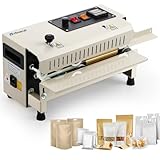
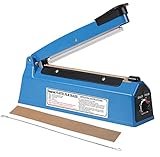


Top 3 picks at a glance
Quick comparison: which commercial sealer fits your operation?
| Sealer type | Typical sealing width | Heat-up time | Throughput | Best for | Typical market range |
|---|---|---|---|---|---|
| Impulse sealer | 200–450 mm | Instant; heat is applied only during the cycle | About 5–15 bags per minute | Small production runs, thick PE/PP bags, changing bag sizes | $80–$500 |
| Constant-heat tabletop sealer | 300–600 mm | 2–10 minutes | About 8–20 bags per minute | Coated foil, gusseted bags, laminated pouches | $250–$1,200 |
| Horizontal band sealer | 2–15 mm seal line | About 5–15 minutes | 20–45 bags per minute | Dry foods, snacks, powders, grains, bakery products | $500–$2,000 |
| Vertical band sealer | 2–15 mm seal line | About 5–15 minutes | 20–45 bags per minute | Liquids, sauces, oils, and products that settle toward the bottom | $700–$2,500 |
These are practical operating ranges rather than guarantees. Actual speed depends on bag opening, operator handling, product type, conveyor speed, and whether the seal must cool before stacking.
Best commercial heat sealers by business situation
Best for low-volume or changing product lines: impulse sealer
An impulse sealer is the most flexible starting point for a farm shop, bakery, market vendor, or small food manufacturer. It heats a narrow element only while the jaws are closed, so there is no long warm-up and little wasted energy between bags.
Choose a 300 mm unit for most small pouches and a 400–450 mm unit when bags are wide or when you want to seal across gussets. A model such as the Audion Magneta range represents the more durable commercial end of impulse sealing, while basic tabletop units are suitable when daily volume is modest.
- Advantages: low purchase cost, rapid changeovers, compact footprint, and good compatibility with polyethylene and polypropylene bags.
- Limitations: one bag at a time, slower output, and less consistent results if the operator varies jaw pressure or dwell time.
- Look for: replaceable PTFE tape, a replaceable heating wire, adjustable dwell time, and a rigid metal chassis.
Best for laminated pouches: constant-heat sealer
Constant-heat sealers use heated jaws or bars on both sides of the package. They are preferable for materials that need heat from both surfaces, including foil laminates, paper/polyethylene structures, and some nylon laminates.
Commercial units from manufacturers such as Hawo are commonly available in widths around 300–450 mm. The important specification is not simply the maximum jaw length: check whether the machine has independently controlled upper and lower temperatures. Different laminate layers may soften at different rates, and independent control can prevent a seal that looks closed but peels apart under pressure.
These machines generally need several minutes to reach operating temperature. That is a minor issue for an eight-hour production shift but inconvenient for intermittent packing. They also need more frequent cleaning around the heated bars because melted film residue can transfer to later seals.
Best for continuous production: horizontal band sealer
A continuous band sealer is usually the best commercial heat sealer for food packaging businesses producing hundreds or thousands of bags per day. The operator places the open bag on a conveyor or support shelf, and the machine transports the bag through heated sealing blocks and cooling blocks.
Common commercial designs include the Hualian FR-900K horizontal band sealer and similar machines sold under multiple industrial brands. Horizontal orientation suits powders, grains, coffee, snacks, and other dry products that remain below the bag opening.
- Throughput: commonly 20–45 bags per minute, depending on bag handling and conveyor speed.
- Seal width: usually 2–15 mm, with 5–10 mm being a practical range for many food bags.
- Controls: temperature, conveyor speed, and sometimes embossing or date-coding options.
- Maintenance: inspect the PTFE belt, heating blocks, pressure wheels, and cooling section regularly.
Best for liquids and wet products: vertical band sealer
Use a vertical band sealer when the product can flow toward the opening. The vertical path keeps liquid, sauce, oil, or fine powder away from the sealing jaws while the bag is being closed. A horizontal machine can work with liquids only if the package is carefully positioned, but leakage and contamination become more likely.
Vertical units cost more and occupy more height, yet they can reduce rejected seals in businesses packing sauces, marinades, pet food gravy, or liquid ingredients. Select a model with an adjustable bag support so the product weight is not hanging from the seal during transport.
Material compatibility matters more than maximum temperature
Do not choose a sealer solely because its temperature range reaches 300°C. The material structure, film thickness, and sealant layer determine the correct setting.
| Packaging material | Suitable sealer | Starting setting or approach | Common risk |
|---|---|---|---|
| Polyethylene (PE) | Impulse or band | Low-to-medium heat; moderate dwell | Wrinkling or burn-through from excessive heat |
| Polypropylene (PP) | Impulse or band | Medium heat; test seal strength after cooling | Weak seals when speed is too high |
| Foil laminate | Constant heat or suitable band sealer | Medium-to-high heat with controlled pressure | Outer layer scorches before inner sealant bonds |
| Paper/poly laminate | Constant heat or band | Use the film supplier’s temperature window | Paper fibers contaminate the seal area |
| Nylon laminate | Constant heat or band | Requires a compatible heat-seal coating | Material stretches or distorts under pressure |
For a new film, cut sample bags and test three settings: a low setting, a middle setting, and a higher setting. After the seal cools, pull the film apart by hand. A good seal should fail by tearing or delaminating the film rather than opening cleanly along the seal line. Always test with the actual product, because oil, crumbs, sugar, and powder can change the result.
A practical throughput calculation
Suppose a business packs 1,200 bags during a six-hour production window. That is 200 bags per hour, or about 3.3 bags per minute. An impulse sealer rated for only 5–15 bags per minute appears fast enough, but the rating usually assumes that every bag is presented correctly with no weighing, filling, labeling, or inspection delay.
If sealing consumes 12 seconds per bag, the theoretical sealing capacity is:
60 seconds ÷ 12 seconds × 60 minutes × 6 hours = 1,800 bags per shift.
Allowing 35% for repositioning, operator pauses, trimming, and quality checks reduces that to approximately 1,170 bags. In this example, an impulse sealer is near its practical limit. A band sealer rated at 25 bags per minute would provide more capacity and reduce operator fatigue, even if the actual packing line remains slower.
Reliability and cleaning checklist
- Sealing element: choose replaceable wires, cartridges, or heater blocks rather than a sealed assembly.
- Temperature control: digital control is useful, but a stable thermocouple and consistent pressure matter just as much.
- Electrical load: a 600 W sealer running continuously for one hour uses 0.6 kWh. A 1,500 W band sealer uses 1.5 kWh per hour while heating continuously, although thermostatic cycling may reduce actual consumption.
- Food-contact areas: prefer stainless-steel surfaces that can be wiped without trapping flour, sugar, or oil.
- Daily cleaning: disconnect power, allow hot parts to cool, remove film scraps, and wipe the work surface with an approved food-safe cleaner.
- Band-sealer cleaning: brush residue away from the PTFE belt and cooling section; never scrape heater blocks with a sharp tool.
- Moisture control: keep water away from electrical housings and dry all surfaces before reconnecting power.
Buying decision: what to choose
| Your situation | Recommended choice | Why |
|---|---|---|
| Under 300 bags per day and several pouch sizes | 300–450 mm impulse sealer | Fast changeovers and low operating cost |
| 300–1,000 dry-food bags per day | Horizontal band sealer | More consistent seals and less operator fatigue |
| Liquids, sauces, or flowing powders | Vertical band sealer | Keeps product away from the sealing path |
| Foil or multilayer pouches | Constant-heat sealer or compatible band sealer | Provides heat and pressure suitable for laminated structures |
| Frequent sanitation and washdown requirements | Stainless commercial unit with protected controls | Easier cleaning and better resistance to corrosion |
For most growing food businesses, the sensible path is to start with a durable impulse sealer if daily volume is uncertain, then move to a horizontal or vertical band sealer when sealing becomes the bottleneck. The right machine is not the one with the highest temperature or longest seal bar; it is the one that matches your film, bag orientation, production rate, cleaning process, and required seal consistency.


