
Buy a portable SSD if the drive will carry a game library you actually play from or ride in a bag every day; buy an external HDD if its job is sitting on a shelf holding backups, because at 4–5TB a spinning drive still costs roughly a third of an SSD per terabyte. Everything else in the external hard disk vs SSD debate — speed, drop survival, size — hangs off that one split, so here is how the two compare on the numbers that matter.
As an Amazon Associate we earn from qualifying purchases at no extra cost to you.


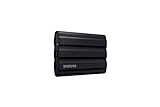

Top 3 picks at a glance
Transfer Speeds: Box Spec vs Real Numbers
The honest external SSD vs HDD gap is not “fast vs slow” — it is which interface tier you land on. Portable HDDs are bottlenecked by physics, while portable SSDs are bottlenecked by your USB port.
| Drive / connection | Advertised speed | Real-world sequential | Typical examples |
|---|---|---|---|
| 2.5″ portable HDD | “USB 3.0” | 100–140 MB/s | WD My Passport, Seagate One Touch, WD Black P10 |
| USB 3.2 Gen 1 SSD (5 Gbps) | 5 Gbps | ~400–460 MB/s | SATA-class portables, Samsung T5 EVO |
| USB 3.2 Gen 2 SSD (10 Gbps) | 10 Gbps | 900–1,050 MB/s | Samsung T7 Shield, Crucial X9 Pro, Kingston XS1000 |
| USB 3.2 Gen 2×2 SSD (20 Gbps) | 20 Gbps | 1,700–2,000 MB/s | Samsung T9, Crucial X10 Pro, Kingston XS2000 |
| USB4 / Thunderbolt SSD | 40 Gbps | 2,800–3,800 MB/s | USB4-class drives such as the OWC Envoy Pro FX |
Two catches worth knowing. First, Gen 2×2 drives need a Gen 2×2 host port — most laptops and even many Thunderbolt 4 ports will run a Samsung T9 or Crucial X10 Pro at plain Gen 2 speeds (~1,000 MB/s), so do not pay for 20 Gbps unless your motherboard spec sheet lists it. Second, budget DRAM-less and QLC-based portable SSDs can fall to 150–300 MB/s once their write cache fills on a big copy — still above HDD territory, but nowhere near the box number. TLC “Pro” models hold their speed across a full-drive write.
What that means in practice, for moving a single 150GB game install:
| 150 GB game folder | Portable HDD (~120 MB/s) | Gen 2 SSD (~1,000 MB/s) | Gen 2×2 SSD (~2,000 MB/s) |
|---|---|---|---|
| Pure sequential copy | ~21 min | ~2.5 min | ~80 s |
| Realistic mixed-file copy | 25–35 min | 3–5 min | ~2 min |
Game folders contain thousands of small asset files, which is where HDDs hurt most — seek time, not bandwidth, becomes the limit. It is also why playing directly from a USB HDD causes texture pop-in and hitching in open-world titles that stream assets, and why several recent AAA releases list an SSD as a hard requirement.
Where 7200 RPM Fits In
If you are weighing hard disk 7200 rpm vs SSD, the comparison barely exists in portable form: nearly all bus-powered 2.5″ external drives are 5400-rpm-class drives using shingled recording. 7200 rpm lives in 3.5″ desktop externals (Seagate Expansion Desktop, larger WD My Book units), which reach ~180–260 MB/s sequential — roughly double a portable HDD — but still deliver seek times around a thousand times slower than any SSD, plus a power brick and a permanent spot on your desk. A 7200 rpm external is a sensible high-capacity backup target, not a drive to run games from.
Drop Survival and Durability
This is the least negotiable difference. An HDD stores data on spinning platters read by an actuator arm floating nanometers above the surface. A knee-height fall onto a hard floor while the drive is running is frequently fatal, and the failure is often total — the drive dies, not a folder. Powered off, the heads are parked and survival odds improve, but no portable HDD carries a meaningful drop rating.
Portable SSDs have no moving parts, and the ruggedized tier is rated for real abuse: the Samsung T7 Shield claims survival from 3-meter drops with IP65 dust and water resistance, and the Crucial X9 Pro carries an IP55 rating. Tossed in a backpack, knocked off a desk by the cable, rained on at a LAN — an SSD shrugs off the accidents that kill hard drives. The trade-off is failure mode: SSDs tend to degrade gradually and report wear via SMART, while HDDs often die suddenly. Neither is a substitute for a second copy of anything important.
Size, Weight, and Power Quirks
- Portable SSD: roughly 30–100 g, smaller than a matchbox, single USB-C cable, happy running off a laptop, tablet, or even a phone port.
- Portable HDD: roughly 150–230 g depending on capacity (4–5TB models are ~19 mm thick), and most still use the wide, awkward USB Micro-B plug.
- Desktop HDD: ~1 kg plus a wall-wart power supply — stationary by design.
One practical gotcha: 2.5″ HDDs draw a burst of spin-up current and can click, disconnect, or fail to mount on underpowered front-panel ports and unpowered hubs. If a portable HDD keeps dropping off, the first fix is a rear motherboard port or a powered hub — the drive is usually fine.
Cost per TB: The Real Math in 2026
| Drive type and capacity | Typical 2026 price | Cost per TB |
|---|---|---|
| Portable HDD 2 TB | $60–85 | $30–42 |
| Portable HDD 4–5 TB | $95–140 | $20–30 |
| Desktop external HDD 8–16 TB | $130–260 | $13–18 |
| Portable SSD 1 TB | $60–95 | $60–95 |
| Portable SSD 2 TB | $105–160 | $52–80 |
| Portable SSD 4 TB | $200–300 | $50–75 |
| Portable SSD 8 TB | $450–600 | $56–75 |
The crossover logic: at 1–2TB the SSD premium is only about $40–70 in absolute terms — a trivial price for ten times the speed and real drop protection. Above 4TB the gap turns into $150+ in savings per drive, which is why HDDs still own the backup role.
For cold storage specifically — a drive that sits unpowered for months — HDDs also have an edge. Consumer SSDs are only guaranteed to retain data for about a year powered off (per JEDEC spec, at end-of-life in 30°C storage), and charge leakage accelerates in warm rooms. Whichever you choose for archives, power it up and verify the data once a year, and follow the 3-2-1 rule: three copies, two different media, one off-site.
Match the Drive to the Job
| Your situation | Buy this | Why |
|---|---|---|
| Steam/Epic library you play from daily | 2 TB USB 3.2 Gen 2 portable SSD | Load times and asset streaming need SSD random speeds |
| Shuttling games between PCs or LANs | Gen 2×2 SSD, only if your port supports it | Otherwise it runs at Gen 2 speeds — save the money |
| Console storage (PS5 / Xbox Series) | 4–5 TB portable HDD | Current-gen titles must copy back to internal anyway — speed is wasted |
| System images, backups, photo archive | 4–5 TB portable or 8+ TB desktop HDD | $/TB and cold-storage retention win |
| Daily bag carry, field work, editing off-drive | Ruggedized IP-rated SSD | Drop and water survival is the whole point |
Concrete Recommendations
For backups: a 4–5TB WD My Passport or Seagate One Touch portable HDD handles most households; for a media library or full-system images of multiple PCs, an 8TB+ Seagate Expansion Desktop or WD My Book cuts the cost per TB nearly in half. Keep it on a shelf, not in a bag.
For a portable game library: a 2TB Samsung T7 Shield, Crucial X9 Pro, or Kingston XS1000-class drive hits the sweet spot — ~1,000 MB/s reads that saturate what most games can use over USB, pocketable size, and real drop protection. Step up to a Samsung T9 or Crucial X10 Pro only when you have confirmed a Gen 2×2 port. For consoles, a WD Black P10 or Seagate Game Drive HDD is cheap cold storage, since PS5 and Series X|S games must move back to internal storage before playing anyway.
FAQ
Can I play games directly from an external HDD?
Yes for most titles, especially older and indie games. Expect longer load times and occasional stutter in open-world games that stream assets continuously, and a growing list of AAA releases now requires an SSD outright. On consoles, USB drives of any type only store current-gen games — they cannot run them.
Do I need a special USB port for a 2,000 MB/s SSD?
Yes — USB 3.2 Gen 2×2 is a distinct 20 Gbps mode that many PCs and nearly all Thunderbolt ports do not support. On a standard 10 Gbps port the drive still works, just at half speed.
Which lasts longer sitting on a shelf?
An HDD. Unpowered SSDs slowly lose cell charge — figure on verifying or refreshing the data yearly, sooner in warm storage. HDDs hold data for years idle, though they should be spun up occasionally to keep the mechanics healthy.


