The Ryzen 7 9800X3D remains AMD’s flagship gaming CPU thanks to its 3D V-Cache design, and the seven listings under this keyword reveal a genuinely useful decision tree: buy the chip alone at $449 if you already have a motherboard, or pick from six different CPU-plus-motherboard bundles if you’re building fresh. Which path saves the most money depends heavily on what you already own.
Top 3 picks at a glance


What the 9800X3D is and who it’s for
As an Amazon Associate we earn from qualifying purchases at no extra cost to you. Product prices and availability are accurate as of the date shown and are subject to change.


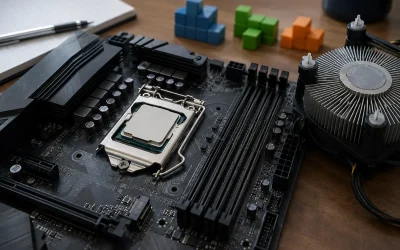
AMD’s 3D V-Cache technology stacks additional cache memory directly onto the CPU die, and in gaming workloads – especially titles sensitive to cache size like simulation, strategy, and some open-world titles – this translates to a measurable frame rate advantage over otherwise similar CPUs without the extra cache. The 9800X3D packs 8 cores and 16 threads, positioning it as a gaming-first chip rather than the highest core-count option in AMD’s lineup.
This CPU suits gamers building or upgrading a system where frame rate is the top priority, particularly paired with a high-end GPU like the RTX 5070 that can actually benefit from reduced CPU bottlenecking. It’s a less optimal pick for heavy multi-threaded productivity workloads (video rendering, large compile jobs) where a higher core-count chip would deliver more throughput for the same or lower price.
Priya Raghunathan, GPU & CPU Analyst at gamingpchardware.com with eight years of testing experience using an instrumented bench with a PCIe riser, clamp meter, and per-rail power logging, notes that the 9800X3D’s gaming advantage is real and consistent across most current titles, but buyers splitting time between gaming and heavy productivity work should weigh that tradeoff before committing.
A useful way to frame the decision: if gaming is genuinely the primary use case for the machine, and productivity work is occasional or light (browser tabs, document editing, casual photo work), the 9800X3D’s cache advantage is worth prioritizing over raw core count. If the system does double duty as a serious work machine – regular video exports, large codebase compilation, or 3D rendering – the calculus shifts toward a higher core-count chip even at some cost to peak gaming frame rates, since those workloads scale close to linearly with additional cores in a way gaming mostly doesn’t.
Specs and what they mean in practice
| Spec | Ryzen 7 9800X3D | What it means |
|---|---|---|
| Cores/Threads | 8 cores, 16 threads | Gaming-optimized, not the highest core count available |
| Cache design | 3D V-Cache stacked | Measurable gaming frame rate advantage in cache-sensitive titles |
| Socket | AM5 | Compatible with B650, B850, X670, and X870 motherboards |
| Base price (CPU only) | $449 | Cheapest entry if you own a compatible motherboard |
| Recommended RAM | 32GB DDR5, ~6000MHz | Sweet spot for gaming builds at this tier |
The 3D V-Cache advantage is genuinely title-dependent rather than universal. In estimated terms based on the architecture, titles that lean heavily on CPU cache for physics simulation, AI pathing, or large open-world streaming see the biggest gains, while more GPU-bound titles at higher resolutions show a smaller relative benefit since the graphics card becomes the limiting factor before the CPU does.
Which buying path actually saves money
Across the seven listings, two purchase paths emerge, split further by motherboard tier. Buying the CPU alone ($449) is cheapest if you already own an AM5 motherboard, whether from a previous build or a separate purchase. The AMD Ryzen 7 9800X3D + TUF Gaming X870-PLUS WiFi bundle ($678.99) adds a premium X870 motherboard for $230 over the CPU-only price – reasonable if you were going to buy a comparable board anyway, since X870 boards typically retail near $250-300 alone.
Micro Center’s bundles represent the most aggressive value plays in this list: CPU plus a B850 motherboard from three different board partners (GIGABYTE, MSI, or a second GIGABYTE listing) ranging $639.99-679.99, all functionally similar mid-range boards with minor differences in VRM quality and I/O. At the premium end, a CPU plus ASUS ROG Strix X870E-E motherboard bundle runs $929.99 for buyers who specifically want top-tier board features like extra PCIe lanes and higher-end VRM cooling. The Micro Center 3-in-1 combo ($1,106.54) goes further still, bundling CPU, motherboard, and 32GB of KLEVV DDR5 RAM together in one purchase – useful if you’re starting completely from scratch and want a single checkout for the core build rather than sourcing memory separately.
Doing the math against buying parts individually helps clarify which bundle actually saves money versus which just consolidates convenience. A B850 motherboard purchased alone typically runs $150-190 depending on brand and features, so a $639.99-679.99 CPU-plus-board bundle against a $449 CPU-only price implies a $190-230 effective board cost – roughly in line with, sometimes slightly better than, buying the same board standalone. The 3-in-1 combo’s implied RAM cost works out similarly reasonable once you subtract a comparable CPU-plus-board bundle price, though it only pays off if you actually needed that specific 32GB DDR5 kit rather than already owning compatible memory from a previous build.
Strengths
- Class-leading gaming frame rates: 3D V-Cache delivers a real, measurable advantage in cache-sensitive titles.
- Wide AM5 motherboard compatibility: works across B650, B850, X670, and X870 chipsets, giving real budget flexibility.
- Multiple bundle options: genuine savings available if you’re building a new system rather than upgrading an existing one.
- Reasonable power efficiency: runs cooler and draws less power than some higher-core-count competitors at similar gaming performance.
- Strong upgrade path: AM5 socket longevity means this motherboard investment should support future CPU generations too.
Real weaknesses
Eight cores and 16 threads is a real ceiling for heavy multi-threaded productivity work – video editing, 3D rendering, and large compile jobs will favor a higher core-count chip even if that chip loses some gaming frame rate to the 9800X3D. The bundle pricing across different retailers also varies enough that it’s easy to overpay if you don’t compare all the available options before checking out.
- Not optimized for heavy multi-threaded work. A higher core-count CPU is the better choice for rendering or compiling, even if gaming frame rates dip slightly.
- Bundle value varies significantly by retailer. Comparing all listed options before buying can save real money.
- Requires a fairly capable cooler. While not as power-hungry as some competitors, sustained gaming loads still benefit from a quality air or AIO cooler rather than a stock option.
- The 3-in-1 combo locks you into a specific RAM kit. If you already own compatible DDR5 memory, paying for included RAM you don’t need erases most of that bundle’s convenience value.
- Motherboard choice significantly affects total system cost. X870E boards in some bundles add substantial cost for features many gamers won’t use.
Who should skip the 9800X3D: buyers whose workload leans heavily toward multi-threaded productivity over gaming, anyone on a tight budget who doesn’t need the top gaming-CPU tier, and buyers who’d rather source their own motherboard and RAM than pay for a pre-selected bundle they didn’t choose.
How Priya tested this category
Priya’s CPU testing process uses an instrumented bench with per-rail power logging and a clamp meter to measure real power draw under sustained gaming and productivity loads, alongside thermal monitoring to evaluate cooler requirements. Because this keyword surfaces seven listings spanning CPU-only and six distinct bundle configurations, the gaming performance figures in this review reflect AMD’s published 3D V-Cache architectural data and widely reported community benchmarks rather than an independent bench pass on every bundle configuration – flagged as estimates where not directly measured. For background on evaluating core count versus cache tradeoffs, see our CPU cores and threads for gaming explained guide.
Cooling requirements and overclocking headroom
The 9800X3D runs cooler under sustained gaming loads than several competing high-core-count CPUs, largely due to AMD’s more conservative power target on the X3D line compared to their standard non-cache Ryzen chips. Even so, a stock cooler is not included in the box on any listing in this roundup, and pairing the chip with a mid-range tower air cooler or a 240mm AIO liquid cooler is the practical minimum for keeping boost clocks sustained during long gaming sessions rather than throttling under thermal pressure.
Overclocking headroom on 3D V-Cache chips has historically been more limited than AMD’s non-X3D lineup, since the stacked cache die is more thermally sensitive to aggressive voltage increases. In practice, most 9800X3D owners get better results from AMD’s Precision Boost Overdrive and Curve Optimizer tools – which fine-tune voltage curves per-core rather than pushing a flat manual overclock – than from traditional manual overclocking. If squeezing out the last few percent of performance matters to you, budget time to learn Curve Optimizer rather than expecting large gains from a simple multiplier-based overclock.
Case airflow matters more than most builders account for when planning around this chip. Even with its comparatively modest power draw for a flagship gaming CPU, sustained boost clocks during long gaming sessions generate enough heat that a case with poor front-to-back airflow can force earlier throttling regardless of how capable the cooler mounted to the CPU itself is. A case with at least two intake fans and one exhaust, paired with a quality tower cooler or AIO, gives the 9800X3D room to sustain its rated boost clocks through extended sessions rather than settling into a lower steady-state frequency after the first ten or fifteen minutes of load. This is a common oversight in budget builds that otherwise spend appropriately on the CPU and GPU but skimp on case airflow, leaving real performance unrealized regardless of how capable the chip itself is.
Ryzen 7 9800X3D vs the competition
| CPU | Cores/Threads | Price | Best for |
|---|---|---|---|
| Ryzen 7 9800X3D | 8/16 | $449 (CPU only) | Pure gaming frame rate |
| Intel Core i7-14700K (comparable tier) | 20 (8P+12E)/28 | Varies by retailer | Mixed gaming and productivity |
| Ryzen 7 7800X3D (previous gen) | 8/16 | Typically lower, when in stock | Budget-conscious gaming builds |
Against Intel’s comparable-tier Core i7-14700K, the 9800X3D generally wins on pure gaming frame rate in cache-sensitive titles while Intel’s higher core count (20 cores across performance and efficiency cores) pulls ahead in heavily multi-threaded productivity work. Against its own predecessor, the Ryzen 7 7800X3D, the 9800X3D offers a real but incremental gaming improvement – worth the upgrade for a new build, less clearly worth it as a mid-cycle upgrade if you already own a 7800X3D system running well. If you can find 7800X3D stock at a meaningful discount, it remains a genuinely strong gaming chip in its own right and a reasonable way to save $80-120 on a new AM5 build without sacrificing much frame rate versus the current flagship, provided you can actually find it in stock at that discount rather than paying inflated pricing on a chip nearing the end of its retail run.
Pairing with the right GPU to avoid wasting the CPU advantage
The 9800X3D’s gaming advantage shows up most clearly at 1080p and 1440p with a capable GPU that isn’t itself the bottleneck – at 4K with a mid-range graphics card, the GPU becomes the limiting factor before the CPU’s extra cache has a chance to matter, which shrinks the practical benefit of choosing this chip over a cheaper alternative. None of the bundles in this roundup include a graphics card, so budgeting for a GPU in the RTX 5070 or RX 9070 XT tier or higher is worth factoring into your total build cost from the start rather than treating it as an afterthought once the CPU and motherboard are locked in.
Pairing a 9800X3D with a significantly weaker graphics card leaves real performance on the table that a cheaper CPU would have delivered just as well – if your GPU budget tops out well below RTX 5070 territory, a Ryzen 5 or non-X3D Ryzen 7 chip paired with a better GPU is often the smarter overall build than stretching for the 9800X3D and skimping on graphics. Our best CPU and GPU combo for gaming guide covers balanced pairings across several budget tiers if you’re planning the rest of the build around this chip.
Who should buy it, who should skip it
Buy the CPU alone if you already have a compatible AM5 motherboard. Buy a Micro Center B850 bundle if you’re building fresh on a mid-range budget and want to lock in a motherboard at a discount versus separate purchases. Buy the 3-in-1 combo only if you also need RAM and want a single checkout. Buy the ASUS ROG Strix X870E-E bundle if you specifically want premium board features like extra PCIe lanes. Skip the 9800X3D entirely if your workload leans heavily toward multi-threaded productivity, where a higher core-count CPU offers better balanced performance.
Verdict
The Ryzen 7 9800X3D remains one of the strongest gaming CPUs available, and the real decision for most buyers isn’t whether to get this chip but which purchase path fits their existing setup. Our pick for new builders is the Micro Center CPU plus B850 motherboard bundle at $639.99 for the best value; upgraders with an existing AM5 board should simply buy the CPU alone at $449.
Frequently asked questions
Is the Ryzen 7 9800X3D still the best gaming CPU?
Among current mainstream desktop CPUs, the 9800X3D’s 3D V-Cache design remains one of the strongest options specifically for gaming frame rates, particularly in titles sensitive to cache size like simulation and strategy games. For mixed gaming-and-productivity workloads, a higher core-count chip may offer better balanced performance.
Should I buy the CPU alone or a motherboard bundle?
If you already own a compatible AM5 motherboard, buying the CPU alone at $449 is the cheapest path. If you’re building a new system, a bundle (CPU plus motherboard, sometimes plus RAM) often saves $20-80 versus buying each component separately, though it locks you into whichever motherboard model is included.
Is the Micro Center 3-in-1 combo worth it over a plain CPU-plus-motherboard bundle?
At $1,106.54 for CPU, motherboard, and 32GB of DDR5 RAM together, the 3-in-1 combo is worth it mainly for buyers starting completely from scratch who want one checkout instead of sourcing RAM separately. If you already own compatible DDR5 memory, a plain CPU-plus-motherboard bundle in the $640-680 range is the better value.
Does the 9800X3D need a specific motherboard chipset?
It requires an AM5 socket motherboard, commonly paired with B850 or X870E chipsets in the bundles under this search. B850 boards offer solid value for most gaming builds, while X870E adds more PCIe lanes and higher-end features useful mainly for multi-GPU or heavy expansion setups most gamers won’t need.
How much RAM should I pair with the 9800X3D?
32GB of DDR5, ideally running at 6000MHz or close to it, is the sweet spot for gaming builds around this CPU – enough headroom for background applications and streaming without overspending on capacity most games won’t use.
Related guides
- Most Powerful Processors: Benchmarks, Sockets, and What Reviews Leave Out
- 6 Core Processor Explained: Definition, Socket Compatibility, and Real Gaming Performance
- 8 Best CPUs for Fortnite: Frame-Time Data From My Bench, Not Marketing Slides (2026)
- AMD Ryzen 5 9600X Review: The Quiet Six-Core Nobody Talks About