Our Short List of 3
All 5 Picks at a Glance
| Product | Specs | Action |
|---|---|---|
 Logitech G560 LIGHTSYNC PC Gaming Speakers | Check price on Amazon | |
 Edifier M60 Multimedia Speakers | Check price on Amazon | |
 Edifier R1280DBs Active Bluetooth Bookshelf Speakers | Check price on Amazon | |
 Edifier MR4 Powered Studio Monitor Speakers | Check price on Amazon | |
 Creative Pebble Pro 2.0 USB-C Desktop Speakers | Check price on Amazon |
A computer can hold a whole music library, a film collection, and a game library at once, yet the sound that comes out of it depends on the speakers beside the monitor. This guide ranks desktop computer speakers on sound first. Every pick is a powered pair or a powered set that connects straight to a computer, and every pick is judged from what its own listing names: driver size and type, cabinet material, amplifier design, tuning modes, and the inputs on the back. No listening claim is made here, and no figure is presented as a promise for a particular room. All figures come from the product listings and the makers, and where a listing stays silent on a detail, this guide says so.
The five picks cover different ways of getting good sound from a desk. One is a 2.1 set with a separate subwoofer for deep low end. Three are powered bookshelf and monitor pairs with wood cabinets and larger drivers. One is a compact USB pair for a small desk. Three of the five come from the same maker, Edifier, which is a fact about the current Amazon US shelf for powered desktop speakers rather than a brand preference — Three of the five come from the same maker, Edifier, which is a fact about the current Amazon US shelf for powered desktop speakers rather than a brand preference. This guide reads the keyword as a sound-first brief for music, movies, and games together.
Our Top Picks
Top 3 picks at a glance
What to look for
Driver size and type set the ceiling for what a desktop speaker can do. A larger woofer moves more air, which is why the 4-inch woofers in the bookshelf picks reach lower than the 2.25-inch drivers in the compact pick. A silk dome tweeter, named on three picks here, handles voices and high notes. A passive radiator, named on the Creative pick, is a panel that moves with the air inside the cabinet and adds low end without a separate subwoofer.
Cabinet material matters because a cabinet that hums along with the drivers adds its own noise. Medium-density fibreboard, named on the Edifier bookshelf and monitor picks, is heavy and dense, which keeps the cabinet quiet while the drivers work. Small plastic cabinets can still sound clean at modest volume, and the compact picks use them, but a wood cabinet is the safer bet when the goal is full sound at higher volume.
Power figures need a careful read. Makers list output in watts, and the number to compare is the RMS figure, which describes continuous output, rather than the peak figure, which describes a brief maximum. The Logitech pick lists 240 watts peak, while the Edifier M60 lists 66 watts RMS and the R1280DBs lists 42 watts RMS. These numbers do not line up with each other, so compare RMS with RMS and peak with peak, and remember that a larger number does not by itself mean a better sound.
Inputs decide what the speakers can connect to. A 3.5 mm analog input takes a direct cable from a computer. A USB input carries digital audio from the computer and, on the compact picks, also carries power, so one cable does two jobs. Bluetooth lets a phone or tablet play through the same speakers without a cable, and optical and coaxial inputs, named on the R1280DBs, carry digital audio from a computer, a television, or a console. A subwoofer line out, named on the R1280DBs, lets a separate subwoofer join later.
Tuning controls change how the sound behaves in a room. Bass and treble knobs, named on the R1280DBs and the MR4, let the listener trim the low end and the high end to suit the room and the desk. A dual-mode switch, named on the MR4, flips between a flat monitor mode for mixing and a music mode for casual listening. Touch controls, named on the M60, sit on top of the speaker and handle volume and playback without a remote.
Placement shapes the sound as much as the speakers do. Desktop speakers sound best when the tweeters sit near ear height and the two speakers form a triangle with the listener. Angled stands, included with the M60, tilt the drivers toward the ears. Keep the speakers a little away from the wall behind them when the listing names a rear bass port, because a port pressed against a wall can make the low end sound thick and muddy.
Logitech G560 LIGHTSYNC PC Gaming Speakers
The Logitech G560 is the only 2.1 set in this guide, and it is the pick for a listener who wants deep low end and a wide sound from a desk. Two round satellite speakers sit beside the monitor, and a large down-firing subwoofer sits on the floor. The listing names 240 watts peak output for the whole set, with DTS:X Ultra surround sound built in, and LIGHTSYNC RGB lighting that follows the sound and the game on screen. The satellites carry the voices and the detail, while the subwoofer carries the low end that a small desktop pair cannot reach on its own.
The listing names USB, Bluetooth, and 3.5 mm inputs, so the set takes a computer over USB, a phone over Bluetooth, and a second analog source over cable. The subwoofer is large and needs floor space, and its down-firing design means it should sit on a hard floor rather than on thick carpet, where the low end can sound muffled. The listing names the model number 980-001300, and buyers should confirm that number on the listing, since Logitech sells bundles of the G560 with a mouse under a different code.
A 2.1 set is a different kind of sound from a bookshelf pair. The satellites are small, so the midrange comes from compact drivers, and the subwoofer handles everything below them. That split gives films and games a physical weight that a 2.0 pair cannot match, and it gives music a fuller low end. For a desk where films and games matter as much as music, the G560 is the strongest pick in this guide.
Edifier M60 Multimedia Speakers
The Edifier M60 is the compact flagship of this guide, and it is the pick for a listener who wants the strongest sound from the smallest cabinets. Each speaker measures 100 mm wide, 168 mm high, and 147 mm deep, which is close to the size of a mobile phone standing upright, yet the listing names 66 watts RMS total output, with a 1-inch silk dome tweeter and a 3-inch mid-low driver in each cabinet. The listing names Hi-Res Audio and Hi-Res Audio Wireless certification, with LDAC support over Bluetooth 5.3, and a Class-D amplifier with a built-in digital signal processor running at 24-bit and 96 kHz. The listing names aluminum stands included in the box, angled at 15 degrees to tilt the drivers toward the ears.
The listing names USB-C, AUX, and Bluetooth inputs, so the M60 takes a computer over USB-C, a phone over Bluetooth, and a second analog source over cable. The listing names the model M60, and the black finish is the listing used here. White and Classic Oak finishes sell under different codes, so buyers should confirm the black finish on the listing.
The trade is low end: a 3-inch driver in a compact cabinet cannot reach as deep as a 4-inch woofer in a bookshelf cabinet, and there is no subwoofer line out on the listing, so a separate subwoofer cannot join later. For a small desk where music and films matter and space is tight, the M60 is the strongest compact pick in this guide.
Edifier R1280DBs Active Bluetooth Bookshelf Speakers
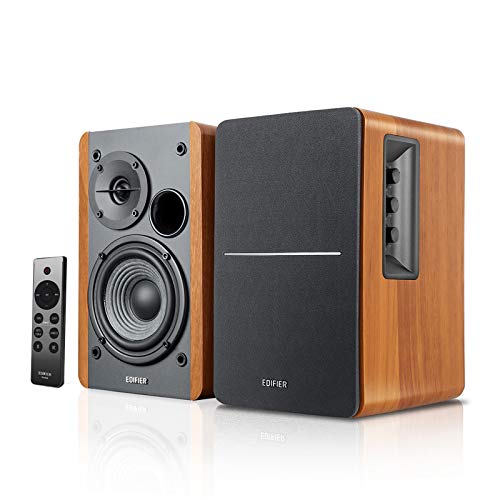
The Edifier R1280DBs is the classic powered bookshelf pick, and it is the pick for a listener who wants a full, warm sound from a pair that also works as a small living-room speaker. Each cabinet holds a 4-inch bass driver and a silk dome tweeter, with 42 watts RMS total output, 21 watts per side. The cabinets are medium-density fibreboard with a wood grain finish, and the listing names a removable mesh grille, side-mounted knobs for volume, bass, and treble, and a wireless remote. The listing names Bluetooth 5.0, optical, coaxial, and dual RCA inputs, plus a subwoofer line out for a separate subwoofer later. The listing used here is the wood grain finish, model R1280DBS, and the black finish sells under a different code.
The 4-inch driver reaches lower than the 3-inch drivers in the compact picks, and the wood cabinet keeps the sound clean at higher volume. The optical and coaxial inputs carry digital audio from a computer, a television, or a console without an analog cable, and the subwoofer line out means the low end can grow later without replacing the pair.
The R1280DBs is the oldest design in this guide, and that shows in its connections: Bluetooth 5.0 rather than the newer 5.3 on the M60 and the Pebble Pro, and no USB input, so a computer connects over optical, coaxial, or analog cable rather than a single USB cable. For a listener who wants a pair that fills a room with music and also serves films and games, and who has the desk space for it, the R1280DBs is the most complete bookshelf pick in this guide.
Edifier MR4 Powered Studio Monitor Speakers
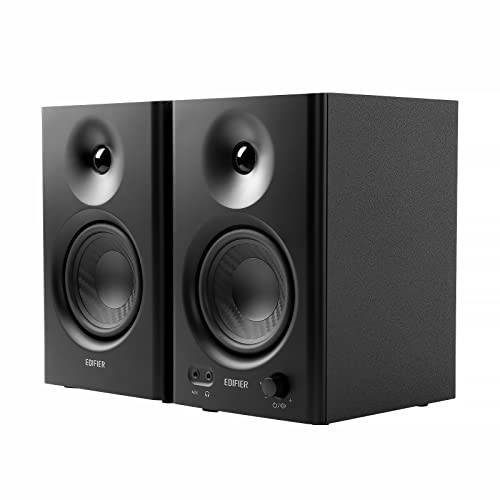
The Edifier MR4 is the studio monitor pick, and it is the pick for a listener who wants a near-flat sound that shows what a recording actually holds. Each cabinet holds a 4-inch woofer and a 1-inch silk dome tweeter, with 42 watts total output. The listing names a Class-D amplifier with a TI TAS5713 digital power amplifier chipset and a digital signal processor, plus a dual-mode sound effect: Monitor Mode for music production and Music Mode for casual listening. The cabinets are medium-density fibreboard, and the listing names balanced 1/4-inch TRS inputs alongside RCA and AUX, plus a front headphone jack. The listing used here is the black finish, and the white finish sells under a different code.
The listing names a frequency response down to 60 Hz, which is the deepest low end named on any 2.0 pick in this guide, and the 4-inch woofer is the part that reaches it. The balanced TRS inputs reject hum from long cables, which matters when the speakers sit beside a computer with many cables behind it. The dual-mode switch sets the MR4 apart: Monitor Mode keeps the sound flat for mixing, while Music Mode warms it for casual listening.
The MR4 is a studio monitor first, so its sound is flatter and less warm than the R1280DBs, and a listener who wants a rich, full sound for films may prefer the bookshelf pick. For a listener who mixes music, edits audio, or simply wants to hear a recording as it was made, the MR4 is the most honest pick in this guide.
Creative Pebble Pro 2.0 USB-C Desktop Speakers
The Creative Pebble Pro is the compact USB pick, and it is the pick for a small desk where one cable should do the whole job. Each speaker holds a 2.25-inch full-range driver with a passive radiator, tilted at 45 degrees to aim the sound at the ears. The listing names USB-C audio, Bluetooth 5.3, and a 3.5 mm AUX input, plus customizable RGB lighting, Clear Dialog for voices, and BassFlex for low end. Each speaker measures 123 mm wide, 123 mm deep, and 118 mm high, and the pair weighs 780 grams together. The listing names the model MF1710, and the black finish is the listing used here.
The listing names up to 10 watts RMS total output on a standard USB-C connection from a computer, with a peak figure of up to 20 watts, and up to 30 watts RMS total with a separate 30-watt USB-C PD adapter, which the listing names as a separate purchase. That split is the detail to read carefully: the one-cable mode from a computer gives the lower figure, and the higher figure needs a PD adapter that is not in the box.
The Pebble Pro is the smallest and lightest pick in this guide, and its sound is the most limited by size. The 2.25-inch drivers cannot reach as deep as the 4-inch woofers in the bookshelf picks, and the 10-watt figure on a standard USB-C connection is the lowest output in this guide. For a small desk, a laptop setup, or a second computer where space matters more than deep low end, the Pebble Pro is a sensible pick.
Comparison
| Speaker | Form | Drivers | Output | Inputs | Cabinet |
|---|---|---|---|---|---|
| Logitech G560 | 2.1 with subwoofer | Satellites plus down-firing subwoofer | 240W peak | USB, Bluetooth, 3.5 mm | Satellites plus floor subwoofer |
| Edifier M60 | 2.0 compact pair | 1-inch silk dome tweeter plus 3-inch mid-low driver per speaker | 66W RMS | USB-C, AUX, Bluetooth 5.3 | Compact, aluminum stands included |
| Edifier R1280DBs | 2.0 bookshelf pair | Silk dome tweeter plus 4-inch bass driver per speaker | 42W RMS | Bluetooth 5.0, optical, coaxial, dual RCA | Wood grain MDF, remote included |
| Edifier MR4 | 2.0 studio monitor pair | 1-inch silk dome tweeter plus 4-inch woofer per speaker | 42W total | Balanced TRS, RCA, AUX | MDF, front headphone jack |
| Creative Pebble Pro | 2.0 compact pair | 2.25-inch full-range driver plus passive radiator per speaker | 10W RMS on USB-C, 30W RMS with PD adapter | USB-C, Bluetooth 5.3, 3.5 mm AUX | Compact, 45-degree tilt |
Frequently asked questions
Do I need a subwoofer for good computer sound?
No, and the answer depends on what the listener plays most. A 2.0 pair with 4-inch woofers, such as the R1280DBs or the MR4, reaches low enough for most music and films, and the MR4 listing names a response down to 60 Hz. A separate subwoofer adds the deepest low end for films and games with heavy bass, and the G560 builds one in, while the R1280DBs carries a subwoofer line out for one later.
What input should I use from a computer?
USB is the simplest path when the listing names it, because one cable carries digital audio and, on the compact picks, power as well. The M60 and the Pebble Pro both take a computer over USB-C, and the G560 takes a computer over USB. Optical and coaxial inputs, named on the R1280DBs, carry digital audio without an analog cable and suit a computer with a digital output. A 3.5 mm analog cable works with every pick in this guide and is the fallback when no digital input is free.
How much desk space do desktop speakers need?
A compact pair such as the M60 or the Pebble Pro fits beside a monitor with little fuss, and the M60 stands tilt the drivers toward the ears without extra hardware. A bookshelf pair such as the R1280DBs or the MR4 needs more room: each cabinet is bookshelf sized, and the listing names a rear bass port on the MR4, so a little space behind the speakers keeps the low end clean. The G560 needs floor space for its subwoofer as well as desk space for its satellites. As a rule, give each speaker a little room behind it, aim the tweeters toward the ears, and keep the two speakers an equal distance from the listener.
How to choose
Match the pick to the desk and to what gets played most. For films and games with heavy low end, the G560 is the pick, because its separate subwoofer reaches deeper than any 2.0 pair in this guide. For the strongest sound from the smallest cabinets, the M60 is the pick, with its 66-watt RMS output, silk dome tweeters, and Hi-Res Audio certification in a pair close to the size of a mobile phone. For a full, warm sound that fills a room and also serves a television, the R1280DBs is the pick, with its wood cabinets, optical and coaxial inputs, and subwoofer line out for later. For mixing, editing, or hearing a recording as it was made, the MR4 is the pick, with its flat Monitor Mode and balanced inputs. For a small desk or a laptop setup where one cable should do the whole job, the Pebble Pro is the pick, with its USB-C audio, 45-degree tilt, and compact size.
Before ordering, confirm the exact model and finish on the listing, since the M60, the R1280DBs, and the MR4 each sell in more than one finish under different codes. The G560 sells in a bundle with a mouse under a different code, so confirm the model number 980-001300 for the speaker set alone.
Disclosure: As an Amazon Associate, we may earn a commission from qualifying purchases made through links in this article, at no additional cost to you.
Related guides
More from Amazon
Programs that pair well with the guide above. Offers and eligibility are set by Amazon and may change.
A free business account with business pricing and bulk-buying tools for work, shop or home office.
Create a business accountFree shipping on eligible items, Prime Video and more. Eligible new members can start with a free trial.
Start a Prime free trialAudiobooks and podcasts to listen to on the go. Eligible new members can start with a free trial.
Try Audible freeAd-free music streaming. Eligible new subscribers can start with a free trial.
Try Music Unlimited freeAs an Amazon Associate we earn from qualifying purchases.