Our Short List of 3

- Best for: Front left and right channels in medium or large rooms where the pair must carry real bass weight before a subwoofer arrives.
- Tweeter: 1-inch Terylene dome
- Woofer: 6.5-inch mica-reinforced polypropylene
- Frequency response: 41 Hz to 40,000 Hz
- Sensitivity: 86 dB

- Best for: Mixed movie and music rooms that want a balanced front pair with useful bass from a 6.5-inch woofer.
- Tweeter: 1-inch cloth dome
- Woofer: 6.5-inch aramid fiber
- Design: 2-way bass reflex
- Frequency response: up to 35,000 Hz, per the listing title

- Best for: Larger rooms and modest receivers that need high output and clear dialogue without amplifier strain.
- Tweeter: 1-inch aluminum LTS, horn-loaded
- Woofer: 5.25-inch spun-copper IMG
- Frequency response: 62 Hz to 21 kHz
- Sensitivity: 93 dB
All 5 Picks at a Glance
| Product | Specs | Action |
|---|---|---|
| Polk Signature Elite ES20 |
| Check price on Amazon |
| ELAC Debut 2.0 B6.2 |
| Check price on Amazon |
| Klipsch R-51M |
| Check price on Amazon |
 KEF Q150 |
| Check price on Amazon |
 Sony SSCS5 |
| Check price on Amazon |
For a home theater front stage, the deciding question is not how a bookshelf speaker handles a favorite song. It is whether dialogue stays clear at modest volume, whether effects pan across the screen without a tonal jump, and whether the speaker still sounds composed when a scene turns loud. Woofer size, sensitivity and how the cabinet behaves near a wall matter more here than cabinet styling or a long feature list.
This guide is for movie-first listeners building a receiver-based system, whether the pair will work as front left and right channels now or move to surround duty later. Every pick below is a passive bookshelf pair sold on Amazon, chosen from the drivers, power handling and dimensions stated on its product page, so the numbers quoted here can be checked against the listing before ordering.
Our Top Picks
Top 3 picks at a glance
Quick Picks
As an Amazon Associate we earn from qualifying purchases
| Product | Best for | Key spec from title |
|---|---|---|
| Polk Signature Elite ES20 | Full front-stage sound without a subwoofer at first | 1″ tweeter & 6.5″ woofer, Power Port Technology |
| ELAC Debut 2.0 B6.2 | Balanced movie and music listening in medium rooms | 1″ cloth dome tweeter & 6.5″ aramid fiber woofer |
| Klipsch R-51M | Loud, clear dialogue from a modest receiver | Bookshelf speaker pair, Black |
| KEF Q150 | Even sound across a wide sofa | Q150 bookshelf speakers, Pair, Black |
| Sony SSCS5 | Starting a matched Sony CS surround system | 3-Way 3-Driver Bookshelf Speaker System, Pair, Black |
How to Choose
Match sensitivity to your receiver and room
Sensitivity tells you how much sound a speaker makes from a given amount of power, and it shapes how hard your receiver has to work during loud scenes. The Klipsch R-51M is listed at 93 dB, so it reaches theater volume with relatively little power, which suits entry-level receivers and larger rooms. The Polk ES20 and KEF Q150 sit at 86 dB, so they ask more from the amplifier to reach the same level. None of this makes one speaker better outright. It means the efficient model forgives a smaller receiver, while the less sensitive models reward an amplifier with genuine headroom behind them.
Plan around the center channel from day one
In most films the center speaker carries the dialogue, so a bookshelf pair should belong to a family that offers a matching center. Polk pairs the ES20 with Signature Elite center models, Sony builds the SSCS5 into a full CS lineup with its own center, towers and subwoofer, and KEF and Klipsch both sell centers voiced for their bookshelf lines. Buying the front pair without checking its center partner is a common dead end. Confirm the matching center exists, fits your stand or shelf, and shares the same tweeter family before committing to any pair in this guide.
Check depth and port direction against your wall
Bookshelf speakers in a theater rarely sit in free space. They go on a media console, inside a cabinet or close to the wall behind the screen, and cabinet depth decides whether that works. The Polk ES20 is unusually deep at 13-13/16 inches, and its rear Power Port needs breathing room, so measure the console before ordering. Rear-ported models such as the ELAC B6.2 and KEF Q150 also change character when pushed flat against a wall, gaining bass weight but losing clarity. Leave a few inches behind any rear-ported pair, or choose placement on stands where the port can work as designed.
Decide how much bass the pair must carry alone
A 6.5-inch woofer moves more air than a 5.25-inch one, and that difference decides how the system feels before a subwoofer arrives. The ELAC B6.2 is rated down to 44 Hz and the Polk ES20 to 41 Hz, so both carry film scores and effects with some weight on their own. The Klipsch, KEF and Sony models give up earlier in the bass, which matters little once a subwoofer handles everything below the crossover. Be honest about the plan. If no subwoofer is coming, favor the larger woofers. If one is, smaller cabinets become easier to place and integrate.
The 5 Best Options
Polk Signature Elite ES20
- Best for: Front left and right channels in medium or large rooms where the pair must carry real bass weight before a subwoofer arrives.
- Tweeter: 1-inch Terylene dome
- Woofer: 6.5-inch mica-reinforced polypropylene
- Frequency response: 41 Hz to 40,000 Hz
- Sensitivity: 86 dB
Front left and right channels in medium or large rooms where the pair must carry real bass weight before a subwoofer arrives.
The cabinet is nearly 14 inches deep and the port fires from the back, so confirm console depth and wall clearance first.
The ES20 is the pair to build around when the front stage has to sound big before any subwoofer joins the system. Its 6.5-inch woofer and rear Power Port give it the deepest listed bass extension here, which helps film scores and effects land with weight in medium and larger rooms. The listing also marks it as Hi-Res Audio certified and compatible with Dolby Atmos and DTS:X systems, and the matching Signature Elite center channel makes a matched front three straightforward to assemble over time.
ELAC Debut 2.0 B6.2
- Best for: Mixed movie and music rooms that want a balanced front pair with useful bass from a 6.5-inch woofer.
- Tweeter: 1-inch cloth dome
- Woofer: 6.5-inch aramid fiber
- Design: 2-way bass reflex
- Frequency response: up to 35,000 Hz, per the listing title
Mixed movie and music rooms that want a balanced front pair with useful bass from a 6.5-inch woofer.
Sensitivity is moderate, so very large rooms at high volume call for a receiver with solid power reserves.
The B6.2 suits listeners who split their time between films and music and want one pair that treats both seriously. The 6.5-inch aramid fiber woofer gives it low-frequency reach close to the Polk, while the cloth dome tweeter keeps dialogue natural rather than pushed forward. It is a 2-way bass reflex design with a front-facing layout that behaves predictably on a console or stands, and its 6-ohm impedance and moderate sensitivity pair comfortably with most mainstream AV receivers without demanding unusual amplifier current.
Klipsch R-51M
- Best for: Larger rooms and modest receivers that need high output and clear dialogue without amplifier strain.
- Tweeter: 1-inch aluminum LTS, horn-loaded
- Woofer: 5.25-inch spun-copper IMG
- Frequency response: 62 Hz to 21 kHz
- Sensitivity: 93 dB
Larger rooms and modest receivers that need high output and clear dialogue without amplifier strain.
Bass stops at 62 Hz, so a subwoofer is effectively required for full film impact.
The R-51M is the efficient option, and efficiency is a genuine theater advantage. At a listed 93 dB sensitivity it plays loud with modest receiver power, so action scenes stay clean in bigger rooms and dialogue remains intelligible without pushing the volume. The horn-loaded 1-inch aluminum tweeter and 5.25-inch spun-copper woofer give it a direct, forward presentation that many movie listeners prefer, and the compact MDF cabinet fits shelves and stands where the deeper Polk cannot. It also leaves a clear upgrade path with Klipsch Reference center and surround models.
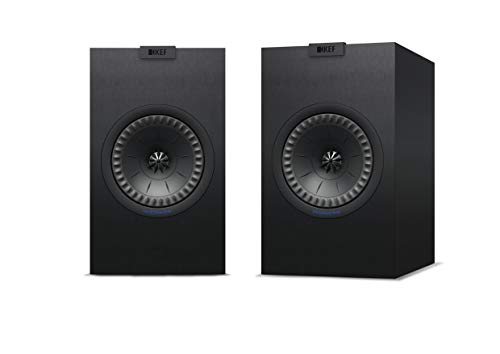
KEF Q150
- Best for: Wide sofas and shared seating where listeners sit off center and still need consistent dialogue and imaging.
- Driver array: Uni-Q, tweeter mounted at the woofer center
- Tweeter: 1-inch vented aluminum dome
- Woofer: 5.25-inch aluminum
- Frequency response: 51 Hz to 28 kHz
Wide sofas and shared seating where listeners sit off center and still need consistent dialogue and imaging.
Grilles are not the focus of this listing and the rear port needs space from the wall, so check both before placing them in a cabinet.
The Q150 solves a problem most bookshelf pairs ignore: seats away from the middle of the sofa. Its Uni-Q array mounts the 1-inch vented aluminum dome tweeter at the center of the 5.25-inch aluminum woofer, so sound leaves from a single point and stays consistent as listeners move off axis. For a family sofa, that wider, more even coverage can matter more than raw output. The cabinet is the most compact of the larger-driver models here, the rear CFD port keeps bass tidy for its size, and KEF offers matching Q Series centers for a matched front stage.
Sony SSCS5
- Best for: First receiver-based systems that will grow into a full matched Sony CS surround setup piece by piece.
- Design: 3-way, 3-driver, bass reflex
- Woofer: 5.12-inch Mica Reinforced Cellular cone
- Tweeter: 0.98-inch soft dome
- Super tweeter: 0.75-inch soft dome
First receiver-based systems that will grow into a full matched Sony CS surround setup piece by piece.
The 6-ohm load is fine for most receivers, but confirm your model supports 6-ohm speakers before wiring everything up.
The SSCS5 is the straightforward starting point for a matched Sony system. It is a 3-way, 3-driver design, unusual at this level, splitting work between a 5.12-inch Mica Reinforced Cellular woofer, a 0.98-inch tweeter and a 0.75-inch super tweeter. Sony positions the pair explicitly for home theater, and the surrounding CS range includes a center channel, floorstanding models, Atmos-enabled speakers and a subwoofer, so every later addition can match. Its 6-ohm impedance and 87 dB sensitivity are easy loads for mainstream receivers, and the cabinet depth suits ordinary media consoles.
Which One Fits Your Situation
A living room theater with no subwoofer yet
Start with the Polk ES20 or the ELAC B6.2. Both use 6.5-inch woofers and reach into the low 40 Hz range, so scores and effects carry weight the smaller models cannot match alone. The Polk goes deeper and suits a larger room, while the ELAC is easier to place on a typical console. Add a subwoofer later and either pair hands over the lowest octave cleanly.
A big room driven by an entry-level receiver
Choose the Klipsch R-51M. Its 93 dB sensitivity means the receiver reaches convincing theater volume within its comfort zone, keeping loud scenes clean instead of strained. Dialogue benefits most, since the horn-loaded tweeter projects voices clearly across a long seating distance. Budget for a subwoofer alongside it, because the 62 Hz lower limit leaves the deepest effects to another cabinet.
A family sofa where nobody sits in the middle
Pick the KEF Q150. The Uni-Q driver array spreads sound evenly across the seating row, so the person at the end of the sofa hears balanced dialogue rather than the nearer speaker dominating. That consistency also helps when the pair doubles for music. Pair it with the matching Q Series center when the system grows, and keep a few inches behind the rear port.
A first system you plan to expand channel by channel
Take the Sony SSCS5. The pair works as a stereo start or as front channels immediately, and the wider CS range supplies a matching center, towers, Atmos-enabled speakers and a subwoofer in the same voicing family. That removes the guesswork from every later purchase, which is exactly what a first-time builder needs.
Common Mistakes
- Buying a front pair with no matching center channel in the same speaker family, then mixing brands across the front stage where voices pan.
- Pushing rear-ported cabinets flat against the wall or inside a closed cabinet, which bloats bass and blurs dialogue.
- Ignoring cabinet depth, especially the deep Polk ES20, until the speaker overhangs the console or blocks the port.
- Running 5.25-inch models full range at high volume with no subwoofer and expecting full film bass from a 62 Hz lower limit.
- Mixing impedances carelessly, such as wiring several 6-ohm speakers to a receiver only rated for 8-ohm loads, without checking its manual.
Frequently Asked Questions
Can bookshelf speakers work as front channels, or do I need towers?
Bookshelf speakers work well as front channels in most rooms, especially with a subwoofer handling the lowest frequencies. Towers mainly add bass extension and output in large spaces. On stands at ear height, a pair such as the ES20 or B6.2 covers the front stage of a typical living room theater completely.
Do these passive speakers need a receiver?
Yes. Every pair in this guide is passive, so each needs an AV receiver or stereo amplifier plus speaker wire. The receiver also provides the center and surround channels and the subwoofer crossover a theater system depends on. Check it supports the speaker impedance, particularly with the 6-ohm Sony SSCS5 and ELAC B6.2.
Where should bookshelf speakers sit in a home theater?
Place the pair on stands or a console so the tweeters sit near ear height for the main seats, roughly as far apart as the distance to the listening position, angled slightly toward the listeners. Keep rear-ported models a few inches from the wall. The KEF Q150 is more forgiving of wide seating because of its Uni-Q array.
Should I buy the center channel or the subwoofer first?
For dialogue-heavy viewing, the matching center channel usually comes first, because it anchors voices to the screen and frees the front pair for music and effects. For action-heavy viewing with smaller models such as the R-51M, a subwoofer may matter sooner, since the speakers cannot reproduce the lowest effects alone.
Related guides
More from Amazon
Programs that pair well with the guide above. Offers and eligibility are set by Amazon and may change.
A free business account with business pricing and bulk-buying tools for work, shop or home office.
Create a business accountFree shipping on eligible items, Prime Video and more. Eligible new members can start with a free trial.
Start a Prime free trialAudiobooks and podcasts to listen to on the go. Eligible new members can start with a free trial.
Try Audible freeAd-free music streaming. Eligible new subscribers can start with a free trial.
Try Music Unlimited freeAs an Amazon Associate we earn from qualifying purchases.