Our Short List of 3

- Best for: A main living-room system built around several wired and wireless sources.
- Output: 256W total, per the listing title
- Bluetooth: Version 5.0 with Qualcomm aptX HD
- Drivers: Planar diaphragm tweeters and 6.5-inch woofers
- Frequency range: 38 Hz to 40 kHz
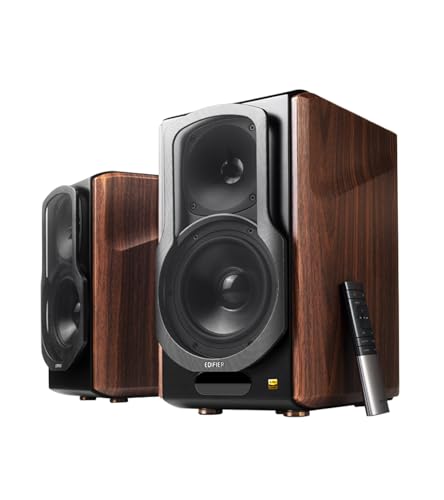
- Best for: Focused desk or study listening where tri-amped control matters more than size.
- Output: 130W tri-amped design
- Bluetooth: Version 5.0 with Qualcomm aptX HD decoding
- Drivers: Planar diaphragm tweeters and 5.5-inch mid-bass drivers
- Inputs: Bluetooth, optical, coaxial, and dual line-in
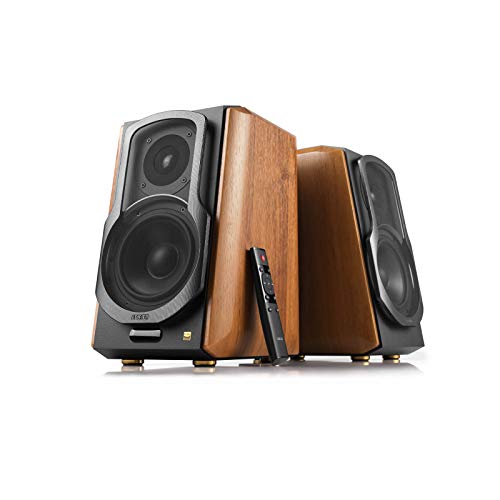
- Best for: A first serious stereo pair for a desk or bedroom system.
- Output: 120W maximum input figure in the listing comparison
- Bluetooth: Version 5.0 with Qualcomm aptX HD
- Drivers: 1-inch tweeter and 5.5-inch aluminium mid-woofer
- Frequency range: 45 Hz to 40 kHz
All 5 Picks at a Glance
| Product | Specs | Action |
|---|---|---|
| Edifier S3000MKII |
| Check price on Amazon |
| Edifier S2000MKIII |
| Check price on Amazon |
| Edifier S1000MKII |
| Check price on Amazon |
 Audioengine A5+ Wireless |
| Check price on Amazon |
 Kanto TUK |
| Check price on Amazon |
The real decision with an audiophile Bluetooth speaker is not whether it plays music wirelessly, because almost everything does now. The decision is what happens to the signal before it reaches the drivers: which codec carries it, how the amplification is split, and whether the cabinet and drivers were built for careful listening or for background noise. A speaker that only lists Bluetooth with no codec named is asking you to trust it blindly.
This guide is for listeners building a desk setup, a small-room stereo system, or a turntable corner who want that information in writing. Every pick below is a powered stereo pair whose Amazon listing names a high-quality codec such as aptX HD, states its driver sizes and output figures, and adds wired inputs for the sources Bluetooth cannot serve well. Specs are taken from the listings themselves, nothing else.
Our Top Picks
Top 3 picks at a glance
Quick Picks
As an Amazon Associate we earn from qualifying purchases
| Product | Best for | Key spec from title |
|---|---|---|
| Edifier S3000MKII | Largest rooms and the fullest driver package | 256W with planar diaphragm tweeters |
| Edifier S2000MKIII | Tri-amped near-field listening | 130W tri-amped studio monitor design |
| Edifier S1000MKII | A first serious audiophile pair | 120W with Bluetooth 5.0 aptX HD |
| Audioengine A5+ Wireless | Analog amplification and long Bluetooth range | 150W with 24-bit audio support |
| Kanto TUK | Vinyl plus streaming in one system | Built-in USB DAC and phono pre-amp |
How to Choose
Start With the Codec, Not the Bluetooth Version
Bluetooth version numbers describe the radio, not the sound. Two speakers can both list Bluetooth 5.0 while one carries only the basic codec and the other adds Qualcomm aptX HD, which the listings here support at 24-bit, 48 kHz. That difference decides how much of a lossless file survives the trip from your phone or laptop. Check that your source device also supports the codec named on the speaker listing, because the connection falls back to whatever both ends share. If neither side lists aptX HD or a comparable option, treat the wireless path as convenience rather than the main event, and plan to use a wired input for serious sessions.
Read the Driver List Like a Specification, Not a Slogan
Driver sizes and materials on a listing tell you what the speaker can physically do. A 5.5-inch mid-bass driver in a compact cabinet will not move air like the 6.5-inch woofers in the largest pair here, whatever the marketing line says. Tweeter construction matters too: the planar diaphragm tweeters on the two bigger Edifier models, the silk dome on the Audioengine, and the AMT tweeter on the Kanto each come straight from their listings, and each implies a different cabinet and crossover design. Match driver size to room size first, then compare the frequency range figures the listing publishes, such as 38 Hz to 40 kHz on the S3000MKII.
Decide How the Amplification Is Organised
Power figures only mean something alongside amplifier layout. The S2000MKIII listing describes a tri-amped design, where separate amplifier channels drive separate parts of the driver array, while the Audioengine A5+ Wireless lists a Class A/B analog amplifier and the S1000MKII a Class D design. Total output also needs context: 256W across the S3000MKII pair and 130W RMS across the Kanto TUK describe different measurement habits, so compare them as rough headroom indicators rather than a ranking. What matters for a desk or small room is clean output at the distance you actually sit, and the listing figures for signal-to-noise ratio, where given, help more than a headline watt number.
Count the Wired Inputs You Will Genuinely Use
Bluetooth is one input among several on every speaker here, and the wired list often decides long-term satisfaction. Optical suits a television or game console, coaxial suits some disc players and streamers, balanced XLR on the S3000MKII suits studio-style sources, and the Kanto TUK adds a USB DAC input plus a dedicated phono stage for a turntable without its own pre-amp. List your sources before shopping: a PC, a TV, and a record player need three different connections. A speaker that covers all three avoids adapters and switch boxes later, and it keeps a wired path available for the recordings you care about most.
The 5 Best Options
Edifier S3000MKII
- Best for: A main living-room system built around several wired and wireless sources.
- Output: 256W total, per the listing title
- Bluetooth: Version 5.0 with Qualcomm aptX HD
- Drivers: Planar diaphragm tweeters and 6.5-inch woofers
- Frequency range: 38 Hz to 40 kHz
A main living-room system built around several wired and wireless sources.
The cabinets are the biggest here, so measure shelf depth and keep the rear panels accessible for the XLR and USB connections.
The largest system in this guide suits listeners who want one pair to fill a living room and still resolve detail at moderate volume. Its listing pairs planar diaphragm tweeters with 6.5-inch woofers, quotes a frequency range starting at 38 Hz, and adds a wireless link between the two cabinets, so placement is not dictated by a connecting cable. Bluetooth 5.0 with aptX HD covers streaming, while the wired side is the broadest here, spanning USB, balanced XLR, optical, coaxial, and RCA, which makes it the natural hub for a mixed collection of sources.
Edifier S2000MKIII
- Best for: Focused desk or study listening where tri-amped control matters more than size.
- Output: 130W tri-amped design
- Bluetooth: Version 5.0 with Qualcomm aptX HD decoding
- Drivers: Planar diaphragm tweeters and 5.5-inch mid-bass drivers
- Inputs: Bluetooth, optical, coaxial, and dual line-in
Focused desk or study listening where tri-amped control matters more than size.
There is no USB input on the listing, so a computer connects by Bluetooth, optical, coaxial, or analogue line-in instead.
This model is aimed at near-field listeners who sit close and listen carefully, at a desk or in a small study. The listing describes a tri-amped 130W design built as a studio monitor style pair for audiophiles, with planar diaphragm tweeters and 5.5-inch mid-bass drivers. Bluetooth 5.0 with aptX HD handles wireless playback, and the wired complement of optical, coaxial, and dual line-in connections means a computer, a television, and an analogue source can stay connected at once. For buyers who value amplifier organisation over raw cabinet size, this is the most technically interesting option in the group.
Edifier S1000MKII
- Best for: A first serious stereo pair for a desk or bedroom system.
- Output: 120W maximum input figure in the listing comparison
- Bluetooth: Version 5.0 with Qualcomm aptX HD
- Drivers: 1-inch tweeter and 5.5-inch aluminium mid-woofer
- Frequency range: 45 Hz to 40 kHz
A first serious stereo pair for a desk or bedroom system.
The listed Bluetooth range is 32.8 feet, shorter than some rivals here, so keep the source in the same room.
The S1000MKII is the entry point into this Edifier line and the simplest recommendation for a first audiophile pair. Its listing states 120W of output, a 1-inch tweeter with a 5.5-inch aluminium diaphragm mid-woofer, and a Class D amplifier with digital signal processing and an electronic crossover. Bluetooth 5.0 with aptX HD is supported, and optical, coaxial, and line-in inputs cover a television and a wired source alongside the phone. On-speaker controls for volume, bass, and treble are listed as well, which helps when the remote is across the room and you want a quick adjustment.
Audioengine A5+ Wireless
- Best for: Listeners who want an analog amplifier design and the longest listed Bluetooth range.
- Output: 150W peak stereo output, per the listing title
- Bluetooth: Version 5.0 with aptX HD, listed range of 100 feet
- Audio: 24-bit high fidelity audio support
- Amplifier: Class A/B analog design
Listeners who want an analog amplifier design and the longest listed Bluetooth range.
There is no optical input on this model, so a television without an analogue output needs another solution.
Audioengine takes a different route from the Edifier models: the listing specifies a built-in Class A/B analog amplifier, 24-bit audio support, and Bluetooth 5.0 with aptX HD reaching a stated 100 feet. The driver set is a 5-inch woofer with a 0.75-inch tweeter in a wood cabinet, and the signal-to-noise figure is listed above 95 dB. Analogue connections include dual inputs and a subwoofer output, so the pair can grow into a larger system later. Buyers who prefer an analogue amplifier path and a long wireless leash, for a computer in one corner and speakers in another, will find this the most suitable design here.
Kanto TUK
- Best for: A combined vinyl and streaming setup that needs a phono stage and USB DAC built in.
- Output: 130W RMS, 260W peak, per the listing
- Bluetooth: Version 4.2 with aptX HD and AAC
- Drivers: AMT tweeter and 5.25-inch aluminium driver
- Inputs: Bluetooth, USB DAC, optical, and RCA with phono pre-amp
A combined vinyl and streaming setup that needs a phono stage and USB DAC built in.
Bluetooth is version 4.2 rather than 5.0, so check codec support on your phone and keep expectations for range modest.
The TUK is built for the listener whose sources include a turntable. Its listing names a dedicated RCA input with a phono pre-amp, a built-in USB DAC, an optical input, and a headphone output, alongside Bluetooth 4.2 with aptX HD and AAC support. The driver pairing is an AMT tweeter with a 5.25-inch aluminium driver, and the listing quotes 130W RMS with 260W peak output. That combination makes it the most source-flexible compact pair here for a vinyl shelf that also streams from a phone, provided you accept the older Bluetooth version in exchange for the phono stage and DAC.
Which One Fits Your Situation
A Desk Setup for Focused Listening
Choose the Edifier S2000MKIII if your chair is a metre or so from the speakers and the system lives on or beside a desk. The tri-amped layout and planar tweeters are specified for near-field use in the listing, and the dual line-in connections let a computer and a second source stay plugged in. The S1000MKII is the alternative when desk space is tighter and you still want aptX HD streaming.
A Living Room With a Television and Several Sources
The Edifier S3000MKII fits this room because its input list covers a television over optical, a streamer over USB or coaxial, and a phone over Bluetooth without swapping cables. Its 6.5-inch woofers and 38 Hz lower figure are the strongest bass specifications in this group, which suits film soundtracks as well as music. Leave ventilation and cable space behind the cabinets when you place them.
A Turntable Corner That Also Streams
Pick the Kanto TUK when a record player is the centre of the system. The built-in phono pre-amp removes a separate box from the chain, the USB DAC gives a laptop a wired digital path, and aptX HD Bluetooth covers casual streaming from a phone. No other pair in this guide combines all three of those connections in one listing.
A Computer in One Spot, Speakers in Another
The Audioengine A5+ Wireless is the sensible choice when the source cannot sit beside the speakers. Its listing states a 100-foot Bluetooth range, far beyond the figures quoted for the other models here, and the subwoofer output leaves room to extend the low end later. The analogue inputs also accept a turntable with its own phono stage or a simple wired player.
Common Mistakes
- Buying on Bluetooth version alone, without checking which codec the listing names and whether your phone or laptop supports that same codec.
- Comparing headline watt figures across brands as if they were measured the same way, when some listings quote RMS, others peak, and others a total for the pair.
- Placing large powered cabinets in a closed shelf with no access to the rear panel, where the optical, USB, and power connections actually live.
- Forgetting that a turntable needs a phono stage somewhere in the chain, then discovering the chosen speaker only offers a line-level input.
- Assuming Bluetooth replaces wired inputs entirely, and later finding the television or console has no suitable wireless path to the speakers.
Frequently Asked Questions
Does aptX HD guarantee better sound than standard Bluetooth?
It guarantees a higher specification on paper: the listings here describe aptX HD as carrying 24-bit, 48 kHz audio, beyond the basic codec. Whether you hear the full benefit depends on the source file and on your phone supporting the codec. With a wired input available on every model here, you always have a reference path for comparison.
Are these speakers portable like travel Bluetooth models?
No. Every pick in this guide is a powered stereo pair designed for tabletop placement, with a mains power source listed rather than a battery. They are built to stay in one room, connected to several sources. If you need sound on a patio or in a bag, this category is the wrong starting point entirely.
Can I connect a television to these speakers?
In most cases, yes. The Edifier models and the Kanto TUK list optical inputs, which suit most televisions, and all five pairs offer analogue inputs as a fallback. The Audioengine A5+ Wireless is the exception, with no optical input on its listing, so check your television outputs carefully before choosing it for that role.
Do I still need a separate amplifier or receiver?
No separate amplifier is required, because each system here is a powered pair with amplification built into the cabinets, as the listings describe. A receiver only enters the picture if you plan to expand into passive speakers or surround channels later. For a two-channel music and television setup, these pairs are complete on their own.
Related guides
More from Amazon
Programs that pair well with the guide above. Offers and eligibility are set by Amazon and may change.
A free business account with business pricing and bulk-buying tools for work, shop or home office.
Create a business accountFree shipping on eligible items, Prime Video and more. Eligible new members can start with a free trial.
Start a Prime free trialAudiobooks and podcasts to listen to on the go. Eligible new members can start with a free trial.
Try Audible freeAd-free music streaming. Eligible new subscribers can start with a free trial.
Try Music Unlimited freeAs an Amazon Associate we earn from qualifying purchases.