The best sound card for Ableton Live 10 is the Focusrite Scarlett 2i2 4th Gen for clean, simple recording, while the MOTU M2 leads for latency, the Steinberg UR22C suits producers who want DSP monitoring, and the Behringer UMC204HD gives budget setups four outputs. All five picks here are external USB audio interfaces, not internal PCIe cards, because Live 10 production needs XLR inputs, phantom power, and a stable ASIO driver.


This guide is for bedroom producers tracking vocals and guitar, keyboard players who need MIDI input, and beat makers moving from a laptop microphone to a real interface. Each pick was chosen from Amazon titles and specifications, with inputs, sample rates, MIDI, bundled software, and driver support checked against the listing.
Top 3 picks at a glance

Quick Picks
As an Amazon Associate we earn from qualifying purchases
| Product | Best for | Key spec from title |
|---|---|---|
| Focusrite Scarlett 2i2 4th Gen | Simple vocal and guitar recording | 2-in/2-out USB-C interface, 24-bit/192 kHz, Air mode, Auto Gain |
| MOTU M2 | Lowest latency and live monitoring | 2×2 USB-C interface, ESS Sabre32 Ultra DAC, LCD level meters, MIDI in/out |
| Steinberg UR22C | DSP monitoring with effects | USB 3.0 interface, 32-bit/192 kHz, D-PRE mic preamps, MIDI in/out |
| Behringer U-Phoria UMC204HD | Most outputs on a tight setup | 2×4 USB interface, 24-bit/192 kHz, Midas mic preamps, MIDI in/out |
| PreSonus AudioBox USB 96 25th Anniversary | Budget entry with Studio One Artist | 2-in/2-out USB interface, 24-bit/96 kHz, Class-A mic preamps, MIDI in/out |
How to Choose
Start With Inputs, Not Sample Rates
Count what you will plug in at once before you look at any other number. A singer with one microphone and one guitar needs two inputs, and every interface here has them, but a keyboard player with a hardware synth and a microphone needs a third source that none of these two-input units can take. The UMC204HD helps on the output side with four outputs for monitors and a second feed, while the rest give you two. Sample rate matters less than the input count, since Live 10 sessions sound fine at the rates these units offer, and a wrong input layout forces an upgrade sooner than any spec gap does.
Demand a Stable ASIO Driver
On Windows, Ableton Live 10 relies on an ASIO driver, and a flaky driver causes dropouts, clicks, and sessions that stop mid-take. The Scarlett, MOTU, Steinberg, Behringer, and PreSonus units all ship with their own Windows drivers, while Mac users get Core Audio support that mostly works without extra software. Check the current driver page before you buy, because Live 10 still runs on older operating systems while current drivers increasingly demand newer ones. A unit whose driver no longer supports your OS is useless no matter how good its preamps sound.
Check MIDI Before You Buy
If you own a hardware synth, a drum machine, or a MIDI controller with five-pin ports, you need MIDI in and out on the interface itself. The MOTU M2, Steinberg UR22C, Behringer UMC204HD, and PreSonus AudioBox USB 96 all include MIDI, but the Focusrite Scarlett 2i2 has none, and MIDI starts at the larger Scarlett 4i4. USB controllers connect directly to the computer and need no MIDI port, so count only your five-pin gear. Buying the 2i2 and discovering your synth has nowhere to plug in is the most common regret in this price range.
Watch Latency and Monitoring Style
Latency decides whether you can play a virtual instrument or monitor your voice without a distracting delay. MOTU claims 2.5 ms round-trip at 96 kHz with a 32-sample buffer, but that figure depends on your computer and buffer settings, and no other pick here publishes a fixed number. Every interface in this roundup offers direct or hardware monitoring, which routes your input straight to your headphones with no computer delay. If you record vocals often, that monitoring path matters more than any headline latency figure, so test it at a small buffer before a real session.
The 5 Best Options
Focusrite Scarlett 2i2 4th Gen
The Scarlett 2i2 4th Gen is the simplest path into Live 10 recording, and it suits a singer-songwriter who wants two clean inputs and no extra configuration. Its 24-bit/192 kHz conversion, up to 69 dB of mic gain, and 120 dB dynamic range cover vocals and guitar with room to spare, while Air mode adds presence to a dull microphone and Auto Gain sets levels for you. It runs on USB-C bus power, works in standalone mode, and bundles Ableton Live Lite, so a new producer can open Live and record the same day. The catch is the missing MIDI port, which rules it out for five-pin hardware.
Specs
- 2-in/2-out USB-C audio interface, bus-powered
- 24-bit/192 kHz conversion, up to 69 dB mic gain
- 120 dB dynamic range, Air mode, Auto Gain
- 48V phantom power per input, direct monitoring
- Standalone mode; bundles Ableton Live Lite and Pro Tools Intro+
Best for: Singers and guitarists who want the easiest two-input setup for Live 10.
Watch out for: No MIDI in or out, so a five-pin synth or drum machine needs a different interface, and the current driver requires a newer operating system than Live 10 itself supports.
MOTU M2
The MOTU M2 is the pick for producers who care most about latency and metering, and it is the only interface here with a published round-trip figure. MOTU claims 2.5 ms round-trip at 96 kHz with a 32-sample buffer, and real latency depends on your computer and buffer settings, but the full-colour LCD level meters make gain staging visible. Its ESS Sabre32 Ultra DAC, 120 dB output dynamic range, and -129 dBu EIN mic preamps give it the cleanest numbers in the group, and it adds MIDI in and out plus loopback channels for streaming or sampling system audio. One-touch hardware monitoring keeps vocals delay-free while you track.
Specs
- 2-in/2-out USB-C audio interface, bus-powered
- 24-bit/192 kHz conversion, ESS Sabre32 Ultra DAC
- 120 dB output dynamic range, -129 dBu EIN mic preamps
- Full-colour LCD level meters, MIDI in/out, loopback channels
- 48V phantom power per input, one-touch hardware monitoring
Best for: Producers who want the lowest stated latency, visible meters, and MIDI in one compact unit.
Watch out for: The 2.5 ms figure is a maker claim at a specific buffer and sample rate, so your own latency depends on your computer, and Windows users must install the MOTU USB driver.
Steinberg UR22C
The Steinberg UR22C suits producers who want effects while they monitor, because its SSP3 DSP chip runs reverb and channel-strip processing in hardware with no computer delay. Its 32-bit/192 kHz conversion and Class-A D-PRE mic preamps give it a different character from the 24-bit units here, and the dspMixFx software adds REV-X reverb, Sweet Spot Morphing Channel Strip, and Guitar Amp Classics for tracking. MIDI in and out cover hardware synths, and 48V phantom power handles condenser microphones on both channels. It bundles Cubase AI and Cubasis LE rather than Ableton, so Live 10 users should plan to use their own copy of Live.
Specs
- 2-in/2-out USB 3.0 audio interface, USB-C, bus-powered
- 32-bit/192 kHz conversion, Class-A D-PRE mic preamps
- SSP3 DSP chip, zero-latency DSP monitoring via dspMixFx
- MIDI in/out, 48V phantom power on two channels
- Bundles Cubase AI and Cubasis LE
Best for: Producers who want hardware effects while monitoring and a 32-bit signal path.
Watch out for: The current Yamaha Steinberg USB driver may not support older operating systems that Live 10 still runs on, so confirm driver support for your OS before buying.
Behringer U-Phoria UMC204HD
The Behringer U-Phoria UMC204HD is the value pick for producers who need more outputs than the rest of the group, with a 2-in/4-out layout that the two-output units cannot match. Its two Midas-designed mic preamps, 24-bit/192 kHz conversion, and inserts on each channel suit a small setup with monitors and a second output feed, and MIDI in and out cover a hardware synth. A direct monitor switch keeps tracking delay-free, and 48V phantom power supports condenser microphones. It uses the Behringer ASIO driver on Windows and runs class-compliant on Mac, so setup stays simple on either platform.
Specs
- 2-in/4-out USB 2.0 audio interface, bus-powered
- 24-bit/192 kHz conversion, 2 Midas-designed mic preamps
- Inserts per channel, MIDI in/out
- 48V phantom power, direct monitor switch
- Behringer ASIO driver on Windows, class-compliant on Mac
Best for: Budget producers who need four outputs, MIDI, and inserts in one interface.
Watch out for: No DAW bundle was verified for this listing, so do not expect bundled software, and confirm the current ASIO driver supports your operating system.
PreSonus AudioBox USB 96 25th Anniversary
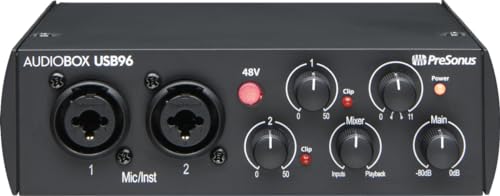
The PreSonus AudioBox USB 96 25th Anniversary is the cheapest way into this roundup, and it suits a beginner who wants a complete starter package with software included. Its two Class-A mic preamps, MIDI in and out, 48V phantom power, and direct monitoring mix control cover the basics of a Live 10 vocal or instrument session, and it bundles Studio One Artist plus the Studio Magic plug-in suite. The 24-bit/96 kHz maximum is lower than the 192 kHz ceiling of the other picks, but it is more than enough for most Live 10 sessions, and the two inputs handle a microphone and an instrument at once.
Specs
- 2-in/2-out USB 2.0 audio interface, bus-powered
- 24-bit/96 kHz maximum resolution
- 2 Class-A mic preamps, MIDI in/out
- 48V phantom power, direct monitoring mix control
- Bundles Studio One Artist and Studio Magic plug-in suite
Best for: Beginners who want the lowest-cost entry with a bundled DAW and MIDI.
Watch out for: Check live for a new-condition US offer before buying, since this 25th Anniversary edition is an older design and current stock signals are weak.
Which One Fits Your Situation
You Record Vocals and Guitar Only
Pick the Focusrite Scarlett 2i2 4th Gen, because its two clean inputs, Auto Gain, and Air mode cover a microphone and an instrument with the least setup. The bundled Ableton Live Lite gets you recording quickly, and direct monitoring keeps your voice delay-free. Skip it only if you own five-pin MIDI gear, since the 2i2 has no MIDI port at all.
You Play Virtual Instruments Live
Pick the MOTU M2, because its stated 2.5 ms round-trip latency at 96 kHz with a 32-sample buffer is the lowest published figure here, and the LCD meters show your levels clearly. MIDI in and out connect a hardware controller, and loopback channels help with sampling. Remember that real latency depends on your computer and buffer settings.
You Want Effects While You Track
Pick the Steinberg UR22C, because its SSP3 DSP chip runs reverb and channel-strip effects in hardware with no computer delay. The 32-bit/192 kHz path and D-PRE preamps suit producers who monitor with effects on. Confirm the current driver still supports your operating system first, since Live 10 runs on older systems.
You Need the Most Connections for the Least Money
Pick the Behringer U-Phoria UMC204HD, because its 2-in/4-out layout, inserts, and MIDI give you more routing than any other pick here. If you want the absolute cheapest entry and a bundled DAW, the PreSonus AudioBox USB 96 is the alternative, with 24-bit/96 kHz resolution and Studio One Artist included.
Common Mistakes
- Buying the Scarlett 2i2 and then discovering your hardware synth has no MIDI port to connect to.
- Assuming the bundled Ableton Live Lite is Live 10, when it is the current Live Lite and a separate paid version.
- Expecting 192 kHz from the AudioBox USB 96, which tops out at 96 kHz.
- Trusting a latency number as a measured fact instead of a maker claim tied to a specific buffer and sample rate.
- Skipping the driver check and finding the current driver no longer supports the older OS your Live 10 setup runs on.
Frequently Asked Questions
Are these sound cards or audio interfaces?
They are external USB audio interfaces, which is what buyers usually mean by sound cards for music production. They are not internal PCIe cards, and a PCIe card has no XLR inputs, no 48V phantom power, and no MIDI ports. For Ableton Live 10 production, the external interface is the right tool.
Which interface has the lowest latency for Ableton Live 10?
The MOTU M2 publishes the lowest figure, with MOTU claiming 2.5 ms round-trip at 96 kHz with a 32-sample buffer. Real latency depends on your computer, buffer size, and driver, so treat every latency number as a maker claim under stated conditions. All five picks offer direct or hardware monitoring with no computer delay.
Do any of these include Ableton Live 10?
No, none of them ships Ableton Live 10, which is a paid legacy version. The Scarlett 2i2 and MOTU M2 bundle the current Ableton Live Lite instead, while the UR22C bundles Cubase AI and the AudioBox bundles Studio One Artist. The article covers hardware that works with Live 10, not hardware that ships it.
Do I need MIDI on my audio interface?
You need MIDI only if you own hardware with five-pin MIDI ports, such as a synth or drum machine. The MOTU M2, Steinberg UR22C, Behringer UMC204HD, and PreSonus AudioBox USB 96 all include MIDI in and out. USB controllers connect straight to the computer, and the Scarlett 2i2 has no MIDI port.
Related guides
More from Amazon
Programs that pair well with the guide above. Offers and eligibility are set by Amazon and may change.
A free business account with business pricing and bulk-buying tools for work, shop or home office.
Create a business accountFree shipping on eligible items, Prime Video and more. Eligible new members can start with a free trial.
Start a Prime free trialAudiobooks and podcasts to listen to on the go. Eligible new members can start with a free trial.
Try Audible freeAd-free music streaming. Eligible new subscribers can start with a free trial.
Try Music Unlimited freeAs an Amazon Associate we earn from qualifying purchases.