The best binoculars for general viewing are a roof-prism 8×42 with fully multi-coated optics, such as the Nikon Monarch M5 8×42, because they balance brightness, field of view and hand-holdability better than any other size. If you want a cheaper option, the Celestron Nature DX 8×42 and Nikon Prostaff P3 8×42 are solid. If your hands shake or you watch distant subjects, the Canon 10×30 IS II adds image stabilization. The numbers below show how to match specs to what you want to watch.
As an Amazon Associate we earn from qualifying purchases at no extra cost to you.


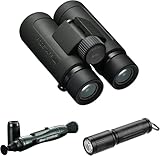

Top 3 picks at a glance
Quick comparison of the picks
| Pick | Best for | Key specs (per manufacturer) | Price range |
|---|---|---|---|
| Nikon Monarch M5 8×42 | Best overall, all-round viewing | 8x, 42 mm, exit pupil 5.25 mm, ED glass, roof prism, wide field | Mid-range to upper mid-range |
| Celestron Nature DX 8×42 | Best value for nature and scenery | 8x, 42 mm, exit pupil 5.25 mm, roof prism, fully multi-coated | Budget to mid-range |
| Nikon Prostaff P3 8×42 | Best budget starter | 8x, 42 mm, exit pupil 5.25 mm, eyeglass-friendly eye relief | Budget |
| Vortex Diamondback HD 10×42 | Best for distant wildlife and sports | 10x, 42 mm, exit pupil 4.2 mm, HD glass, roughly 6° field | Mid-range |
| Canon 10×30 IS II | Best stabilized pair | 10x, 30 mm, optical image stabilization, battery powered | Upper mid-range to premium |
| Celestron Cometron 7×50 | Best for stargazing on a budget | 7x, 50 mm, exit pupil about 7 mm, porro prism | Budget |
| Swarovski EL 8×42 class | Premium, lifetime keeper | 8x, 42 mm, flat-field optics, top-tier coatings | Premium |
Check current specs before you buy. Manufacturers revise models and field-of-view figures between generations.
Best overall: Nikon Monarch M5 8×42
An 8×42 gives a steady image you can hold for minutes, a wide field that makes moving subjects easy to find, and a 5.25 mm exit pupil that stays bright at dusk. The Monarch M5 adds extra-low-dispersion glass for cleaner edges on high-contrast scenes such as dark birds against bright sky. It is a good fit for birding, hiking, scenery, and general viewing from a balcony or window.
Trade-off: It costs noticeably more than entry-level 8×42 models. It is also bulkier than compact 8×32 or 10×30 pairs, so it is less comfortable for all-day pocket carry.
Best value: Celestron Nature DX 8×42
This is the pick for people who want the 8×42 format without paying for premium glass. It has a roof-prism body, multi-coated lenses, and a wide field suited to scanning landscapes. It suits beginners, families, and anyone who wants one pair for travel and a car trunk.
Trade-off: Expect some color fringing on bright edges and a softer image at the outer field compared with ED-glass models. Budget optics lose more contrast in low light.
Best budget: Nikon Prostaff P3 8×42
The Prostaff P3 is a straightforward entry-level pair with a rubber-armored body and eyeglass-friendly eye relief. It is a sensible first pair for daytime viewing, sports from the stands, and casual nature watching.
Trade-off: Dusk performance and edge sharpness are a step below the Monarch class. It is meant for daylight use rather than critical viewing.
Best for distance: Vortex Diamondback HD 10×42
The 10×42 format brings subjects 25% closer than 8x. That helps with shorebirds, distant wildlife, and field sports. HD glass keeps the image sharp at that power.
Trade-off: The field narrows and hand shake is more visible. If you struggle to hold the image still, a tripod adapter or a stabilized pair may serve you better.
Best stabilized: Canon 10×30 IS II
Canon’s image stabilization steadies the view at the press of a button. It makes 10x much more usable for people with tremors, for boat or vehicle viewing, and for long observation sessions. It suits viewers who find unstabilized 10x tiring.
Trade-off: It needs batteries and weighs around 600 g, per the manufacturer. The 30 mm objective limits low-light brightness, and it costs much more than a non-stabilized pair of similar size.
Best for stargazing: Celestron Cometron 7×50
A 7×50 has a large exit pupil of about 7 mm, which suits dark-adapted eyes and sweeping across the Milky Way and star clusters. It is a cheap way into astronomy viewing without a telescope.
Trade-off: It is heavy, so you will want to brace it or use a tripod. It is also a poor fit for daytime birding because the porro-prism body is bulky.
How to choose: the numbers that matter
Decode the two numbers
A pair labeled 8×42 has 8x magnification and a 42 mm objective lens. Divide the objective by the magnification to get the exit pupil, which is the width of the light beam reaching your eye. A larger exit pupil gives a brighter image in dim light, up to the size of your own pupil (about 2–3 mm in daylight, 5–7 mm in the dark; the latter shrinks with age).
Worked example: exit pupil and twilight performance
Twilight factor is the square root of magnification multiplied by objective diameter. It is a rough index of how much detail you resolve in poor light. Higher is better.
| Format | Exit pupil (mm) | Twilight factor | Subject apparent distance (subject at 80 m) | Best use |
|---|---|---|---|---|
| 8×32 | 4.0 | 16.0 | Looks like 10 m | Light travel, hiking |
| 10×32 | 3.2 | 17.9 | Looks like 8 m | Daylight distance viewing |
| 8×42 | 5.25 | 18.3 | Looks like 10 m | All-round viewing |
| 10×42 | 4.2 | 20.5 | Looks like 8 m | Wildlife, sports |
| 7×50 | 7.1 | 18.7 | Looks like 11.4 m | Stargazing, low light |
| 10×50 | 5.0 | 22.4 | Looks like 8 m | Dusk wildlife, astronomy |
The 8×42 and 10×42 comparison is the key trade-off. The 10×42 resolves about 12% more in dim light by this formula (20.5 versus 18.3), but its exit pupil falls from 5.25 mm to 4.2 mm, so the image is dimmer and shakier in the hand. Magnification divides the viewing distance: at 8x, a bird 80 m away looks as though it were 10 m away.
Field of view: convert degrees to what you actually see
Spec sheets give field of view as feet at 1,000 yards or as degrees. Multiply degrees by 52.5 to get feet at 1,000 yards. A 6.5° field covers about 341 feet at that distance, while an 8.0° field covers about 420 feet. That extra 80 feet makes moving animals much easier to locate. Wider is usually better, but extremely wide fields tend to soften at the edges on budget glass.
Decision matrix: match your situation to a choice
| Your situation | Choose | Why |
|---|---|---|
| One pair for everything | 8×42 roof prism | Bright, wide, steady |
| Small hands or lots of walking | 8×32 or 10×30 compact | Lighter and easier to carry |
| Distant wildlife, open country | 10×42 | 25% more reach than 8x |
| Shaky hands, boat, car | Stabilized 10×30 or similar | Steadies the image without a tripod |
| Night sky | 7×50 or 10×50 | Large exit pupil for dark-adapted eyes |
| You wear glasses | Eye relief of 15 mm or more | Allows the full field with glasses on |
| Tight budget | Entry-level 8×42, fully multi-coated | Best quality for the cost |
Other features worth checking
- Roof prism vs porro prism: Roof prisms are slimmer and more durable. Porro prisms give more depth and brightness per cost but are bulkier.
- Coatings: Look for “fully multi-coated” in the spec sheet. “Coated” or “multi-coated” alone usually means fewer treated surfaces and lower contrast.
- Eye relief: 15 mm or more suits glasses wearers, and twist-up eyecups should lock in position.
- Close focus: Around 2 m or less helps with butterflies and nearby details.
- Weatherproofing: Look for waterproof and nitrogen or argon purged, which prevents internal fogging.
- Weight: A pair above roughly 800 g gets tiring in the hand, so consider a harness-style strap.
Setup tips that improve the view
- Set the interpupillary distance first. Fold the barrels until you see one round circle. This reduces eye strain.
- Focus with the right eye closed. Use the center wheel on the left side view, then adjust the diopter ring for the right eye so both match.
- Adjust the eyecups. Twist them up without glasses and down with glasses to keep the full field visible.
- Brace your elbows. Resting against a wall, rail, or your chest cuts shake more than any spec upgrade.
Frequently Asked Questions
What is the best all-round binocular size for viewing?
8×42 is the best all-round size. It gives a bright 5.25 mm exit pupil, a wide field of view, and a steady image you can hold without a tripod. It works for birds, landscapes, sports, and dusk.
Is 10x better than 8x?
10x is better for distant subjects but worse for steadiness and field of view. It magnifies 25% more than 8x, yet hand shake grows with it and the field narrows. For most beginners, 8x is easier to use.
Are expensive binoculars worth it?
Premium pairs add sharper edges, better contrast in low light, and tougher builds. The gains are real but incremental, so mid-range ED-glass models like the Nikon Monarch M5 deliver most of the benefit for the cost. If you use binoculars weekly or at dawn and dusk, the upgrade is easier to justify.
Can I use binoculars if I wear glasses?
Yes, if you pick a pair with at least 15 mm of eye relief and fold down the eyecups. Without enough eye relief, you will see a narrowed, tunnel-like view. Check the manufacturer’s eye relief figure before buying.
Are binoculars good for stargazing?
Yes. A 7×50 or 10×50 pair shows star clusters, the Moon’s craters, and the Andromeda galaxy under dark skies. Brace them against a chair or mount them on a tripod for a stable view.
Do I need image stabilization?
Not for 8x pairs, but it helps at 10x and above, on boats and vehicles, or if you have a tremor. The trade-off is battery dependence, extra weight, and a higher cost. For most viewers, practicing a steady stance is enough.
Related guides
More from Amazon
Programs that pair well with the guide above. Offers and eligibility are set by Amazon and may change.
A free business account with business pricing and bulk-buying tools for work, shop or home office.
Create a business accountFree shipping on eligible items, Prime Video and more. Eligible new members can start with a free trial.
Start a Prime free trialAudiobooks and podcasts to listen to on the go. Eligible new members can start with a free trial.
Try Audible freeAd-free music streaming. Eligible new subscribers can start with a free trial.
Try Music Unlimited freeAs an Amazon Associate we earn from qualifying purchases.


