The best affordable silverware set for most households is a 20-piece (service for 4) or 40-to-45-piece (service for 8) set in 18/10 or 18/8 stainless steel with a mid-weight handle of roughly 2.5–3.5 mm. If the budget is tighter, 18/0 stainless is the acceptable compromise, as long as you do not mind occasional spotting and a slightly lighter feel. Real silver-plated or sterling “silverware” is a different, much pricier category, so for everyday use you are almost always shopping for stainless flatware.
As an Amazon Associate we earn from qualifying purchases at no extra cost to you.


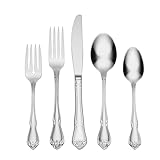

Top 3 picks at a glance
Quick comparison of the best affordable silverware set types
Instead of chasing specific model names that change constantly, it is more reliable to buy by spec class. These are the classes that consistently offer the best value, based on the steel grade and weight ranges manufacturers publish on their spec sheets.
| Pick | Best for | Key specs | Price range |
|---|---|---|---|
| Best overall: 18/10 mid-weight set | Daily use, families, dishwasher | 20 or 40 pieces, 18% chromium / 10% nickel, 2.5–3.5 mm handle | Mid-range (still affordable) |
| Best budget: 18/0 set | Students, first apartments, backup set | 20 pieces, 18% chromium / 0% nickel, 1.8–2.5 mm handle, magnetic | Budget |
| Best for larger households: 45-piece set | 4–6 people, frequent guests | Service for 8 plus serving pieces, 18/8 steel, 2.5–3 mm | Budget to mid-range |
| Best small-space set: 16-piece | Solo, couples, dorms, desk meals | Service for 4 (4 dinner forks, 4 knives, 4 spoons, 4 teaspoons) | Budget |
| Best for looks: matte or PVD-coated | Modern tables, hand-wash households | Stainless core with black, gold or brushed finish, coating wear varies | Mid-range |
| Best heavy feel: 18/10 heavyweight | People who dislike light cutlery | 3.5–4.5 mm handle, 18/10, forged knives | Mid-range to premium |
Best overall: 18/10 mid-weight stainless set
An 18/10 set is the sweet spot because the 10% nickel gives a brighter polish and better resistance to pitting and staining than cheaper grades. Mid-weight handles of about 2.5–3.5 mm feel solid without the cost of forged heavyweight sets. Choose this if the set will be used every day and go through the dishwasher several times a week.
Trade-off: It costs more than 18/0, and if anyone in the household has a nickel sensitivity, the nickel content matters (see the FAQ).
Best budget: 18/0 stainless set
An 18/0 set (often labeled 430 stainless) contains chromium but no nickel. It is cheaper, magnetic, and perfectly serviceable for casual meals. It suits students, secondary homes, office kitchens, and anyone who wants a backup set for parties.
Trade-off: It is more prone to water spots and light rust marks if left wet, or if it sits in the dishwasher with salty food residue. Handles also tend to be thinner, so it can feel flimsy.
Best for larger households: 45-piece service for 8
A 45-piece set typically gives 8 five-piece place settings (dinner fork, salad fork, knife, tablespoon, teaspoon) plus 5 serving pieces. It is usually the lowest cost per usable piece, because the serving spoons, slotted spoon, butter knife and sugar spoon are bundled in. If you have four or more people at home, this is where the value is.
Trade-off: Storage. It needs a larger drawer tray, and you may never use all the pieces.
Best small-space set: 16 pieces
A 16-piece set gives you service for 4 with no padding. It fits a standard drawer organizer, suits couples, and works well if you eat at a desk or a gaming setup and just need clean forks without a big cutlery stash. Pair it with a second identical set later if your needs grow.
Trade-off: There is no buffer for guests or for a delayed dishwasher run.
Best for looks: matte and PVD-coated sets
Black, gold and rose-tone finishes are usually a thin PVD coating over a stainless core. They look striking and are now available at accessible prices. Handle them gently: abrasive sponges, harsh dishwasher detergent and cutting directly on plates can wear the finish at the edges of the knives and tines.
Trade-off: Coating longevity varies by maker. Check whether the manufacturer states the set is dishwasher-safe, and consider hand-washing.
Steel grades explained
| Grade | Chromium / nickel | Magnetic? | Corrosion resistance | Typical use |
|---|---|---|---|---|
| 18/0 (430) | 18% / 0% | Yes | Fair | Budget everyday sets |
| 18/8 (304) | 18% / 8% | Generally no | Very good | Mainstream mid-priced sets |
| 18/10 (304) | 18% / 10% | Generally no | Very good, brighter polish | Higher-end everyday sets |
Worth knowing: 18/8 and 18/10 are both 304-family stainless, so the practical gap between them is smaller than marketing suggests. If you have to choose between a lightweight 18/10 and a sturdier 18/8, the sturdier handle is often the better buy. A quick check at home is a fridge magnet. If it sticks firmly to the handle, the set is 18/0 (or the knife blades, which are often a magnetic grade even in 18/10 sets).
Worked example: how many pieces do you actually need?
Many people overbuy or underbuy because they count people, not wash cycles. Use this formula: people × sit-down meals before the dishwasher runs × 1.25 buffer, rounded up to a whole place setting.
- Couple, dishwasher runs daily, 2 meals at the table: 2 × 2 = 4 settings, × 1.25 = 5. A 16-piece set is tight; a 20-piece set (service for 4) is fine, and 24 pieces (service for 6) is comfortable.
- Family of 4, dishwasher runs daily, 2 meals at the table: 4 × 2 = 8, × 1.25 = 10 settings. A 45-piece set (service for 8) plus a few extra teaspoons covers it, or buy two 20-piece sets.
- Family of 4, dishwasher every other day: 4 × 4 meals = 16, × 1.25 = 20 settings. That is two 45-piece sets, or change the habit and run the dishwasher daily.
- Solo, hand-washing daily: 1 × 3 = 3, × 1.25 = about 4. A 16-piece set is plenty.
Teaspoons and dinner forks wear out of rotation fastest. If a set offers extra teaspoons as an add-on, that is usually cheaper than a second full set.
Decision matrix: match your situation to a set
| Your situation | Choose | Why |
|---|---|---|
| First apartment, tight budget | 18/0, 16–20 pieces | Lowest cost, covers 4 settings |
| Family, dishwasher daily | 18/8 or 18/10, 40–45 pieces | Corrosion resistance, lowest cost per piece |
| Nickel sensitivity | 18/0, or a nickel-free labeled set | Avoids nickel in the alloy, though check the maker’s statement |
| Hand-wash only, style matters | PVD-coated matte set | Looks best; avoids dishwasher wear |
| Dislike light cutlery | 18/10 with 3.5 mm or thicker handles | Better balance and weight in the hand |
| Frequent hosting | 45 pieces plus a second set | Buffer for 12+ guests |
What to check before you buy
- Steel grade stamped or stated: Look for 18/0, 18/8, 18/10 or 304/430 on the spec sheet, not just “stainless steel.”
- Handle thickness or weight: Some brands list a gauge in millimeters or a weight per piece. Under about 2 mm feels thin.
- Fork tine finish and knife edge: Smooth, polished tine ends and a serrated or sturdy blade edge matter more than the pattern.
- Dishwasher-safe claim: Required if you plan to use one, particularly for coated sets.
- Warranty: A multi-year or limited-lifetime warranty is a quality signal, though read what it covers.
- Piece mix: Some cheap sets skimp on salad forks or include four-piece settings with no teaspoon.
Care tips that stretch an affordable set
- Unload the dishwasher promptly; sitting in humid heat is when spots form.
- Keep stainless away from silver-plated pieces in the dishwasher to avoid pitting from contact.
- Rinse off salt, vinegar and acidic sauces, especially on 18/0 sets.
- Use a dry cloth to buff knives and any spotted pieces.
Frequently Asked Questions
Is silverware the same as flatware or cutlery?
In everyday use, yes. “Silverware” in North America is generally used for knives, forks and spoons, even though most sets today are stainless steel rather than real silver. If a product is genuinely silver or silver-plated, it will say so and cost much more.
Is 18/0 stainless safe to eat with?
Yes, 18/0 stainless is a food-safe grade used in many everyday sets. The main drawbacks are lower corrosion resistance and a duller finish compared with 18/8 or 18/10, not safety. It is also magnetic, which is a handy identification test.
Is 18/10 really better than 18/8?
Only slightly. Both are austenitic, 304-family stainless steels, and the extra 2% nickel in 18/10 gives a marginally brighter finish and a bit more stain resistance. Handle thickness and build quality usually affect daily use more than that difference.
How many place settings should I buy?
Multiply the number of people by the sit-down meals between dishwasher runs, then add about 25% for guests and extras. A couple that runs the dishwasher daily is comfortable with 20 to 24 pieces, while a family of four is better served by about 40 to 45 pieces or two smaller sets.
Are black or gold silverware sets worth it?
They can be, if you value the look and are willing to hand-wash or follow the maker’s care instructions. The coating is thin and can wear at contact points over time, so they are best treated as a style choice rather than a durability upgrade.
Do I need to avoid nickel in flatware if I have an allergy?
If you have a known nickel sensitivity, 18/0 stainless or a set explicitly labeled nickel-free is the safer option. 18/8 and 18/10 contain nickel, although it is tightly bound in the alloy and many people with sensitivities tolerate it. Ask your doctor if you are unsure.
Related guides
More from Amazon
Programs that pair well with the guide above. Offers and eligibility are set by Amazon and may change.
A free business account with business pricing and bulk-buying tools for work, shop or home office.
Create a business accountFree shipping on eligible items, Prime Video and more. Eligible new members can start with a free trial.
Start a Prime free trialAudiobooks and podcasts to listen to on the go. Eligible new members can start with a free trial.
Try Audible freeAd-free music streaming. Eligible new subscribers can start with a free trial.
Try Music Unlimited freeAs an Amazon Associate we earn from qualifying purchases.


