
Top 3 picks at a glance
The Short Answer
Most gamers need between 2TB and 4TB of SSD capacity for a comfortable gaming library in 2026. A single AAA title routinely occupies 75–150GB, and popular open-world games can push past 150GB with updates and high-resolution texture packs. A 1TB drive fills up fast — often after just 6–8 major releases. If you play primarily indie titles and older games, 1TB may suffice; if you maintain a rotating library of modern blockbusters across PC, PS5, or Xbox, 4TB or more keeps you from constantly uninstalling and re-downloading.
Capacity is only half the equation, though. This guide also covers the physical dimensions of SSDs — which matter more than most buyers expect when fitting a drive into a console expansion slot, a crowded motherboard, or a laptop bay.
As an Amazon Associate we earn from qualifying purchases at no extra cost to you. Product prices and availability are accurate as of the date shown and are subject to change.



Standard Sizes
SSDs come in two broad categories: internal drives (which follow the M.2 form factor standard) and portable external drives. Here are the real-world dimensions you will encounter:
| Form Factor | Length | Width | Thickness | Typical Weight |
|---|---|---|---|---|
| M.2 2280 (standard internal) | 3.15 in / 80 mm | 0.87 in / 22 mm | 0.09–0.12 in / 2.3–3 mm | 0.25–0.35 oz / 7–10 g |
| M.2 2230 (short, handhelds) | 1.18 in / 30 mm | 0.87 in / 22 mm | 0.09 in / 2.3 mm | ~0.14 oz / 4 g |
| M.2 22110 (enterprise/long) | 4.33 in / 110 mm | 0.87 in / 22 mm | 0.09 in / 2.3 mm | ~0.35 oz / 10 g |
| M.2 with heatsink (PS5-ready) | 3.15 in / 80 mm | 0.87 in / 22 mm | 0.43–0.47 in / 11–12 mm | 0.7–1.1 oz / 20–30 g |
| Portable SSD (e.g., credit-card style) | 2.3–3.5 in / 58–89 mm | 1.2–3.0 in / 30–76 mm | 0.3–0.5 in / 8–13 mm | 1.6–3.5 oz / 46–100 g |
The “2280” designation means 80 mm long by 22 mm wide. The PS5’s expansion bay is the tightest common fit: Sony specifies drives up to 110 mm long, but total height including the heatsink must not exceed 11.25 mm (0.44 in). Many premium internal drives ship with heatsinks that meet this limit, while budget models may require you to add or remove thermal hardware to fit.
How to Measure Your Space
- Identify the slot or bay. Desktop motherboards typically have M.2 slots between the CPU socket and PCIe slots; check your manual for the exact position and whether the slot shares lanes with a SATA port.
- Measure the maximum allowed length. Most desktop and laptop M.2 mounts accept 2280, but some ultrabooks only take 2230 or 2242. Measure standoff screw positions if unsure.
- Check clearance height. On desktops, verify there’s room under your GPU or above the M.2 slot if your drive includes a heatsink — some tall heatsinks conflict with adjacent graphics cards.
- For PS5, measure the heatsink thickness. Remove the side panel and measure the internal bay; total drive-plus-heatsink height must stay under 0.44 in / 11.25 mm.
- For external drives, check your port type. Measure the connector housing if your USB ports are tightly spaced or obstructed by nearby cables; some chunky portable drives block adjacent ports.
- Verify power and heat expectations. High-performance PCIe 4.0 internal drives draw roughly 6–10W under load. A heatsink is strongly recommended in consoles and enclosed laptop bays.
By Room or Use Case
Desktop Gaming PC
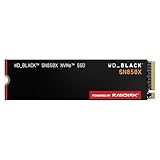
A 2TB NVMe drive is the practical sweet spot, with 4TB ideal for enthusiasts. PCIe 4.0 drives like the WD_BLACK SN850X 1TB ($248.50, up to 7,300 MB/s read) scale to larger capacities in the same 2280 footprint, so upgrading capacity requires no extra physical space. Value-oriented PCIe 4.0 options such as the RONGSHU 1TB NVMe SSD ($152.99, up to 7,400 MB/s read) make it cheaper to fill multiple slots. Budget roughly $60–$90 per terabyte for mainstream PCIe 4.0 drives.
PlayStation 5
The PS5 requires a PCIe 4.0 NVMe drive rated at 5,500 MB/s read or faster, mounted on a 2280 module with a heatsink under 11.25 mm total height. The WD_BLACK 1TB SN850P ($239.99, up to 7,300 MB/s) is officially licensed and sized to fit out of the box. Given PS5 exclusives often exceed 100GB, start at 2TB if possible.
Living Room / Console Shelves
If you use external storage for older or last-gen titles, a compact portable SSD like the Samsung T7 1TB ($229.99, up to 1,050 MB/s) measures roughly 3.4 × 2.3 × 0.3 inches and weighs about 2 ounces — small enough to tuck behind a console. Note that PS5 and Xbox Series X|S cannot run current-gen titles from external drives, only store them.
Handheld Gaming (Steam Deck, ROG Ally)
Handhelds use the short M.2 2230 form factor, so only drives measuring 1.18 × 0.87 inches fit. Capacities here typically top out at 1–2TB. Check thickness — handheld bays have almost no height allowance.
Home Office / Mixed-Use Gaming Setup
If one machine handles both work and play, a 1–2TB internal drive for the OS and games plus a 1–2TB portable SSD for archival storage covers most needs. Portable drives in this tier run $100–$230 depending on capacity and speed class, and draw power from the USB port — no wall adapter needed.
Common Sizing Mistakes
- Buying 1TB for a modern library. With AAA games at 75–150GB each, 1TB leaves usable space for only a handful of titles once the OS claims 30–60GB.
- Ignoring the heatsink height limit on PS5. A drive that fits a desktop may exceed the 11.25 mm console bay limit and physically won’t close the cover.
- Confusing storage speed with load-time gains. Beyond the console’s rated threshold, extra read speed yields diminishing returns; spend the difference on capacity instead.
- Buying the wrong M.2 length. A 22110 drive won’t mount in a 2280-only laptop. Verify the length code before checkout.
- Forgetting overhead and reserves. Manufacturers count a terabyte as 1 trillion bytes; Windows and consoles report usable capacity roughly 7% lower, and drives slow down when kept above ~85% full. Plan for 10–15% headroom.
- Overpaying for flagship speed on secondary storage. A budget PCIe 4.0 drive at $150–$160 per terabyte often delivers nearly identical gaming load times to a $250 flagship.
FAQ
Is 1TB enough for gaming in most cases?
It depends on your library. Casual players focused on a few titles or indie games will find 1TB workable. Enthusiasts juggling five or more modern AAA games will hit the ceiling within months — 2TB is the safer minimum today.
Do bigger SSDs come in bigger physical sizes?
No. Internal M.2 drives stay 22 mm wide regardless of capacity, and most remain 80 mm long — a 4TB drive occupies the same slot as a 500GB model. Portable SSD capacities also share identical enclosures across the range.
How much should I expect to pay per terabyte?
As of 2026, mainstream internal PCIe 4.0 gaming drives run roughly $90–$160 per terabyte, with flagship models near $200–$250 per terabyte. Compact portable SSDs typically cost $180–$230 per terabyte at the premium end.
Should I choose a heatsink version for my console?
Yes, provided total height stays under 11.25 mm. A heatsink keeps sustained transfer speeds consistent during long download sessions and is effectively required for PS5 operation. Pre-fitted heatsinks on licensed models remove the guesswork.
