
Most PS5 owners who buy an NVMe SSD get one of two things wrong. Either they overspend on speeds the console will never use, or they buy a drive that technically fits but fails Sony’s minimum requirement — 5,500 MB/s sequential read — and stutters when loading big open-world games. Others forget the heatsink entirely, then discover their drive throttles mid-session because the PS5’s internal bay runs warm and there’s no room for a tall cooler.
The good news: the compatibility rules are simple, published, and easy to check before you spend a dime. This guide walks through exactly what Sony requires, what actually affects load times, and where you can safely save money. Whether you’re looking at the $469.95 WD_BLACK SN850P or a budget Gen4 drive around $170, the same checklist applies.
As an Amazon Associate we earn from qualifying purchases at no extra cost to you. Product prices and availability are accurate as of the date shown and are subject to change.


Top 3 picks at a glance
Decide These 3 Things First
Before comparing specific models, lock in three decisions:
1. Capacity. A 1TB drive fills up fast — modern PS5 games run 50GB to 150GB, and Call of Duty alone can eat 200GB or more. Most people should start at 2TB. If you only play a handful of titles, 1TB works, but expect to shuffle games back and forth to the console’s internal 825GB drive.
2. Budget ceiling. Quality PS5-compatible drives now range from roughly $0.14 to $0.30 per gigabyte. Knowing whether you can spend $170 or $450 before you browse prevents the classic mistake of paying a premium for a brand name when a cheaper drive meets every requirement.
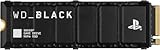
3. Heatsink situation. The PS5’s M.2 bay is shallow. Sony requires the drive plus heatsink to stay under specific thickness limits, so you either buy a drive with an included low-profile heatsink or purchase a compatible one separately (usually $10–$20). Drives sold “officially licensed” for PS5, like the WD_BLACK SN850P line, come with a tested heatsink already attached.
Capacity: 1TB vs. 2TB vs. 4TB
Sony supports drives from 250GB up to 8TB (firmware updates raised the ceiling from the original 4TB limit, and by 2026 8TB-class drives are readily available). Here’s how the common sizes shake out:
- 1TB ($150–$240): Fits roughly 6–10 large games. Fine for casual players, frustrating for anyone with a 30+ game library. The 1TB SN850P at $239.99 sits at the top of this tier; budget Gen4 drives like the fanxiang S660 run around $169.99.
- 2TB ($250–$470): The sweet spot. Roughly doubles your game capacity with a better price per gigabyte than 1TB. The 2TB SN850P lists at $469.95, though mid-range 2TB Gen4 drives frequently sell in the $250–$320 range.
- 4TB and up ($450–$800+): For collectors and digital-only players with huge libraries. Price per gigabyte continues to improve, but the upfront cost is steep.
Rule of thumb: budget at least 150GB per “big” game you keep installed, since patches routinely add 20–50GB on top of base sizes.
Speed Requirements: What Sony Actually Requires
Sony’s official requirement is a sequential read speed of 5,500 MB/s or faster. Here’s where marketing muddies the water: drives rated at 7,300 MB/s do not load games meaningfully faster on a PS5 than drives rated at 6,000 MB/s. The console’s interface simply doesn’t extract the full speed of top-tier PCIe 4.0 drives.
Practical guidance:
- Minimum: 5,500 MB/s sequential read. Below this, games may show performance warnings or stutter.
- Recommended: 6,000–7,300 MB/s. This gives headroom, since real-world sustained speeds are always lower than rated peaks.
- Sequential write: Not officially specified, but 5,000+ MB/s matters for copying large games to the drive during initial setup.
Both PCIe Gen4 and Gen5 drives work; Gen5 is wasted money here since the PS5 doesn’t support that interface speed. Buy Gen4 and pocket the difference.
Heatsink and Physical Dimensions: The Fit Rules
This is where budget drives most often fail compatibility. Sony specifies these maximum dimensions for the drive plus heatsink, measured inside the M.2 bay cover:
- Length: up to 110mm (the standard 2280 size — 80mm — fits with room to spare)
- Width: up to 25mm
- Thickness: up to 11.25mm total, but only 8mm of that is available below the drive’s front side and 11.25mm above it. In practice: the heatsink can add no more than about 6.2mm on top of a typical 2.4mm drive if using a single-sided layout.
The SN850P’s included heatsink keeps total thickness well within these limits. If buying a bare drive separately, look for low-profile aluminum heatsinks in the 3–7mm range and check the listing for explicit PS5 clearance claims. Avoid tall finned coolers designed for desktop PCs — they physically won’t fit under the bay cover.
Interface: M.2 NVMe PCIe Gen4 x4, 2280 form factor, M-key. A standard SATA M.2 drive will not work.
Performance Tier: Budget, Mid-Range, or Premium?
All three example products meet Sony’s speed floor, so what separates them?
- Budget ($150–$200 for 1TB): Drives like the fanxiang S660 (rated up to 5,000 MB/s — note this is actually below Sony’s stated 5,500 MB/s floor, so verify current specifications before buying) or the Bestoss 1TB Gen4 at 7,350 MB/s and $189.99. These use similar NAND and controllers to name brands but with shorter track records and, often, DRAM-less designs. Fine for game storage; slightly slower for massive file transfers.
- Mid-range ($200–$320): Established brands (WD, Samsung, Crucial, Seagate) at 1–2TB, meeting all requirements with proven reliability and better sustained write performance thanks to DRAM caching.
- Premium ($320–$470+): Officially licensed options like the SN850P line, or top-tier 2TB Gen4 drives. You’re paying for the license, the tested heatsink, longer warranties, and consistent high-speed sustained performance. The loading times won’t beat a mid-range drive on PS5 — the value is in reliability and peace of mind.
Warranty and Endurance (TBW)
Two numbers matter here:
- Warranty length: Premium drives carry 5-year warranties (the SN850P includes 5 years). Budget drives may offer 3–5 years — read the fine print, since some budget brands require registration or limit coverage to the original purchaser.
- TBW (terabytes written): A measure of endurance. For PS5 use, even a 600 TBW rating on a 1TB drive is far more than gaming will consume — game installs and patches write far less data than professional workloads. Don’t pay extra for TBW you’ll never use. Typical ranges: 600–1,200 TBW for 1TB, 1,200–2,400 TBW for 2TB.
The bigger warranty differentiator is support quality. WD and Samsung have established RMA processes; smaller brands vary. If a $170 drive fails and takes weeks to replace, your “savings” evaporate.
Installation: What to Expect
Installation is the easiest part of this upgrade and requires no special skill:
- Tools: A small Phillips #0 or #1 screwdriver and about 15 minutes. The PS5’s M.2 slot cover is secured with one screw (some models have a thumb-slide cover with no screw at all).
- Process: Power down and unplug the console, remove the side panel, remove the M.2 cover screw and spacer, insert the drive at an angle, secure it, reassemble. Sony’s on-screen guide then walks you through formatting.
- Format time: The PS5 formats the drive in under a minute. Games must be re-downloaded or transferred from internal storage — transfer over the console runs at roughly 1–2GB per minute for large libraries.
No assembly service is typically offered for internal SSD upgrades, but any local repair shop will do it for $30–$50 if you’d rather not open the console yourself (note: this does not void your PS5 warranty per Sony’s policy).
Spec Checklist
| Spec | Budget ($150–$200/1TB) | Mid-Range ($200–$320/1–2TB) | Premium ($320–$470/2TB) |
|---|---|---|---|
| Sequential read | 5,500–7,350 MB/s | 6,000–7,000 MB/s | up to 7,300 MB/s |
| Interface | PCIe Gen4 x4 NVMe | PCIe Gen4 x4 NVMe | PCIe Gen4 x4 NVMe |
| Heatsink | Included low-profile or $10–$20 add-on | Included low-profile | Included, officially licensed for PS5 |
| Total thickness with heatsink | Under 11.25mm (verify) | Under 11.25mm | Tested to PS5 bay spec |
| DRAM cache | Often DRAM-less | Usually DRAM | DRAM |
| Warranty | 3–5 years | 5 years | 5 years |
| TBW (1TB) | 600–700 TBW | 600–1,200 TBW | 600–1,200 TBW |
Red Flags
- No heatsink included and no low-profile option mentioned. A bare drive may exceed clearance or overheat in the PS5’s enclosed bay.
- Rated below 5,500 MB/s sequential read. Some budget listings advertise “PS5 suitable” while rating the drive at 5,000 MB/s — always check the spec sheet, not the marketing headline.
- SATA or M.2 SATA labeled drives. M.2 is a form factor, not a speed. Only NVMe PCIe drives work in the PS5.
- Gen5 drives sold at a premium “for PS5.” The console can’t use Gen5 speeds; you’re paying for nothing.
- Vague or missing warranty terms. If the listing doesn’t clearly state warranty length and coverage, assume the worst.
- QLC NAND with no SLC cache disclosure. Sustained write speeds on cache-less QLC drives can drop to a few hundred MB/s, making big game installs painfully slow.
- Thickness specs absent from the listing. If the seller can’t tell you the total height with heatsink, the drive may not fit under the bay cover.
FAQ
Do I need a drive that’s officially licensed for PS5?
No. Sony’s licensing program (like the WD_BLACK SN850P) guarantees compatibility and includes a tested heatsink, but any drive meeting the spec requirements — PCIe Gen4 NVMe, 5,500 MB/s or faster read, correct dimensions with heatsink — works identically. Licensed drives cost a premium of roughly 15–30% for that assurance.
Will a faster SSD make my PS5 games load faster?
Not meaningfully beyond the 5,500 MB/s floor. Once a drive clears Sony’s minimum, load times are governed by the console’s own pipeline, not by whether your drive peaks at 6,000 or 7,300 MB/s. Spend your budget on capacity instead.
Can I move my existing PS5 games to the new SSD?
Yes. From Settings, use the storage management menu to transfer PS5 games between the internal drive and your new SSD, or copy PS4 games freely either direction. Note that PS5 games must run from wherever they’re installed — you can store them on the SSD and play directly from it, but you can’t play a PS5 game off an external USB drive (only store it there).
Is a 1TB SSD enough for PS5 storage expansion?
For light use, yes — expect room for roughly 6–10 large games alongside the console’s internal 825GB. But given that 2TB drives have dropped well under $320 and games keep growing, most buyers in 2026 are better served by 2TB. The price-per-gigabyte jump from 1TB to 2TB is usually small; the convenience difference is large.
