The best desk for tabletop gaming is a sturdy, matte-topped desk at least 60 inches wide and 30 to 36 inches deep. A 72 by 36 inch sit-stand model is the best all-rounder for people who also use a PC. Board games, miniatures and RPGs all need more surface than a normal PC desk gives you, so size and surface finish matter more than any gaming extras.
This guide covers desk classes rather than a single “winner”. The right choice depends on which game you play, how many people sit around it, and whether the desk has to double as a PC station.
As an Amazon Associate we earn from qualifying purchases at no extra cost to you.



Our Top Picks
Top 3 picks at a glance
Quick comparison of the best desk types for tabletop gaming
| Pick | Best for | Key specs | Price range |
|---|---|---|---|
| Large sit-stand desk | Best overall, PC plus tabletop | 72 x 36 in top, 200+ lb lift rating, matte surface | Mid-range to premium |
| Deep fixed-height desk | Best budget | 60 x 30 in, steel frame, 150+ lb capacity | Budget |
| Dedicated miniatures table | Wargaming (40K, Kill Team, AoS) | 60 x 44 in or larger, flat top, rated for terrain weight | Mid-range to premium |
| Drop-leaf or fold-away desk | Small rooms | Closed 30 x 18 in, open 48 to 60 in wide | Budget to mid-range |
| Modular gaming table | Dedicated game room, RPG groups | Recessed play area, dice trays, drink holders, 4 to 6 seats | Premium |
| L-shaped desk with return | Solo players with a PC for VTT or rules | Main 60 in plus 40 in return, 1 to 2 players | Budget to mid-range |
Start with the game: how much surface you actually need
Work out desk size from the play area plus a player zone. A practical formula: desk width = play area width + 6 in margin; desk depth = play area depth + 12 in per seated player on that side + 3 in margin. The 12 inches covers dice, character sheets, a phone and a drink.
Typical play areas, based on published rulebook and manufacturer dimensions (check your edition, as sizes change):
| Game / format | Typical play area | Desk for 1 player (one side) | Desk for 2 players (opposite sides) |
|---|---|---|---|
| Magic: The Gathering (2 players, playmats) | 24 x 14 in per player | 30 x 20 in | 30 x 32 in |
| Kill Team (current Killzone boards) | about 30 x 22 in | 36 x 37 in | 36 x 49 in |
| Warhammer 40,000 Combat Patrol (Boarding Patrol sizes vary) | about 44 x 30 in | 50 x 45 in | 50 x 57 in |
| Warhammer 40,000 Strike Force | about 44 x 60 in | 50 x 75 in | 50 x 87 in |
| Common battle mat for D&D | 24 x 36 in | 42 x 39 in | 42 x 51 in |
| Mid-size board game (e.g. Ticket to Ride-class board) | about 20 x 12 in plus cards | 26 x 27 in | 26 x 39 in |
Worked example: two people playing Kill Team on opposite sides need roughly 36 x 49 inches. A standard 60 x 30 inch desk is too shallow, because the 22 inch board leaves only 8 inches total for two players. A 60 x 36 inch desk gives you 14 inches spare, or 7 inches each. That works with a dice tray but is still tight. Moving to a 60 x 44 inch table gives 11 inches per player. Depth is almost always the limiting dimension, not width.
The reach rule
Most adults reach comfortably about 24 to 26 inches without leaning. A table deeper than about 48 inches means one player cannot touch the far edge, which is why Strike Force-sized games usually need a shared table with access from three or four sides rather than a bigger desk against a wall.
Best overall: large sit-stand desk (72 x 36 in)
A 72 by 36 inch height-adjustable desk handles Combat Patrol-sized games with an opponent across the corner, a full RPG session with a battle mat, and daily PC use. Standing height is genuinely useful for miniatures, since it saves your back during a three-hour painting or gaming session.
Look for: a dual-motor frame, a lift rating of 200 lb or more (terrain and a PC monitor add up), a preset memory so you can park it at seated height, and a matte laminate or bamboo top. Trade-off: at full standing height, cheaper frames can wobble. Wobble knocks over miniatures, so lower the desk to a stable height for play and use standing mode for painting.
Best budget: deep fixed-height desk (60 x 30 in)
A solid 60 x 30 inch desk with a steel frame is the lowest-cost way to get playable space. It fits Magic, most board games under about 24 inches deep, and Kill Team for a solo player or a tight two-player game. Pair it with a neoprene mat to dampen dice noise and protect the finish.
Trade-off: 30 inches is the minimum useful depth, and anything larger needs a desk extender or an adjacent table. If you expect to move to full 40K, step up to the next class instead.
Best for miniatures wargaming: 60 x 44 in dedicated table
If your main game is Warhammer 40,000, Age of Sigmar or Kill Team with terrain, you want a table, not a desk. A 60 x 44 inch top gives a 44 x 60 inch Strike Force board with a few inches of margin on each side. Choose a fixed-height or crank-adjustable table with a flat, rigid top and a rating that covers terrain weight: resin and MDF buildings add up to 20 to 30 lb quickly.
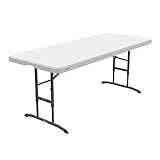
Trade-off: it does not double as a PC desk. A common compromise is a smaller PC desk and a folding 6 foot table that you set up only on game day.
Best for small rooms: drop-leaf or fold-away desk
Drop-leaf and wall-mounted fold-down desks open to 48 to 60 inches wide and close to a compact footprint. They suit apartment players who only need a big surface a few times a month. Check: the hinge and support-bracket rating, since the leaf is the weakest point. Do not place heavy terrain on the leaf edge, and test that the surface stays flush across the seam so dice do not tilt.
Best premium: modular gaming table
Dedicated gaming tables from specialist makers (Wyrmwood is a well-known example) add features that regular desks lack: recessed play surfaces, removable tops, felt or neoprene inserts, built-in dice trays and cupholders, and seating for four to six. They are the right choice for a permanent RPG or board game room.
Trade-off: cost and size. They are premium-priced, heavy and designed for a group, so they are overkill for a solo player or a shared desk-and-PC setup.
Best for solo players who also use a PC: L-shaped desk
An L-shaped desk with a 60 inch main run and a 40 inch return lets you keep your monitor on one wing and a permanent play area on the other. This is useful for solo board games, digital tools like virtual tabletops, or painting stations. Trade-off: the corner is dead space, and the return is usually too narrow for two-person miniature games.
Decision matrix: match your situation to a desk
| Your situation | Choose | Minimum size |
|---|---|---|
| Card games, 2 players, shares a PC desk | Large sit-stand or deep fixed desk | 60 x 30 in |
| Kill Team or skirmish games, 2 players | Deep desk or small table | 60 x 36 in, ideally 44 in deep |
| Full 40K or Age of Sigmar | Dedicated table | 60 x 44 in |
| D&D with 4 to 5 players and a battle mat | Modular or standard 6 ft table | 72 x 36 in with seating on all sides |
| Apartment, play twice a month | Drop-leaf or fold-away | 48 in open, wall depth 18 in closed |
| Solo player with a PC | L-shaped desk | 60 in main plus 40 in return |
Features that matter more than gaming branding
- Surface finish: Matte laminate, wood veneer or a desk mat beats glass and gloss. Glossy tops reflect lamps and make cards slide, and tempered glass makes dice loud and can chip miniatures.
- Flatness: Put a marble or die on the surface. If it drifts consistently, the top is warped or the legs are uneven. Level feet on the frame fix most wobble.
- Edge: Rounded or bullnose edges are kinder to forearms over long sessions. Sharp metal edges are a poor fit for four-hour campaigns.
- Load rating: Add the weight of terrain, a monitor and snacks. Aim for a rating at least 50 percent above that total.
- Cable and power: If you play with a laptop or tablet, a grommet hole and a clamp-on power strip keep leads off the play area.
- Under-desk clearance: You need about 24 inches of knee depth. Deep modesty panels and crossbars can restrict leg room and prevent players sitting close.
- Lighting: Overhead or clamp lighting at about 4000 to 5000 K helps with reading small card text and miniature details without color shifts.
Common mistakes
- Buying by width and ignoring depth. Most 60 inch desks are only 24 to 30 inches deep, which is too shallow for two-player miniature games.
- Choosing a glass top for looks. It amplifies noise and creates glare.
- Skipping the load rating when using heavy terrain or a large monitor on the same desk.
- Forgetting about chairs. A table 30 inches high with a 17 to 19 inch seat is comfortable; a sit-stand desk set too high for guests leads to bad posture, so keep a stool or adjustable chair available.
Frequently Asked Questions
What size desk do I need for tabletop gaming?
For card games and most board games, 60 x 30 inches is the practical minimum. For skirmish miniatures like Kill Team, aim for at least 60 x 36 inches. Full-size Warhammer 40,000 games need about 60 x 44 inches or a larger shared table.
Can a gaming desk double as a tabletop gaming table?
Yes, if it is deep and strong enough. Choose a depth of at least 30 inches, a flat matte surface and a load rating that covers your PC gear plus terrain. A 72 x 36 inch sit-stand desk is the best compromise between PC use and tabletop play.
Is a height-adjustable desk good for miniatures gaming?
It can be, since standing reduces back strain during long games and painting. Make sure the frame stays stable at the height you use, as wobble knocks over models. A dual-motor frame with a crossbar is more stable than a single-motor, single-column design.
What is the best surface for rolling dice?
A matte wood or laminate surface covered by a neoprene or felt mat is best. The mat reduces noise, keeps dice from bouncing off the table and protects the desk. A dice tray or a low-rimmed tray works if you do not want a full mat.
How do I fit tabletop gaming into a small room?
Use a drop-leaf, fold-down or wall-mounted desk that opens to 48 to 60 inches wide only when needed. Store your mat and terrain in a vertical cabinet or under-bed box so you can set up in minutes. For occasional large games, a folding 6 foot table is often cheaper than a permanent large desk.
Related guides
More from Amazon
Programs that pair well with the guide above. Offers and eligibility are set by Amazon and may change.
A free business account with business pricing and bulk-buying tools for work, shop or home office.
Create a business accountFree shipping on eligible items, Prime Video and more. Eligible new members can start with a free trial.
Start a Prime free trialAudiobooks and podcasts to listen to on the go. Eligible new members can start with a free trial.
Try Audible freeAd-free music streaming. Eligible new subscribers can start with a free trial.
Try Music Unlimited freeAs an Amazon Associate we earn from qualifying purchases.


