The best antenna for the AM broadcast band (BCB, roughly 530-1700 kHz) is a loop, either a tuned ferrite or air-core loop beside your radio or an amplified loop of about 1 m diameter feeding an SDR or tabletop receiver. Loops are directional, so you can null a local noise source or a strong co-channel station, and they pick up far less household noise than a wire. A long wire or Beverage outperforms them only when you have outdoor space and a quiet location.
This guide assumes the search means AM medium-wave listening and DXing. It does not cover “BCB” as a shorthand for anything else. Because this is a PC hardware site, it also covers the most common reason BCB reception disappoints: noise from your own computer, monitor and power supplies.
As an Amazon Associate we earn from qualifying purchases at no extra cost to you.
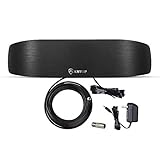

Quick comparison of the best BCB antenna types
| Pick | Best for | Key specs | Price range |
|---|---|---|---|
| Tuned passive loop (e.g. Tecsun AN-200, Select-A-Tenna class) | Portable radios, apartments | Ferrite or small air-core, tuned 530-1700 kHz, couples inductively, no power needed | Budget to mid-range |
| Twin-coil ferrite antenna (e.g. C. Crane Twin Coil Ferrite class) | Home radios with a weak internal antenna | Tuned ferrite rod, inductive coupling, highly directional | Budget to mid-range |
| Amplified broadband loop, about 1 m (e.g. Wellbrook ALA1530LNP class) | SDR and receiver users, best all-round | Wideband (well below 1 MHz up to shortwave), low-noise amplifier, bias-tee or 12 V powered | Premium |
| Tuned air-core MW loop (e.g. Kiwa and Pixel Loop class) | Serious DXers fighting strong locals | Large tuned loop, narrow bandwidth, strong overload resistance, rotatable | Mid-range to premium |
| Compact active loop (e.g. MLA-30 class) | Budget SDR users, balconies | About 30 cm loop plus amplifier, wideband, USB or bias-tee powered | Budget |
| Long wire or Beverage | Rural homes with space | 30-300 m wire, 9:1 or 4:1 unun, ground or termination required | Budget (DIY) to mid-range |
Best overall: a roughly 1 m amplified loop
A Wellbrook-style amplified loop (the ALA1530LNP is the well-known example) is the safest all-round answer if you use an SDR or a general-coverage receiver. It is broadband, so one antenna also covers longwave and shortwave. It sits well away from the house and can be rotated to null interference. The manufacturer lists very low noise and high intercept performance, which matters because medium-wave bands are crowded with strong local signals.
Trade-off: it costs the most of any option here, and it needs a clean bias-tee or battery supply. A noisy switching supply will bring its noise straight into the antenna. Plan on a linear supply or a ferrite-choked cable.
Best for apartments and portables: tuned passive loop
If you listen on a portable radio or a vintage receiver, a tuned loop such as the Tecsun AN-200 or a Select-A-Tenna-style unit gives the biggest improvement per unit of money. It couples to the radio’s internal ferrite bar by proximity, so there is no cable, power or installation. Tuning it peaks one frequency and rejects strong signals elsewhere.
Trade-off: you must retune it for each station, and it only works with radios that have an internal ferrite antenna. It will not connect to an SDR.
Best for strong-local-station areas: large tuned air-core loop
Tuned loops from makers such as Kiwa or Pixel Technologies are narrowband, so a 50 kW local on an adjacent frequency has far less chance of overloading your receiver. For chasing distant stations on a crowded dial, that selectivity is worth more than raw gain.
Trade-off: they are bulky, need manual or remote retuning for each frequency, and cost more than a simple wire.
Best budget SDR option: compact active loop
Small amplified loops in the MLA-30 class are popular with RTL-SDR and SDRplay users who have a balcony but no yard. Per typical manufacturer descriptions, they are about 30 cm in diameter and use a bias-tee or USB for power. They are good for local and regional stations and for learning.
Trade-off: a small loop has a small collecting area, so very weak distant stations suffer on quiet bands. Build quality and amplifier noise vary between suppliers.
Best if you have space: long wire or Beverage
A long wire is the cheapest way to hear far-off stations, and a Beverage adds strong directivity. The catch is wavelength. At 1000 kHz one wavelength is 300 m, so even a 100 m wire is only a third of a wavelength.
Trade-off: a wire collects every noise source near the house. In a suburban setting, an outdoor wire often hears more noise than signal.
Worked example: why wire length matters on BCB
Wavelength in metres is 300 divided by frequency in MHz. The table shows the band edges and a mid-band station.
| Frequency | Wavelength | Quarter-wave | 30 m wire as fraction of wavelength |
|---|---|---|---|
| 530 kHz | 566 m | 142 m | 0.05 |
| 1000 kHz | 300 m | 75 m | 0.10 |
| 1700 kHz | 176 m | 44 m | 0.17 |
A 30 m wire is electrically short across the whole band, so its efficiency is low. For receiving, that is acceptable because atmospheric noise on medium wave is high enough that a short antenna still hears signals above the noise floor. The real limit is local noise. A 1 m loop has a collecting area of π × 0.5² ≈ 0.79 m². That is small, but it is placed well away from the noise and is directional. Because the noise floor is set by the environment rather than the receiver, a short antenna in a quiet spot beats a long wire in a noisy one.
Your PC is probably the noisiest thing on the band
Medium wave is the band most sensitive to the interference gaming PCs create. Switching power supplies, LED lighting controllers, USB hubs and monitors radiate broadband hash. Reduce it in this order, with the reasoning for each step:
- Switch off devices one at a time while listening to a quiet frequency. A battery portable radio shows which device is the culprit, and it costs nothing.
- Move the antenna at least 10 m from the PC if possible. Noise field strength falls off quickly with distance, so distance is the cheapest fix.
- Use a coax run with a common-mode choke at the antenna and at the receiver. This stops the coax shield from acting as a second antenna carrying noise into the receiver.
- Power an amplified loop from a battery or a linear supply. Switch-mode adapters inject noise straight into the amplifier.
- Use a short, shielded USB cable with ferrite beads on the SDR. USB 3 ports radiate noise, so a USB 2 port on a powered hub is often quieter.
- Rotate the loop for a null on the noise source. A loop is strongly directional, so this can reduce a noisy neighbour by many dB.
How to choose: decision matrix
| Your situation | Best choice | Why |
|---|---|---|
| Portable radio, flat or dorm | Tuned passive loop | No power, no cable, nulls noise by rotation |
| SDR, balcony, budget | Compact active loop | Small, bias-tee powered, wideband |
| SDR or receiver, house with garden | 1 m amplified loop | Best noise rejection and all-round performance |
| Strong local AM transmitter nearby | Tuned air-core loop | Narrow bandwidth prevents overload |
| Rural, 100 m or more of space, low noise | Long wire or Beverage | Most signal for the least money |
| Weak home radio with a ferrite bar | Twin-coil ferrite antenna | Inductive coupling, no wiring |
Buying checklist
- Frequency range: confirm it covers 530-1700 kHz (and 531-1602 kHz for regions on 9 kHz spacing). Some small active loops start above 1 MHz and miss the lower end.
- Powering: check whether your SDR supplies a bias-tee. Some models do not, and a separate injector is needed.
- Overload resistance: if you live near a transmitter, favour tuned designs or look for the manufacturer’s stated third-order intercept figure.
- Weather rating: outdoor loops need sealed amplifiers and UV-resistant housings.
- Connector: match your receiver’s input (SMA, BNC or SO-239), or budget for adapters.
Frequently Asked Questions
What does BCB mean in radio?
BCB stands for broadcast band, which usually means the AM medium-wave band of about 530-1700 kHz in the Americas and 531-1602 kHz elsewhere. DXers use it to describe listening for distant AM stations.
Is a loop antenna better than a long wire for AM?
In most homes, yes. A loop is directional and responds mainly to the magnetic field, so it picks up less local electrical noise. A long wire collects more signal, but it also collects more noise unless you are in a quiet rural area.
Can I use an RTL-SDR for AM broadcast band listening?
Standard RTL-SDR dongles do not tune below about 24 MHz without direct-sampling mode or an upconverter, and direct sampling has limited sensitivity. Receivers such as the SDRplay RSP line cover medium wave natively, so they are generally a better match for a BCB loop.
Why is my AM reception worse when my gaming PC is on?
PC power supplies, GPU and CPU voltage regulators, USB devices and RGB controllers all radiate broadband noise that is strongest at lower frequencies. Move the antenna away, choke the cables, and use a battery or linear supply for the antenna amplifier.
How big does a BCB loop need to be?
Larger loops collect more signal, but because medium-wave noise is high, even a 30 cm loop can be useful for local and regional stations. For weak distant signals, a loop of about 1 m diameter is a common step up.
Do I need a ground for a BCB antenna?
A loop does not need one. A long wire or Beverage generally benefits from a ground connection or proper termination, and the exact requirements depend on the antenna design and the unun or transformer used.
Related guides
More from Amazon
Programs that pair well with the guide above. Offers and eligibility are set by Amazon and may change.
A free business account with business pricing and bulk-buying tools for work, shop or home office.
Create a business accountFree shipping on eligible items, Prime Video and more. Eligible new members can start with a free trial.
Start a Prime free trialAudiobooks and podcasts to listen to on the go. Eligible new members can start with a free trial.
Try Audible freeAd-free music streaming. Eligible new subscribers can start with a free trial.
Try Music Unlimited freeAs an Amazon Associate we earn from qualifying purchases.


