
Choosing between a NAS hard drive and a desktop hard drive usually comes down to how you plan to use storage at home, not just what fits your budget today. A desktop drive is built for the stop-and-start life of a single PC, a few hours a day. A NAS drive is built to live inside an always-on enclosure, often alongside other drives, handling constant vibration, heat, and simultaneous requests from multiple users. If you are setting up shared storage for photos, backups, and media streaming, or simply adding capacity to your primary computer, the reliability trade-offs between these two designs will determine whether you save money now or spend more later on replacements and recovery.
Top 3 picks at a glance
Quick Verdict
For reliability in continuous, multi-user, or RAID environments, a NAS hard drive is the safer choice. It is engineered for 24/7 operation, better vibration tolerance, and RAID-specific error handling. For a single desktop PC that runs 8 to 10 hours a day with simple backup habits, a desktop hard drive offers comparable everyday reliability at a lower upfront cost.
As an Amazon Associate we earn from qualifying purchases at no extra cost to you. Product prices and availability are accurate as of the date shown and are subject to change.

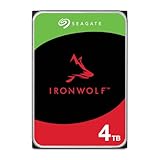


Choose a NAS drive like the Seagate IronWolf family if your drive will live in a NAS enclosure, run constantly, or hold data you cannot afford to lose. Choose a desktop drive like the Seagate BarraCuda line if your drive will live in one PC as its primary or secondary internal drive and you power down regularly. If you need plug-and-play external backup without opening a case, an external desktop solution such as the Seagate One Touch 8TB Desktop HDD gives you desktop-class reliability with simple USB-C connectivity.
Side by Side
| Feature | NAS Hard Drive | Desktop Hard Drive |
|---|---|---|
| Comfort (Noise and Heat) | Tuned for enclosed, multi-bay operation; typical idle noise 20-25 dBA, active seek 25-32 dBA; designed to run at 35-45C inside a NAS chassis | Optimized for open PC cases; similar noise levels but less vibration damping; relies on PC airflow and frequent idle periods to stay cool |
| Durability (Workload and Lifespan) | Rated for 180-300 TB per year workload; Mean Time Between Failures (MTBF) typically 1M to 2.5M hours; includes rotational vibration sensors | Rated for 55-120 TB per year workload; MTBF typically 600K to 800K hours; no rotational vibration compensation |
| Price Range | $120 to $330 for 4TB to 8TB CMR models; example: Seagate IronWolf 4TB (ST4000VNZ06/006) around $189.99, Seagate 8TB IronWolf (ST8000VNZ04) around $329.99 | $90 to $250 for 4TB to 8TB CMR/SMR models; example: Seagate 8TB BarraCuda (ST8000DM004) around $249.99, external Seagate One Touch 8TB (STNB8000400) around $269.99 |
| Maintenance | Lower hands-on maintenance; NAS firmware handles health checks, drive balancing, and RAID rebuilds; supports hot-swap in many enclosures | More manual upkeep; relies on OS tools and periodic backups; drive replacement requires shutting down the PC and opening the case |
| Space Needed | Requires NAS enclosure; 2-bay unit approx. 9.1 x 4.1 x 8.7 inches, 4-bay approx. 8.8 x 6.6 x 9.0 inches; plus drive weight 1.1-1.5 lbs per 3.5-inch drive | No extra enclosure; fits standard 3.5-inch bay inside desktop approx. 5.79 x 4.00 x 1.03 inches; external desktop drive approx. 6.7 x 4.7 x 1.6 inches, about 2.0 lbs |
| Look | Hidden infrastructure; enclosure is a small black or white box, designed to sit on a shelf or in a closet with status LEDs | Invisible when internal; external version is a minimalist enclosure intended for desk use with single-cable USB-C |
| Resale | Holds value better for home lab buyers due to NAS and RAID compatibility and longer warranty (typically 3 years with data recovery services) | Broad demand but lower resale value; typical warranty 2 years; perceived as commodity PC part |
| Best For | Always-on shared storage, family backups, Plex or photo servers, RAID 1/5/6 arrays, small business or creative archives | Single-PC storage expansion, gaming libraries, daily document work, budget builds where downtime is acceptable |
Where Nas Hard Drive Wins
NAS drives win on reliability when the drive never really gets a break. They are designed to spin 24 hours a day, 7 days a week, which is exactly what a home NAS does when it handles Time Machine backups at night, security camera footage, and media streaming on weekends.
The biggest engineering difference is vibration tolerance. In a 2-bay or 4-bay NAS, drives sit inches apart and vibrate against each other. NAS drives include rotational vibration sensors and firmer actuator control to keep the heads on track. Desktop drives do not have this, so in a multi-bay box they are more likely to show slower performance and higher error rates over time.
NAS firmware also plays a critical role. Features like Time-Limited Error Recovery prevent a drive from dropping out of a RAID array because it spent too long trying to fix a single bad sector. A desktop drive will keep retrying, which is fine in a PC but can cause a RAID controller to mark the drive as failed, triggering a stressful rebuild. For that reason, even in early 2026, most NAS makers still list only NAS-rated drives on their compatibility sheets for RAID use.
Finally, endurance ratings matter for peace of mind. A typical 8TB NAS drive such as the Seagate 8TB IronWolf Internal NAS Hard Drive (ST8000VNZ04) is rated for an annual workload of up to 180 TB per year and includes health management that integrates with popular NAS operating systems. The extra cost buys support for multiple simultaneous users and a warranty that often includes rescue services, which is valuable when the drive holds the only copy of family photos or work files.
Where Desktop Hard Drive Reliability Wins
Desktop drive reliability is not poor; it is simply optimized for a different pattern of use. Inside a single PC that runs 6 to 10 hours a day with proper shutdowns, a desktop drive operates well within its thermal and workload limits. Under those conditions, failure rates are low and the drive is perfectly reliable for everyday tasks.
Power consumption highlights that design intent. A 3.5-inch 5400 RPM desktop drive typically draws 3.5 to 5.5 watts under load and 2.5 to 3.5 watts at idle, while a 7200 RPM NAS drive often draws 6.5 to 9.0 watts under load and 4.5 to 6.0 watts at idle. In a tower that sleeps or powers off, the lighter-duty desktop drive generates less heat and places less stress on a standard power supply.
Desktop drives also win on simplicity and cost for single-drive jobs. Installing a Seagate 8TB BarraCuda Internal Hard Drive (ST8000DM004) as a secondary drive for games, video projects, or local backups adds massive capacity for about $249.99 without buying an enclosure or configuring network shares. If you prefer not to open your PC at all, an external option like the Seagate One Touch 8TB External Hard Drive Desktop HDD (STNB8000400) at around $269.99 offers desktop-class reliability with a simple USB-C cable and included backup software.
For users who keep a disciplined 3-2-1 backup routine and replace drives on a 4 to 5 year schedule, the lower workload rating of a desktop drive rarely becomes a limitation. The money saved upfront can instead go toward a second external backup drive, which does more for overall data safety than overspecifying a single internal drive.
Cost Over 5 Years
The purchase price tells only part of the story. To compare true cost, consider the drive, the housing it needs, electricity, and the likely replacement cycle.
A NAS setup starts higher. A 4TB system using a Seagate IronWolf 4TB NAS Internal Hard Drive (ST4000VNZ06/006) at $189.99 plus a 2-bay enclosure at $180 to $300 runs $370 to $490 before disks for the second bay. An 8TB configuration with the Seagate 8TB IronWolf (ST8000VNZ04) at $329.99 pushes that to around $510 to $630. Electricity for a 2-bay NAS with two drives idling most of the day is roughly 18 to 30 watts continuous, or about $22 to $38 per year at the average US rate of $0.15 per kWh, totaling $110 to $190 over five years.
A desktop internal setup is cheaper at the start. An 8TB Seagate BarraCuda at $249.99 has no enclosure cost and, because the PC is not always on, adds only about $5 to $10 per year in incremental power. Over five years that is $25 to $50. An external desktop drive like the Seagate One Touch 8TB at $269.99 is similar, drawing only 5 to 8 watts when active and near zero when unplugged.
Where NAS drives can save money is in avoided failures and warranty coverage. A desktop drive used 24/7 in a NAS may need replacement after 2 to 3 years, while a NAS drive in the same box often lasts the full 4 to 5 year service window. Factor in a single out-of-warranty replacement at $150 to $330 plus the time to rebuild data, and the five-year totals converge. For always-on or RAID use, the NAS drive is typically $80 to $150 cheaper over five years despite the higher sticker price. For intermittent, single-PC use, the desktop drive remains $100 to $200 cheaper overall.
Which One for Your Home
Your home layout and household habits matter as much as the spec sheet. Use these scenarios to match reliability needs to daily life.
Small Apartment
Space and noise are priorities. If your storage lives in your main PC under your desk, a single desktop drive keeps the footprint to zero and avoids another box, fan, and power brick in a tight room. Choose an internal BarraCuda or a single external One Touch that you can tuck behind a monitor and unplug when not backing up. Only choose a NAS if you need phone and laptop backups to run automatically without leaving your PC on, and be prepared to place the small enclosure in a ventilated closet to keep fan noise out of the living area.
Family With Kids and Pets
Shared access and accidental bumps make NAS reliability worth the premium. Kids streaming videos while you back up photos means simultaneous reads and writes, which is exactly where NAS vibration handling and RAID protection help. A 2-bay NAS with two IronWolf drives in RAID 1 gives you an automatic mirror; if one drive fails, the family still has access while you replace it. An external desktop drive can be knocked off a table by a pet or child, so if you go that route, wall-mount the drive or use a short cable and keep one offsite backup.
Rental
Portability and no permanent wiring favor desktop drives. Renters often cannot run Ethernet to an ideal NAS location and may move within a year or two. An internal desktop drive moves with your PC, and an external desktop drive moves with you in a box that weighs about 2 pounds and measures less than 7 inches long. Avoid buying a large 4-bay NAS if you expect to downsize or relocate frequently, as the enclosure and array add bulk and setup time that a simple plug-and-play drive avoids.
Long-Term Home
If you own your home and plan to centralize storage for the next five or more years, build for endurance. A NAS with properly rated drives gives you expandable capacity, centralized backups for every device, and better long-term reliability under continuous use. Budget for two drives from the start for redundancy, place the NAS on a battery backup to handle power fluctuations, and schedule drive health checks quarterly. The higher initial cost pays back in fewer interruptions and simpler management as your photo and video library grows.
FAQ
Can I use a desktop hard drive in a NAS for better savings?
You can physically install it, but it is not reliable for RAID or 24/7 use. Desktop drives lack rotational vibration sensors and have shorter error-recovery timeouts that can cause them to drop from an array. For short-term testing in a single-bay NAS with light use, it will work, but for any mirrored or parity RAID, use a NAS-rated drive to avoid premature failures and rebuild errors.
Can I use a NAS hard drive in my desktop PC?
Yes, and it will be very reliable. A NAS drive works fine as an internal PC drive, though you will pay $40 to $80 more than a comparable desktop drive and may notice slightly higher power draw and seek noise. The trade-off is longer warranty coverage and higher workload endurance, which some users prefer if the PC also serves as a home server.
How long do NAS and desktop hard drives actually last?
Design life for both types is typically 4 to 6 years under their intended workloads, not a guaranteed lifespan. NAS drives are validated for 24/7 operation and higher annual writes, while desktop drives are validated for 2400 to 3200 power-on hours per year. Keeping drives cool, below 40C, under 80 percent capacity, and on a UPS does more to extend life than any brand claim.
Which is more reliable for storing irreplaceable photos and records?
Reliability comes from redundancy, not a single drive model. A single NAS drive is more durable than a single desktop drive under constant use, but both can fail without warning. The safest home setup is two drives in RAID 1 or two separate copies on different devices, plus one offline or cloud copy. In that setup, either drive type is acceptable, though NAS drives are preferred if the copies live together in one enclosure.
