The best Canon mirrorless camera for most buyers in 2026 is the EOS R6 Mark II, a 24.2 MP full-frame body with in-body stabilization, 4K 60p video and dependable autofocus. If you want to spend less, the EOS R50 or EOS R10 covers most needs, and the EOS R7 is the pick if you want APS-C with more resolution and stabilization. The right choice depends mainly on sensor size, stabilization, card slots and how much video you shoot, so the sections below map each of those to a specific body.
As an Amazon Associate we earn from qualifying purchases at no extra cost to you.


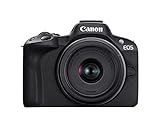
Our Top Picks
 Canon EOS RP Mirrorless Camera RF24-105mm Lens F4-7.1105mm2.8 x 5.2 x 3.3 inches1 poundsCheck on Amazon
Top 3 picks at a glance
Quick comparison of the best Canon mirrorless picks
Specs below come from Canon’s published spec sheets. Prices are general market ranges for new body-only or basic kit listings and move with promotions and regional stock.
| Pick | Best for | Sensor / stabilization | Video | Price range |
|---|---|---|---|---|
| EOS R6 Mark II | Best overall | 24.2 MP full frame, IBIS | 4K 60p oversampled from 6K | Usually $2,000–$2,500 |
| EOS R8 | Best full frame for the money | 24.2 MP full frame, no IBIS | 4K 60p oversampled from 6K | Usually $1,300–$1,600 |
| EOS R7 | Best APS-C for sports and wildlife | 32.5 MP APS-C, IBIS | 4K 60p oversampled from 7K | Usually $1,300–$1,500 |
| EOS R10 | Best mid-range APS-C | 24.2 MP APS-C, no IBIS | 4K 60p (cropped), 4K 30p oversampled | Usually $800–$1,000 |
| EOS R50 | Best budget and first camera | 24.2 MP APS-C, no IBIS | 4K 30p oversampled from 6K | Usually $650–$900 |
| EOS R5 Mark II | Best for professionals | 45 MP full frame stacked, IBIS | 8K up to 60p, 4K up to 120p | Usually $4,000–$4,400 |
Best overall: Canon EOS R6 Mark II
The R6 Mark II is the balanced choice. Its 24.2 MP full-frame sensor keeps files manageable, and its in-body stabilization is rated by Canon at up to 8 stops with certain lenses. It has dual UHS-II SD slots, shoots up to 40 fps with the electronic shutter, and records 4K 60p without a crop. That mix suits hybrid photo-and-video work, events, and a desk-side streaming or content camera.
Trade-off: the price is well above APS-C bodies, and the 24 MP sensor leaves less room for heavy cropping than the R7 or R5 Mark II. Canon has since released an EOS R6 Mark III, so check whether the older body has dropped enough in price to justify the saving.
Best full frame for the money: Canon EOS R8
The R8 uses a 24.2 MP full-frame sensor close to the R6 Mark II’s, in a body of about 461 g with battery and card. It shoots 4K 60p oversampled from 6K and uses Canon’s subject-detection autofocus. It suits travel, portraits, and anyone who wants full-frame depth of field and low-light performance without the R6 II price.
Trade-off: there is no in-body stabilization, only one SD slot, and the small battery gives fewer shots per charge. Handheld video depends on stabilized lenses or electronic stabilization.
Best APS-C for action: Canon EOS R7
The R7 pairs a 32.5 MP APS-C sensor with in-body stabilization, dual SD slots and a more substantial grip. The 1.6x crop factor gives extra reach for birds, motorsport and field sports, and the higher pixel density helps when you crop. It also records oversampled 4K 60p.
Trade-off: APS-C noise performance trails full frame at high ISO, and the RF-S lens range is thinner than RF. Many buyers use RF full-frame lenses on it, which works but adds weight and cost.
Best mid-range APS-C: Canon EOS R10
The R10 has a 24.2 MP sensor, a built-in EVF, a mechanical shutter up to about 15 fps and electronic up to about 23 fps. It is lighter than the R7 and cheaper. It suits enthusiasts who want faster burst shooting than an entry-level body offers.
Trade-off: no in-body stabilization, a single card slot, and 4K 60p uses a noticeable crop (about 1.56x per Canon’s spec sheet), which narrows your field of view in video.
Best budget pick: Canon EOS R50
The R50 weighs about 375 g and has a 24.2 MP APS-C sensor, 4K 30p oversampled from 6K, and the same subject-tracking autofocus family as pricier bodies. It is a strong first mirrorless camera for photography, casual video and vlogging, and a simple way into the RF-S lens range. For people shopping with the R100 in mind, the R50 is worth the extra money for its video and autofocus.
Trade-off: there is no in-body stabilization and the grip and battery are small. Controls are simplified, so advanced shooters will find the body limiting.
Best for professionals: Canon EOS R5 Mark II
The R5 Mark II is the high-end pick, with a 45 MP stacked full-frame sensor, internal 8K raw recording, high-speed burst modes, CFexpress Type B plus SD slots, and strong subject detection. It is for commercial work, high-resolution stills and serious video production.
Trade-off: it is expensive, files are huge, and you need fast cards and a capable PC for editing. A 45 MP sensor and 8K footage can strain older computers. If your editing machine has an older GPU or limited storage, the R6 Mark II is more practical.
How to choose: decision criteria with numbers
1. Sensor size and the crop-factor maths
Canon APS-C bodies have a 1.6x crop factor. The RF-S 18-45mm kit zoom frames like a 29–72mm lens on full frame. A 16mm lens on APS-C frames like roughly 26mm, which is wide enough for a desk or room shot. Depth of field also scales: an f/2.8 lens on APS-C gives similar background blur to roughly f/4.5 on full frame (2.8 × 1.6 = 4.48). If you want strong background separation from a fast lens, full frame (R8, R6 II, R5 II) gives it with less money spent on glass.
2. Storage maths for video
Check the bitrate in your camera’s menu, because it varies by mode. As an illustration, say a mode records at 200 Mbps. Divide by 8 to get 25 MB/s, which is about 90 GB per hour (25 × 3,600 s ÷ 1,000). A 128 GB card therefore holds roughly 85 minutes, and a 64 GB card about 40 minutes. Higher-quality modes such as all-intra or raw can multiply that several times over. The R5 Mark II’s raw video can fill a card very quickly, so budget for CFexpress cards and external SSD backup.
3. Battery and stabilization
Smaller bodies (R50, R10, R8) use smaller batteries, and CIPA ratings for these models are typically in the low-to-mid hundreds of shots on the EVF. The R6 Mark II and R7 use the larger LP-E6NH battery class and last noticeably longer. Video drains faster than stills, so carry spares or use USB-C power where the body supports it. Bodies without IBIS (R50, R10, R8) need stabilized lenses for handheld video, and this affects lens cost.
4. Streaming and webcam use
Many Canon EOS R cameras can act as a webcam through Canon’s EOS Webcam Utility software or send a clean HDMI feed to a capture card. Check Canon’s compatibility list for your exact model and firmware, because support differs between bodies. For long streams, check the manual for recording and heat limits and consider an AC power coupler to avoid battery swaps. A full-frame body with a fast lens produces the cinematic background blur creators like, but a compact R50 often delivers a sharper picture than any standard webcam at a much lower price.
Decision matrix: match your situation to a body
| Your situation | Pick | Why |
|---|---|---|
| First mirrorless camera, under about $900 | EOS R50 | Light, 4K oversampled, simple controls |
| Kids’ sports or birds on a budget | EOS R10 | Fast bursts, 1.6x reach, lower cost |
| Serious wildlife or motorsport, APS-C | EOS R7 | 32.5 MP crop room, IBIS, dual slots |
| Travel, portraits, low light, tight budget for full frame | EOS R8 | Full-frame sensor, small body |
| Weddings, events, hybrid video and photo | EOS R6 Mark II | IBIS, dual slots, 4K 60p uncropped |
| Commercial work, large prints, 8K | EOS R5 Mark II | 45 MP, 8K raw, CFexpress |
| Streaming or YouTube from a desk | EOS R50 or R8 | Good image per dollar; match lens to desk distance |
Lens and ecosystem notes
All six bodies use the RF mount, and RF-S lenses cover APS-C cameras only. If you may upgrade to full frame later, buy RF lenses now, because they work on both formats (APS-C bodies crop the image). Budget at least $300–$600 for a first prime or zoom beyond the kit lens, since lens choice affects image quality as much as the body. Third-party RF-mount lens availability is more limited than on some rival systems, so check Canon’s lens lineup before committing.
Frequently Asked Questions
Which Canon mirrorless camera is best for beginners?
The EOS R50 is the best beginner pick for most people. It is small and light, has automatic subject tracking, and records 4K video. It costs far less than full-frame bodies and uses the same RF mount, so you can keep your lenses if you upgrade later.
Is Canon full frame worth the extra money over APS-C?
Full frame is worth it if you shoot in low light, want shallow depth of field, or plan to print large. For daylight photography, travel and casual video, APS-C bodies such as the R50, R10 and R7 give excellent results for less. The lens cost gap matters too, because full-frame RF lenses are typically pricier.
Do I need in-body image stabilization?
You need it mainly for handheld video and slow shutter speeds with lenses that lack optical stabilization. The R7, R6 Mark II and R5 Mark II have it. The R50, R10 and R8 do not, though many Canon RF and RF-S lenses include their own stabilization.
Can I use a Canon mirrorless camera as a webcam for streaming?
Yes, for most current EOS R models. You can use Canon’s EOS Webcam Utility over USB or send a clean HDMI signal to a capture card. Check Canon’s compatibility list for your exact model, and consider a dummy battery or AC adapter for long sessions.
Should I wait for the newer Canon models?
Waiting rarely pays off unless a specific feature is missing. Canon updates bodies on a multi-year cycle, and the older bodies often drop in price after a successor arrives. If a model on this list fits your needs today, buying it now is usually the better value.
Related guides
More from Amazon
Programs that pair well with the guide above. Offers and eligibility are set by Amazon and may change.
A free business account with business pricing and bulk-buying tools for work, shop or home office.
Create a business accountFree shipping on eligible items, Prime Video and more. Eligible new members can start with a free trial.
Start a Prime free trialAudiobooks and podcasts to listen to on the go. Eligible new members can start with a free trial.
Try Audible freeAd-free music streaming. Eligible new subscribers can start with a free trial.
Try Music Unlimited freeAs an Amazon Associate we earn from qualifying purchases.


