Valorant is a game of stopped movement and clean first shots, and a wired keyboard removes two variables from that equation: no battery to fade mid-match and no wireless link to manage or charge between ranked sessions. What matters instead is how fast a key registers, how quickly it resets for the next counter-strafe, and how consistently the board reports inputs to the PC.
This guide collects five wired keyboards for Valorant across premium, mid-range, and budget tiers. Three use optical or magnetic switches with rapid trigger or near-instant actuation, and two offer hot-swappable alternatives for players who want a different feel without giving up a cable. Every pick connects over USB, so the remaining decisions are layout, switch type, and adjustability.
As an Amazon Associate, we earn from qualifying purchases.
Our Top Picks


Top 3 picks at a glance
Quick Answer
For most Valorant players, the Razer Huntsman V3 Pro TKL 8KHz is the wired pick to beat: analog optical switches, adjustable actuation, rapid trigger, and 8000 Hz polling in a tenkeyless frame. The ASUS ROG Strix Scope II RX adds a full-size option, the SteelSeries Apex 9 TKL offers two-point optical actuation, and the MonsGeek FUN60 Pro covers the budget tier.
Table of Contents
- Razer Huntsman V3 Pro TKL 8KHz
- ASUS ROG Strix Scope II RX
- SteelSeries Apex 9 TKL
- HyperX Alloy Rise 75
- MonsGeek FUN60 Pro
- How to Choose
- Who Should Skip
- FAQ
- Final Verdict
Razer Huntsman V3 Pro TKL 8KHz
The Huntsman V3 Pro TKL 8KHz is the premium wired option here, built around Razer’s second-generation analog optical switches. Each key reads its exact travel depth, so actuation can be set from a hair-trigger 0.1 mm to a deliberate 4.0 mm, and rapid trigger resets a key the moment it starts rising rather than at a fixed point. For Valorant, that makes counter-strafes and jiggle peeks feel immediate, because the A and D keys stop and restart movement with almost no dead travel.
The 8000 Hz polling rate is the other headline: the board reports its state eight times as often as a standard wired keyboard, which pairs naturally with high-refresh monitors. Snap Tap prioritizes the most recent of two opposing movement keys, and onboard adjustments let you change actuation without opening software. The tenkeyless frame leaves generous mouse room for low-sensitivity aim, and a magnetic leatherette wrist rest is included. This White listing is the colorway to use; it is a premium purchase that only makes sense if you will tune the analog settings.
Specs
- Switches: Razer Analog Optical Switches Gen-2
- Actuation: adjustable, 0.1 to 4.0 mm
- Rapid trigger: yes, with Snap Tap prioritization
- Polling rate: 8000 Hz wired
- Layout: tenkeyless
- Keycaps: doubleshot PBT
- Cable: detachable USB-C
- Extras: multi-function digital dial, media controls, magnetic leatherette wrist rest
- Weight: not stated
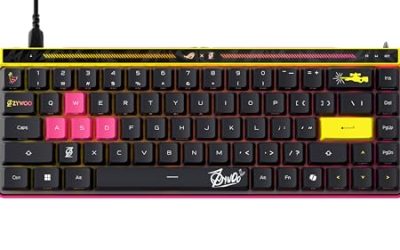
ASUS ROG Strix Scope II RX
The Strix Scope II RX is the pick for players who refuse to give up a number pad. Its ROG RX Red optical switches are pre-lubed and linear, actuating at 1.5 mm with a light initial force, and because they are optical there is no mechanical contact to debounce, keeping registration consistent across long sessions. It has no rapid trigger, so resets happen at a fixed point, but the shallow actuation still suits Valorant if your movement technique is already disciplined.
ASUS adds doubleshot PBT keycaps, sound-dampening foam, streaming hotkeys, and multi-function controls, making it a sensible single keyboard for players who stream or work at the same desk. A wrist rest is included. It sits at the premium end of this list, priced against flagship wired boards rather than compact esports models.
Specs
- Switches: ROG RX Red optical, pre-lubed, linear
- Actuation: 1.5 mm
- Rapid trigger: no
- Polling rate: 1000 Hz wired
- Layout: full-size
- Keycaps: doubleshot PBT
- Cable: wired USB
- Extras: sound-dampening foam, streaming hotkeys, multi-function controls, wrist rest included
- Weight: not stated
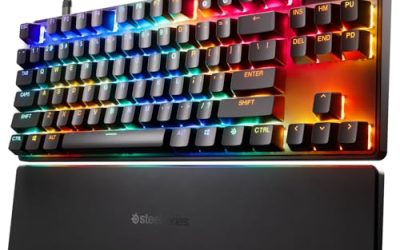
SteelSeries Apex 9 TKL
The Apex 9 TKL takes a different route to fast inputs. Its OptiPoint optical switches actuate at 0.2 mm, and a two-point actuation system lets each key switch between a fast 0.2 mm gaming point and a deeper 1.5 mm typing point, so the board feels responsive in ranked and less twitchy when writing. The optical switches are also hot-swappable, which is rare: you can replace individual switches instead of the whole keyboard.
The frame is aluminum alloy with double-shot PBT keycaps and a detachable USB-C cable, in a tenkeyless footprint that suits smaller desks and low-sensitivity mouse movement. There is no rapid trigger mode, so this pick suits players who value a very fast fixed actuation over magnetic-style resets. It lands in the mid-range tier, below the flagship analog boards and above the budget magnetic options.
Specs
- Switches: OptiPoint optical, hot-swappable
- Actuation: 0.2 mm, with two-point actuation at 0.2 mm and 1.5 mm
- Rapid trigger: no
- Polling rate: 1000 Hz wired
- Layout: tenkeyless
- Frame: aluminum alloy
- Keycaps: double-shot PBT
- Cable: detachable USB-C
- Dimensions: 355 x 128 x 42 mm
- Weight: not stated
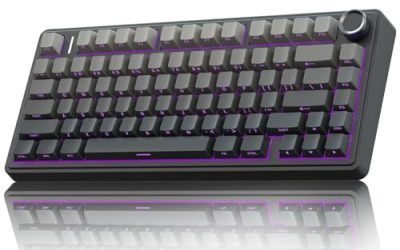
HyperX Alloy Rise 75

The Alloy Rise 75 is the mechanical entry here, and the most customizable wired board in the list. Its pre-lubed HyperX Linear switches sit in a hot-swappable PCB inside a gasket-mounted case, so the feel is softer and quieter than a typical tray-mount esports board, and you can change switches or keycaps later without soldering. It has no rapid trigger or adjustable actuation, making it the slowest-resetting board here on paper, but for players still building movement fundamentals, consistent linear switches are rarely the limiting factor.
Practical touches carry the rest: an ambient light sensor adjusts per-key RGB brightness to the room, a media dial handles volume, and the detachable USB-C cable is easy to replace. The 75 percent layout keeps a function row and arrow keys while trimming the number pad. It sits in the mid-range tier and suits players who want one board for ranked matches and daily typing.
Specs
- Switches: HyperX Linear mechanical, pre-lubed, hot-swappable
- Actuation: fixed, not stated
- Rapid trigger: no
- Polling rate: 1000 Hz wired
- Layout: 75 percent
- Mount: gasket mount
- Keycaps: PBT
- Cable: detachable USB-C
- Extras: ambient light sensor, media dial
- Model number: 7G7A4AA#ABA
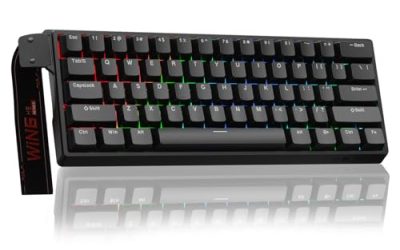
MonsGeek FUN60 Pro

The FUN60 Pro is the budget route to genuine rapid trigger. Its Glare magnetic switches use Hall effect sensing with actuation adjustable from 0.1 mm to 3.3 mm in 0.01 mm steps, and rapid trigger tracks key release at the same fine resolution, so counter-strafes reset far faster than on a mechanical board. Over its USB-C cable it also polls at 8000 Hz, matching the flagship Huntsman on that specification while costing far less.
The trade-offs are about format rather than speed. The 60 percent layout has 61 keys, so arrows and the function row live on a layer, which takes adjustment if you rely on dedicated keys outside the game. The board also offers Bluetooth and 2.4 GHz wireless modes, but for Valorant the wired mode is the one to use, for the full polling rate and consistent latency. It is the natural starting point for players who want to try rapid trigger before committing to a premium model.
Specs
- Switches: Glare magnetic Hall effect switches
- Actuation: adjustable, 0.1 to 3.3 mm in 0.01 mm steps
- Rapid trigger: yes, 0.01 mm adjustment precision
- Polling rate: 8000 Hz in wired mode
- Layout: 60 percent, 61 keys
- Keycaps: shine-through PBT
- Connection: wired USB-C, plus Bluetooth 5.0 and 2.4 GHz wireless modes
- Battery: 3,000 mAh (for wireless modes)
- Weight: not stated
How to Choose
Start with switch behavior, because it decides how the board handles Valorant’s stop-and-shoot movement. Magnetic and analog optical switches with rapid trigger, like the Huntsman V3 Pro TKL 8KHz and the FUN60 Pro, reset a key as soon as you begin releasing it, tightening counter-strafes. Fixed optical switches, like the Apex 9 TKL and the Strix Scope II RX, actuate quickly but reset at a set point. Mechanical switches, like those in the Alloy Rise 75, are the most familiar and easiest to customize, but reset the slowest.
Next, weigh polling rate honestly: an 8000 Hz board reports inputs more often than a 1000 Hz board, but it is a refinement, not a transformation; switch type and movement discipline matter more. Layout is the third decision: tenkeyless and 75 percent boards free up mouse space for low-sensitivity aiming, a 60 percent board frees up the most but hides arrows behind a layer, and full-size keeps the number pad. Finally, hot-swappable boards let you replace a single failing switch, while sealed flagships trade that flexibility for tighter factory tuning.
Who Should Skip
Skip this wired category if your setup needs to move between rooms or devices, because every pick performs best tethered by a cable. Skip the rapid trigger flagships if you mostly play casually: the Huntsman V3 Pro TKL 8KHz only justifies its premium tier when you will tune actuation points per key. Skip the FUN60 Pro if you depend on dedicated arrow keys for work, and skip the Alloy Rise 75 if your priority is the fastest possible key resets, since its switches have neither rapid trigger nor adjustable actuation. Players who already own a recent rapid trigger board will gain little here.
FAQ
Does rapid trigger actually help in Valorant?
It helps with the skill Valorant rewards most: stopping cleanly before firing. Rapid trigger resets a movement key the instant it starts to rise, so alternating between A and D feels tighter and counter-strafes register with less travel. It does not improve aim, but for movement consistency it is the most relevant keyboard feature for this game.
Is 8000 Hz polling worth it over 1000 Hz on a wired keyboard?
For most players the difference is small, because a 1000 Hz board already reports every millisecond. An 8000 Hz board such as the Huntsman V3 Pro TKL 8KHz or the wired FUN60 Pro shortens that interval further, which can matter at the margins on high-refresh setups. Treat it as a bonus on a board you want for its switches, not a reason to buy by itself.
Which layout is best for Valorant, 60 percent, 75 percent, or tenkeyless?
Tenkeyless is the safest default: dedicated arrows and a function row, with space cleared for wide mouse sweeps. A 75 percent board like the Alloy Rise 75 keeps nearly the same keys in a tighter frame. A 60 percent board like the FUN60 Pro maximizes mouse room but puts arrows and function keys on a layer, fine in matches and slower for everyday shortcuts.
Can a mechanical keyboard without rapid trigger still work for ranked play?
Yes. Players climbed to high ranks for years on standard mechanical boards, and a linear mechanical keyboard like the Alloy Rise 75 remains perfectly usable. Rapid trigger makes movement resets faster and more forgiving, but game sense, crosshair placement, and disciplined stopping matter far more than switch technology.
Final Verdict
For a wired Valorant keyboard, buy switch behavior first and the badge second. The Razer Huntsman V3 Pro TKL 8KHz is the complete premium package: analog actuation, rapid trigger, and 8000 Hz polling in the layout most FPS players prefer. The ASUS ROG Strix Scope II RX covers full-size loyalists, the SteelSeries Apex 9 TKL adds rare hot-swappable optical switches, and the HyperX Alloy Rise 75 is the comfortable mechanical all-rounder. On a budget, the MonsGeek FUN60 Pro delivers real magnetic rapid trigger for the least commitment.
Product and ASIN Reference
| Product | ASIN |
|---|---|
| Razer Huntsman V3 Pro TKL 8KHz (White) | B0FRPFNW9Y |
| ASUS ROG Strix Scope II RX | B0CLHLLFBP |
| SteelSeries Apex 9 TKL | B0B169JSRT |
| HyperX Alloy Rise 75 | B0CYNYGKRT |
| MonsGeek FUN60 Pro (Black Shine-Through) | B0DQXBBWZZ |
Related guides
More from Amazon
Programs that pair well with the guide above. Offers and eligibility are set by Amazon and may change.
A free business account with business pricing and bulk-buying tools for work, shop or home office.
Create a business accountFree shipping on eligible items, Prime Video and more. Eligible new members can start with a free trial.
Start a Prime free trialAudiobooks and podcasts to listen to on the go. Eligible new members can start with a free trial.
Try Audible freeAd-free music streaming. Eligible new subscribers can start with a free trial.
Try Music Unlimited freeAs an Amazon Associate we earn from qualifying purchases.