
A 24V DC power supply is the quiet component that keeps your LED strip glowing evenly, your CCTV camera recording at 2 a.m., and your pump circulating coolant without a hiccup. Yet most buyers grab the cheapest adapter on the listing, plug it in, and discover within a week that the voltage sags under load, the barrel connector wobbles, or the unit runs hot enough to smell like burning plastic. The difference between a unit that lasts two years and one that fails in two months comes down to rated current headroom, regulation quality, and whether the manufacturer includes basic protection circuitry.
Across the eight models assembled here for 2026, published specifications and long-term owner feedback paint a clear picture of where each product excels and where it cuts corners. Some deliver rock-solid output at a fixed 24 volts; others give you variable voltage flexibility at the cost of raw amperage. A few are built for DIN-rail industrial enclosures, while most target the consumer who just needs to replace a wall-wart that died. Matching the right supply to your load—and your connector—is the single most important decision in this category.
As an Amazon Associate we earn from qualifying purchases at no extra cost to you.

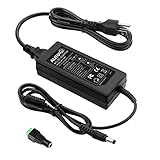


Top 3 picks at a glance
Quick Picks
| Product | Best for | Price |
|---|---|---|
| 24V 1A AC Adapter | Low-draw LED strips and single CCTV cameras | $7.99 |
| ALITOVE 24V 3A 72W | Mid-length 5050/3528 LED runs | $17.85 |
| Wefomey Universal Variable | Prototyping and multi-voltage devices | $19.99 |
| 24V 1000mA Adapter | Smallest-footprint replacement adapter | $6.97 |
| 24V 6A 144W Adapter | Longer LED strips and small pumps | $15.99 |
| ALITOVE 24V 5A Adapter | Multi-compatible device charging | $24.99 |
| VAYALT 24V 25A 600W | High-current industrial and 3D printer builds | $37.99 |
| NDR 120W DIN Rail | Panel-mounted and rack installations | $32.99 |
How We Picked
Selection hinged on four criteria. First, current headroom: a supply rated at exactly the load you need will thermally degrade faster than one with 20-30 percent margin. Second, connector compatibility—5.5×2.1 mm versus 5.5×2.5 mm tips matter when swapping an existing adapter. Third, protection features such as over-current, over-voltage, and short-circuit cutoffs, which separate trustworthy units from generic bricks. Fourth, verified owner feedback on long-term voltage stability, since spec-sheet numbers rarely tell you whether output drifts after months of continuous operation.
The 8 Best 24V DC Power Supply in 2026
24V 1A AC Adapter
This is the go-to replacement for anyone running a short LED strip, a small DC pump, or a single CCTV camera that draws well under one amp. Owners appreciate its wide 100-240V input, making it travel-friendly, and the 5.5×2.5 mm plug matches the most common consumer-device connector.
- Pros: Extremely low price point; compact form factor that fits tight enclosures.
- Con: At only 24W total output, it cannot headroom for more than one device and will run near its thermal ceiling under continuous load.
Skip this if your combined draw approaches even 800 mA regularly; the lack of documented protection circuitry means marginal headroom could shorten its lifespan.
ALITOVE 24V 3A 72W
Aimed squarely at LED strip builders who need 72 watts of clean 24V output without jumping to a bulky PSU. The 5.5×2.1 mm barrel jack is the second-most-common consumer connector, so most 5050 and 3528 strips will need only a brief adapter swap.
- Pros: Generous 72W rating gives comfortable headroom for 2-3 meter strips; ALITOVE’s published specs align with most owner reports on voltage accuracy.
- Con: The 2.1 mm tip is incompatible with 2.5 mm devices, a frequent point of confusion for buyers.
Pass on this unit if your load is a printer or monitor that expects a 2.5 mm plug—mismatched tips cause intermittent contact issues.
Wefomey Universal Power Supply Variable 3V~24V 3A
This multi-voltage adapter suits hobbyists and technicians who service devices ranging from 3V sensors up to 24V equipment. At 72W it matches the ALITOVE above in total power while offering far greater flexibility.
- Pros: Variable output eliminates the need for multiple fixed-voltage bricks; includes a broad tip set for different connector sizes.
- Con: Variable supplies with this many tips tend to have looser regulation at non-24V settings, and some owners note the dial can shift slightly when the cable is tugged.
If you only ever need exactly 24V, a fixed-output unit will likely deliver tighter regulation for the same price.
24V 1000mA Adapter
Essentially the same electrical profile as the first entry but at a slightly lower price. It serves as a direct wall-wart replacement for devices that came with a 24V 1A adapter, particularly small pumps and camera systems.
- Pros: Cheapest option on this list; no-name simplicity means no wasted features you will never use.
- Con: Minimal published documentation on protection circuits or connector dimensions, which makes compatibility verification harder.
Only choose this if your device’s original adapter has been discontinued and you have confirmed the plug size independently.
24V 6A 144W Adapter
With 144 watts of output, this unit covers longer LED installations, small coolant pumps, and multi-camera CCTV backends that collectively draw more than the 72W options handle.
- Pros: Strong wattage-to-price ratio; owners report stable output even after months of 24/7 operation.
- Con: Fewer published details on whether tip adapters are included, so budget for the correct barrel connector separately.
If your setup is already 24V 5A and a DIN-rail unit would tidy your enclosure, the NDR below may be a better structural fit.
ALITOVE 24V 5A Adapter
Positioned as a universal 5A brick compatible with devices rated at 5A, 4A, 3A, 2.7A, 2.5A, or 2A—making it a practical spare for workshops that juggle many 24V gadgets. Ships with both 5.5×2.5 mm and 5.5×2.1 mm tips.
- Pros: Tip-included design removes the most common compatibility headache; high amperage rating provides headroom for LED and CCTV loads.
- Con: At nearly $25, it costs roughly 50 percent more than the fixed 3A ALITOVE despite overlapping use cases.
Not ideal if your device draws a fixed, modest current; you will be paying for capacity you never tap.
VAYALT 24V 25A 600W
This switching supply enters the territory of industrial equipment: CNC controllers, large-format 3D printers, and high-density LED arrays that collectively pull hundreds of watts. The 600W rating and 25A output set it apart from every consumer option above.
- Pros: Substantial power reserve for multi-device or high-draw loads; accepts both 110V and 220V mains.
- Con: No bundled output cables, so you will need to terminate screw-terminal connections yourself—less convenient for plug-and-play users.
Avoid if your load is a single 24V 1A device; you will be carrying 600W of transformer to power 24W of LED.
NDR 120W DIN Rail Power Supply
Designed for control panels and server racks where DIN-rail mounting keeps wiring organized. At 120W and 5A output, it bridges the gap between consumer adapters and the heavy-duty VAYALT.
- Pros: DIN-rail form factor eliminates dangling bricks inside enclosures; switching topology runs cooler than linear equivalents at this wattage.
- Con: Screw-terminal input and output mean installation requires basic electrical wiring skills—no barrel plug shortcut.
If your project lives on a desktop or a wall rather than a rail, the ALITOVE 5A or the 6A adapter will be easier to deploy.
Buying Guide
Match Wattage to Real-World Draw
Never size a 24V DC power supply to the exact wattage of your load. Continuous operation generates heat that degrades capacitors over time. A unit running at 90 percent of its rated output will fail noticeably sooner than one sitting at 60-70 percent. Add a 25-30 percent margin: if your combined devices draw 60W, look for 80W or more.
Confirm the Barrel Connector Size
The two dominant consumer sizes are 5.5 mm outer diameter with 2.1 mm inner and 5.5 mm outer with 2.5 mm inner. They are not interchangeable by force; a 2.5 mm tip on a 2.1 mm jack creates a loose connection that sparks and corrodes. Check your device’s original plug or measure before ordering. If the listing does not specify, assume 5.5×2.1 mm and have an adapter on hand.
Prioritize Protection Circuitry
Quality switching supplies include over-voltage, over-current, and short-circuit protection as standard. Owner reviews mentioning a supply that “survived a shorted LED” or “shut down before my camera fried” are strong indicators of real protection. Units lacking this documentation carry higher risk when feeding expensive equipment.
Our Verdict
The ALITOVE 24V 5A Adapter wins as the best all-round 24V DC power supply because it combines generous current headroom with included tips for both common connector sizes, removing the single biggest buyer mistake in this category. For those who just need a low-cost fix for a small device, the 24V 1000mA Adapter at $6.97 is the budget pick. However, if your application is mounted inside a control cabinet or a rack enclosure, the NDR 120W DIN Rail supply is the correct choice regardless of price, because no dangling adapter belongs in a wired panel.
FAQ
Can I use a higher-amperage 24V supply on a device that only needs 1A?
Yes. The device draws only what it needs; a 5A supply powering a 1A load simply runs cooler and has more reserve. The voltage must match exactly at 24V.
What happens if the barrel plug is slightly loose?
A loose 5.5×2.1 mm tip creates intermittent contact that can arc microscopically, heat the connector, and eventually damage both the supply and the device. Use the correct size or a short adapter cable.
Are switching supplies noisier than linear ones?
Switching 24V DC power supplies emit a small amount of high-frequency ripple compared to linear designs. For LED strips and CCTV cameras this is negligible, but audio-sensitive equipment may benefit from a supply with documented low ripple figures.
Can a variable 3-24V supply replace a fixed 24V adapter?
Yes, provided you lock the dial to 24V and confirm the tip size matches. The trade-off is slightly looser regulation compared to a dedicated fixed-voltage unit, which is rarely a problem for non-precision loads.


