
Our Top Picks
 Audio-Technica ATN3600LC Conical Replacement Stylus Needle for AT-LP60X4 x 3 x 1.25 inches0 PoundsCheck on Amazon
 Audio-Technica AT-VMN95E Elliptical Replacement Turntable Stylus for AT-VM954 x 1 x 3 inches0 PoundsCheck on Amazon
 Audio-Technica ATN3600LE Elliptical Replacement and Upgrade Stylus Needle4 x 3 x 1.25 inchesCheck on Amazon


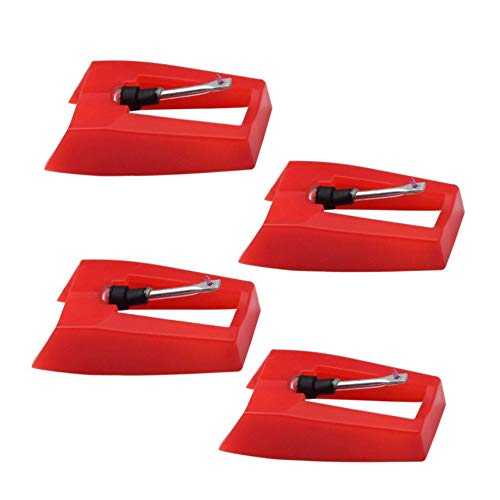
Top 3 picks at a glance
Quick Comparison
The table below maps every stylus in this roundup to the job it does best. Prices are given as tiers rather than fixed figures because listings shift constantly; treat the tier as a band, not a quote. “Compatibility” means the cartridge or turntable family the listing explicitly names, not a universal claim.
| Product | Best for | Key specs & compatibility | Price tier |
|---|---|---|---|
| Audio-Technica ATN3600LC Conical Replacement Stylus | Restoring a stock AT-LP60X / Sound Burger without changing the sound character | Conical (spherical) profile; fits AT-LP60X, AT-LP60XBT, Sound Burger, AT-SB727; bonded diamond tip; stock tracking force class | Premium |
| Voltrish 4-Pack Record Player Needles (Ruby) | Keeping a cheap all-in-one alive for the lowest possible cost | 4 styli per pack; ruby (synthetic corundum) tip; ceramic-cartridge all-in-one decks: Crosley, Victrola style | Budget |
| Audio-Technica AT-VMN95E Elliptical Stylus | Upgrading a VM95-family cartridge for detail and inner-groove tracking | Elliptical profile; fits all AT-VM95 Series cartridges (VM95C/VM95E/VM95EN bodies); user-replaceable on the cartridge | Premium |
| Gartopvoiz Diamond Stylus Replacement (2-pack) | Budget diamond replacement where the deck uses a generic ceramic stylus mount | 2 styli per pack; diamond tip; ceramic-cartridge turntables, LP/phonograph all-in-ones | Budget |
| Audio-Technica ATN3600LE Elliptical Stylus | Getting more detail out of an AT-LP60X without buying a new turntable | Elliptical profile; fits AT-LP60X, AT-LP60XBT, Sound Burger; drop-in replacement for the ATN3600 family | Premium |
| Ywhomal 4-Pack Ruby Needle | Spares drawer for ION / Jensen / Crosley / Victrola / Sylvania all-in-ones | 4 styli per pack; ruby tip; named compatibility with ION, Jensen, Crosley, Victrola, Sylvania ceramic decks | Budget |
| banpa Record Player Cartridge + 4 Diamond Styli | Replacing a dead cartridge, not just the needle, on a budget deck | 1 cartridge + 4 styli; diamond tips; ceramic-cartridge all-in-ones: Crosley, ION, LP style | Mid-range |
| Audio-Technica AT-VMN95C Conical Stylus | Cheap, durable playback on a VM95 cartridge — DJ practice, worn records, shared systems | Conical profile; fits AT-VM95 Series cartridges; same cartridge body as the AT-VMN95E, different tip | Mid-range |
| ROVLET 2-Pack ATN3600L / ATN3600LC Conical Needle | Two spare conicals for an AT-LP60X-family deck at a lower entry point | 2 styli per pack; diamond conical tip; compatible with ATN3600L / ATN3600LC applications | Mid-range |
How We Chose
This roundup is built around one question that a spec sheet never answers on its own: will this stylus physically fit your cartridge, and does its tip profile suit how you actually listen? So the first filter was compatibility. Every entry names the cartridge or turntable family it is sold for — Audio-Technica’s VM95 and ATN3600 families, or the generic ceramic-cartridge mounts used across budget all-in-one decks. Anything that claimed universal fit without naming a family was left out.
The second filter was category fit. Replacement styli fall into two worlds that are not interchangeable: moving-magnet cartridges like the AT-VM95 series, where the stylus is a precision user-replaceable assembly with a defined tracking-force window, and ceramic cartridges in budget all-in-ones, where the stylus is a snap-in plastic carrier with a bonded tip and a much cruder suspension. Mixing the two produces either a stylus that physically will not seat or a deck that tracks too heavily and chews records.
Third, upgrade path. We preferred options where the same cartridge body accepts more than one tip profile, so a reader can buy a conical now and an elliptical later without replacing the cartridge. Finally, value at each tier: budget packs are judged on consistency and how cheaply they keep a low-cost deck running, premium options on whether the price buys a genuine improvement in tracking and detail rather than just a name. We did not test these products; the assessment is based on published specifications, cartridge-family documentation, and the established engineering differences between tip profiles and tracking forces.
1. Audio-Technica ATN3600LC Conical – Best for Restoring a Stock AT-LP60X or Sound Burger
As an Amazon Associate we earn from qualifying purchases at no extra cost to you.

If your AT-LP60X, AT-LP60XBT, Sound Burger, or AT-SB727 has started sounding dull, sibilant, or distorted on loud passages, this is the direct, no-thought-required answer. It is the conical stylus Audio-Technica sells for exactly the turntables above, which means the compliance, tracking force, and physical mount all match what the deck was designed around. You are not making a choice so much as restoring the original condition.
Who it suits
Owners of an unmodified AT-LP60X-family deck who liked the way it sounded when new and simply want that back. Also good for anyone who plays a mix of used vinyl in unknown condition — the conical tip’s larger contact patch rides over light scratches and groove damage more gracefully than a fine elliptical will, because it sits higher in the groove and skips over the crud that a sharper tip digs into.
Key specs
- Profile: conical (spherical) — a rounded, larger-radius contact point
- Tip: bonded diamond
- Fits: AT-LP60X, AT-LP60XBT, Sound Burger, AT-SB727 (ATN3600 family application)
- Tracking force: stock class for these decks (the low end of the moving-magnet range, roughly 2–3 g as specified by the turntable, not the stylus)
- Mount: integrated stylus assembly that clicks into the existing cartridge body — no alignment, no screws
Strengths
The headline strength is determinism. There is no guesswork about whether it will fit, whether the tracking force needs adjusting, or whether the arm’s anti-skate will behave. It reproduces the tuning Audio-Technica intended for these entry decks, which is deliberately forgiving: decent midrange, a warm top end, and a tolerance for imperfect records that a $200+ cartridge would expose brutally.
It is also the safest choice for a shared or family turntable. Conicals are hard to knock out of alignment and tolerate a slightly clumsy cue drop far better than an exposed fine-line elliptical. Record wear is a function of tracking force and tip condition more than tip shape, so run within the deck’s specified range and replace on schedule and this stylus is not a wear risk.
Pros
- Exact-fit replacement for the named turntables — no alignment or setup
- Conical tip is forgiving of worn, dirty, or scratched records
- Robust against accidental handling damage
- Restores the deck’s factory voicing, so nothing sounds “off” afterward
- Bonded diamond tip holds up well for the price class
Cons
- You get no upgrade in detail or high-frequency extension compared to the ATN3600LE
- Premium tier pricing for what is functionally a like-for-like part
- Not compatible with the AT-VM95 cartridge family or with ceramic all-in-one mounts
- Conical profiles mistrack inner grooves on demanding pressings more readily than elliptical
Compared with the nearest alternative
The nearest alternative here is the ATN3600LE elliptical, which fits the same turntables. The choice between them is the single most common decision a budget Audio-Technica owner faces. Pick the ATN3600LC if you want the deck to sound exactly as it did, or if most of your records are secondhand and rough. Pick the LE if you want a genuine step up in resolution and inner-groove tracking. The LE reveals more of the record, but it also reveals more of the record’s damage — which is precisely why the conical still exists.
2. Voltrish 4-Pack Ruby Stylus – Best for Keeping a Cheap All-in-One Alive

The Voltrish four-pack is the pragmatic choice for a Crosley or Victrola all-in-one where the point is to keep the thing playing, not to chase fidelity. You get four ruby-tipped styli in one order, which is roughly the number a heavy user will burn through in a year on a ceramic-cartridge deck that tracks at 5–6 g and grinds cheap records flat.
Who it suits
Anyone with a suitcase or briefcase-style player, a compact all-in-one with built-in speakers, or a novelty deck bought as a gift. If your turntable uses the standard ceramic-cartridge snap-in stylus carrier, this is the cheapest sane way to stay supplied. It is not a fit for moving-magnet turntables like the AT-LP60X or any AT-VM95 cartridge — those take completely different stylus assemblies.
Key specs
- Quantity: 4 styli per pack
- Tip material: ruby (synthetic corundum, an aluminum-oxide crystal) rather than diamond
- Profile: conical
- Compatibility: Ceramic-cartridge all-in-ones sold under Crosley and Victrola names, with the standard snap-in stylus carrier
- Mount: press-fit into the ceramic cartridge — no alignment
Strengths
Value and availability. Ruby is softer than diamond, so it wears faster, but on a ceramic deck that already tracks heavy, a diamond tip is arguably wasted — the record is the limiting factor long before the tip material is. Four at once means you are never caught with a dead needle and no spare, which is the actual failure mode of budget turntables: people stop using them because the needle got scratchy and they did not want to deal with sourcing one.
The press-fit ceramic mount is genuinely foolproof. Push the old carrier out, push the new one in, done. There is no overhang to measure, no cartridge to align, no tracking-force screw to mistrust. On the decks this is aimed at, that simplicity is the whole point.
Pros
- Four styli per pack — cheap insurance against a dead needle
- Snap-in installation with zero setup or alignment
- No risk of damaging a cartridge during replacement
- Keeps a low-cost deck usable instead of landfilling it
- Conical tip tolerates the heavy tracking force these decks impose
Cons
- Ruby wears faster than diamond; expect more frequent swaps
- Not compatible with moving-magnet cartridges or the AT-LP60X family
- Sound quality is limited by the ceramic cartridge and built-in speakers, not improved by the stylus
- Heavy tracking force on these decks causes real record wear regardless of stylus condition
- Little consistency between individual units compared with OEM parts
Compared with the nearest alternative
The direct competitor is the Ywhomal four-pack, which covers nearly the same ground with an even broader compatibility list (ION, Jensen, Crosley, Victrola, Sylvania). If your deck is one of those specific named brands, the Ywhomal list is the safer bet. If it is a generic Crosley or Victrola, either works, and the Voltrish pack’s main argument is that it is aimed squarely at those two brands. The Gartopvoiz two-pack is the same idea with diamond tips and fewer units — consider it if you would rather change styli less often than be supplied in bulk.
3. Audio-Technica AT-VMN95E Elliptical – Best for Upgrading a VM95 Cartridge
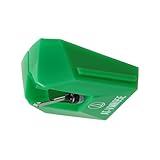
This is the stylus to buy if you already own a turntable with an AT-VM95 series cartridge — most commonly the AT-LP120X, AT-LP3, AT-LP5X, and the VM95-equipped versions of Audio-Technica’s DJ and hi-fi decks — and you want the single most cost-effective sound upgrade available anywhere in vinyl. Swapping the stock conical stylus for the AT-VMN95E elliptical transforms what the same cartridge body can extract from a groove.
Who it suits
Listeners with a decent pair of speakers or headphones who are hearing the cartridge’s limits rather than the record’s. If you have started noticing that cymbals smear, that vocal sibilance sounds coarse, or that the last two tracks on an LP side sound noticeably worse than the first two, an elliptical tip addresses exactly those symptoms. It is also the natural first upgrade for someone who bought a VM95-equipped deck and wants to know what it can really do before spending on a new cartridge.
Key specs
- Profile: elliptical — a narrower side radius than conical, giving a longer, more precise contact line in the groove
- Tip: bonded diamond
- Fits: all AT-VM95 series cartridge bodies (VM95C, VM95E, VM95EN and related)
- Tracking force: the VM95 elliptical’s specified range, typically around 1.8–2.2 g as documented for the family
- Mount: user-replaceable stylus assembly on the existing cartridge body — no cartridge re-alignment needed
Strengths
The elliptical profile is the real story. A conical tip presents a roughly circular contact patch; an elliptical presents a narrower, elongated one that sits lower and deeper in the groove and traces high-frequency modulations the conical simply cannot resolve. The practical result is better inner-groove tracking, cleaner cymbals and strings, tighter stereo imaging, and less of the gritty quality that conicals produce on complex passages.
The upgrade economics are excellent because the VM95 is a modular family. You keep the cartridge body, the headshell, and the alignment you already have, and change only the tip. That is a fraction of the cost of a new cartridge and takes about a minute with no tools — you grip the stylus assembly, pull it forward and down, and press the new one on until it seats. Nothing about the arm, the anti-skate setting, or the overhang changes.
Pros
- Substantial, immediately audible upgrade over a conical on the same cartridge
- Better inner-groove tracking and high-frequency detail
- Tool-free swap that leaves cartridge alignment untouched
- Modular VM95 family — the same body accepts conical, elliptical and finer profiles
- Bonded diamond tip is durable at the family’s moderate tracking forces
Cons
- Premium pricing relative to a bare conical replacement
- Exposes surface noise and pressing defects a conical would have masked
- More sensitive to tracking force and anti-skate setup — misadjustment shows up audibly
- Will not fit ATN3600-family turntables or ceramic all-in-one mounts
Compared with the nearest alternative
Its closest relative in this list is the AT-VMN95C conical for the same VM95 body. The C is the durability and forgiveness play: cheaper, more tolerant of worn records, and a sensible choice if you are cueing over a turntable at a party or practicing scratches. The E is the fidelity play. Because both drop onto the same cartridge, the smart long-term move is to own the E and keep the stock conical as a spare for rough records — you get the upgrade without giving up the forgiveness. Against the ATN3600LE, the honest framing is that they are different products for different decks: the LE upgrades an AT-LP60X, the VMN95E upgrades a VM95-equipped deck.
4. Gartopvoiz Diamond Stylus Replacement (2-Pack) – Best for Budget Diamond Replacement
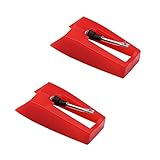
The Gartopvoiz two-pack is the middle option for ceramic-cartridge all-in-ones: fewer styli than the four-packs, but a diamond tip instead of ruby. If you would rather swap the needle once a year than four times, diamond is the specification that matters, and this is the budget-tier way to get it.
Who it suits
Owners of a generic LP or phonograph all-in-one whose stylus carrier matches the common ceramic pattern, and who want the longest possible service life from each tip. It also suits people who own two such decks, or who keep one in a holiday home or garage, since two styli covers two players.
Key specs
- Quantity: 2 styli per pack
- Tip material: diamond — harder than ruby, so slower to wear
- Profile: conical
- Compatibility: ceramic-cartridge turntables, LP and phonograph all-in-ones with the standard snap-in stylus carrier
- Mount: press-fit, no alignment required
Strengths
The diamond tip is the differentiator at this price. Diamond holds its shape far longer than ruby under the same tracking force, which means the stylus stays in the “good” part of its life for more playing hours and the sound degrades more slowly. On a deck tracking at 5–6 g, that matters — a worn tip at heavy force is the mechanism by which cheap turntables damage records.
Two units is also a sensible quantity for a single household. You get one installed and one spare, which is enough to cover the period between noticing degradation and ordering more. Installation is the same press-fit operation as every other ceramic stylus: no tools, no alignment, no risk of bending a cantilever with an awkward screwdriver.
Pros
- Diamond tip outlasts ruby at the same tracking force
- Two-pack gives one spare without over-buying
- Tool-free press-fit installation
- Slower sound degradation between replacements
- Budget tier pricing keeps a cheap deck economical to run
Cons
- Only two units — heavy users will reorder sooner than four-pack buyers
- Compatibility is generic rather than naming specific brands, so verify the carrier shape first
- Not for moving-magnet cartridges or AT-LP60X-family turntables
- Sound remains limited by the ceramic cartridge and built-in amplification
- Diamond or not, heavy tracking force still causes accelerated record wear
Compared with the nearest alternative
Against the Voltrish and Ywhomal four-packs, this is a quantity-versus-material trade. Four ruby styli or two diamond styli cost roughly the same at the budget tier, and the right answer depends on how you use the deck. Someone playing an hour a week will get more calendar time out of two diamonds; someone playing daily on a deck that will not be replaced anyway may prefer four rubies and simply swap more often. Against the banpa cartridge-plus-styli bundle, the difference is scope: that product replaces the cartridge too, which is the right move only if the cartridge itself has failed.
5. Audio-Technica ATN3600LE Elliptical – Best for a Genuine Sound Upgrade on an AT-LP60X

The ATN3600LE is the single best upgrade you can make to a stock AT-LP60X, AT-LP60XBT, Sound Burger, or AT-SB727. It fits the same mount as the original conical stylus, requires no alignment or tracking-force change, and replaces a rounded contact point with a narrow elliptical line that resolves detail the conical cannot. Same turntable, same cartridge, measurably more record.
Who it suits
Anyone who has outgrown their entry Audio-Technica but does not want to buy a new turntable. If you have upgraded your speakers or headphones and started noticing that the deck sounds vague — soft transients, smeared cymbals, congested inner grooves — this is the bottleneck you are hearing. It suits clean-record listeners best, because an elliptical tip reads surface noise and pressing flaws more faithfully too.
Key specs
- Profile: elliptical — narrower contact patch than conical
- Tip: bonded diamond
- Fits: AT-LP60X, AT-LP60XBT, Sound Burger, AT-SB727 — drop-in for the ATN3600 mount
- Tracking force: within the same range the turntable specifies for the ATN3600 family; no arm adjustment needed
- Mount: integrated stylus assembly, click-in, no tools
Strengths
It is the rare upgrade that carries no setup risk. Because the tracking force and anti-skate are set by the turntable and not adjustable on the LP60X family, you cannot misconfigure anything — you just install it. What you get in return is the elliptical profile’s longer, narrower contact line, which traces high-frequency groove modulations with far more accuracy and holds the inner grooves of a side much better than a conical.
Practically, listeners describe it as the deck opening up: better separation between instruments, more articulate bass, and a top end that stops sounding like a blanket is over the speakers. Because it is an Audio-Technica part built for these exact decks, the compliance and suspension match the arm mass, so you are not trading tracking stability for detail.
Pros
- Drop-in upgrade with no alignment, tracking-force, or anti-skate adjustment
- Clearly better high-frequency detail and inner-groove tracking than the stock conical
- Genuine Audio-Technica part matched to the deck’s arm and suspension
- Keeps the original ATN3600 mount, so reverting to a conical later is trivial
- Best value-per-change upgrade available for this turntable family
Cons
- Premium pricing for a stylus, even though it costs far less than a new turntable
- Reveals surface noise, static, and pressing defects the conical masked
- Requires clean records to show its advantage — invest in a brush and cleaning fluid
- Not compatible with AT-VM95 cartridges or ceramic all-in-one mounts
- Cannot fix the LP60X’s fixed tracking force, which limits ultimate refinement
Compared with the nearest alternative
The ATN3600LC is the direct alternative and the honest comparison is philosophical rather than technical: identical mount, identical ease of installation, different tip. The LC is the “keep it as designed, tolerate rough records” choice; the LE is the “extract more from good records” choice. If your collection is mostly thrift-store vinyl, the LC’s forgiveness may actually sound better on most of your records. If your collection is clean and your speakers are decent, the LE is the upgrade that makes the LP60X feel like a more expensive turntable. Against the ROVLET two-pack, that product gives you two conicals rather than one elliptical — a supply decision, not a sound decision.
6. Ywhomal 4-Pack Ruby Needle – Best for Named Compatibility With Budget All-in-Ones
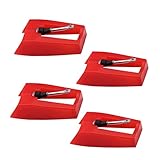
Where the Voltrish pack targets Crosley and Victrola, the Ywhomal four-pack casts a wider net, naming ION, Jensen, Crosley, Victrola, and Sylvania turntables. If your all-in-one wears one of those badges and you want a part the seller explicitly says will fit it, this is the most reassuring of the budget bulk packs.
Who it suits
Owners of an ION or Jensen deck that is harder to find parts for than the more common Crosley and Victrola models, and anyone who owns several budget turntables and wants one order to cover all of them. It is also the sensible pick for a school, community centre, or rental where several cheap decks are in circulation and needles go missing.
Key specs
- Quantity: 4 styli per pack
- Tip material: ruby
- Profile: conical
- Named compatibility: ION, Jensen, Crosley, Victrola, Sylvania turntables with the standard ceramic-cartridge stylus carrier
- Mount: press-fit, no tools or alignment
Strengths
The compatibility list is the selling point. Budget turntable stylus shopping is plagued by “will this fit?” anxiety, because the snap-in carriers look similar but are not always identical. A listing that names your brand removes most of that uncertainty. ION and Jensen owners in particular have fewer clearly labelled options than Crosley owners, so this pack fills a genuine gap.
Beyond that, it is the same value proposition as the other four-packs: enough spares that a dead stylus never becomes a reason to stop using the deck, and an installation process so simple that there is no realistic way to get it wrong. Push out, push in, play.
Pros
- Names ION, Jensen, Crosley, Victrola, and Sylvania — broader than most competitors
- Four styli per pack at budget tier pricing
- Zero-setup press-fit installation
- Good choice for households with multiple budget decks
- Conical tip suits the heavy tracking force these players use
Cons
- Ruby tip wears faster than diamond
- No compatibility with moving-magnet cartridges or ATN3600/VM95 families
- Cannot improve sound quality beyond what the ceramic cartridge allows
- Brand lists are indicative — visually check the carrier shape before ordering
- Record wear remains a concern on any deck tracking this heavily
Compared with the nearest alternative
The Voltrish pack is the closest competitor and the decision is nearly binary: if your deck is an ION, Jensen, or Sylvania, take the Ywhomal for the named compatibility. If it is a Crosley or Victrola, both are fine and you can choose on availability. If you want fewer swaps, the Gartopvoiz diamond two-pack is the material upgrade; if you want maximum spares, this four-pack wins. None of these options will make a ceramic-cartridge deck sound good — they simply keep it running.
7. banpa Record Player Cartridge With 4 Diamond Styli – Best for Replacing a Dead Cartridge
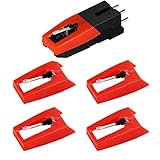
Most stylus purchases are a wear item. This one is a repair. The banpa bundle includes a complete ceramic cartridge plus four diamond styli, which is the right product if your all-in-one has gone silent, distorted, or weak on one channel — symptoms that point to the cartridge, not the needle. A new stylus will not fix a failed cartridge body.
Who it suits
Anyone troubleshooting a budget deck that has stopped producing proper sound after a stylus swap did not help. Also suitable as a pre-emptive replacement on a used deck of unknown history, where you cannot be sure the cartridge has not been damaged by a bent cantilever or a corroded internal contact.
Key specs
- Contents: 1 ceramic cartridge + 4 diamond styli
- Tip material: diamond
- Profile: conical
- Compatibility: ceramic-cartridge all-in-ones sold under Crosley, ION, and LP/phonograph style names
- Mount: cartridge seats in the existing tonearm wiring harness; styli press-fit into it
Strengths
Scope is the advantage. Buying a cartridge and four styli together costs about what the cartridge alone would cost separately, and it resets the entire front end of a budget deck in one order. That means the moving parts most likely to have failed — the cartridge body, its internal contacts, and the cantilever — are all new, and you still have four spare tips.
It also removes diagnosis guesswork. If a stylus swap has not restored sound, the cartridge is the next suspect, and this bundle addresses that without requiring you to source a cartridge and styli separately from two different listings. For a deck that is otherwise working, it is the cheapest route back to a functioning turntable short of replacing the whole thing.
Pros
- Replaces the cartridge as well as supplying four styli
- Diamond tips rather than ruby, so each stylus lasts longer
- Fixes faults a stylus change alone cannot, such as channel loss or distortion
- Bundled pricing is better than sourcing the parts separately
- Useful as a reset on a secondhand deck of unknown condition
Cons
- More involved installation than a stylus swap — the cartridge must be seated correctly in the arm wiring
- Still limited by the ceramic cartridge architecture; no real sound upgrade
- Mid-range pricing above the simple bulk stylus packs
- Overkill if only the stylus is worn
- Not compatible with moving-magnet turntables
Compared with the nearest alternative
Compare it with the Gartopvoiz two-pack. If your deck makes sound but sounds tired, the Gartopvoiz package is the correct, cheaper answer — you are replacing a wear item. If your deck is silent, distorted, or unbalanced in a way that persisted after a stylus change, the banpa bundle is the one that actually addresses the fault, because it replaces the cartridge too. Buying the cheaper stylus pack first and discovering the cartridge was the problem is the false economy this product exists to prevent.
8. Audio-Technica AT-VMN95C Conical – Best for Durable Everyday Playback on a VM95 Cartridge

The AT-VMN95C is the conical stylus for Audio-Technica’s VM95 cartridge family, and it is the sensible choice whenever durability and forgiveness matter more than detail. It fits the same bodies as the more expensive AT-VMN95E, so if you already own a VM95-equipped turntable, this is a direct swap that trades some resolution for robustness.
Who it suits
Three groups. First, DJs and anyone back-cueing or scratching, where an exposed fine-line tip is a liability. Second, listeners whose collections are largely secondhand and imperfect, where a conical’s larger contact patch rides above light groove damage instead of amplifying it. Third, shared systems — a family turntable, a party deck, a classroom — where the stylus may be handled carelessly and a replacement needs to be cheap and quick.
Key specs
- Profile: conical (spherical)
- Tip: bonded diamond
- Fits: all AT-VM95 series cartridge bodies
- Tracking force: within the VM95 family’s specified range; conicals in this class are typically run at the higher end of the family’s window for stability
- Mount: tool-free stylus assembly replacement on the existing cartridge
Strengths
Durability under abuse is the core strength. A conical tip has a larger, blunter contact area, so it is less fragile in handling and more tolerant of cueing errors, warped records, and heavy tracking. It also skips past the surface noise that an elliptical highlights, which can make a rough record more listenable even though it is technically less accurate.
Because it shares the VM95 body with the elliptical version, it is the natural second stylus to own rather than an alternative to the first. Keeping a conical mounted for rough records or practice and an elliptical for critical listening takes about a minute to switch and means you never ruin a good tip on a bad pressing.
Pros
- Conical tip is robust against handling and cueing errors
- Tolerates worn and scratched records better than elliptical
- Shares the VM95 body, so no cartridge change or re-alignment needed
- Mid-range pricing makes it a cheap spare to keep on hand
- Diamond tip is durable at the family’s tracking forces
Cons
- Noticeably less high-frequency detail than the AT-VMN95E
- Weaker inner-groove tracking on demanding pressings
- Cannot improve a recording’s shortcomings — it simply reveals less
- Not for ATN3600-family turntables or ceramic all-in-one mounts
- Buying it as your only stylus leaves performance on the table
Compared with the nearest alternative
Against the AT-VMN95E, this is a trade of resolution for ruggedness on an identical mount. The E is the better listening stylus; the C is the better beater stylus. Because both fit the same body, the ideal arrangement for a VM95 owner is both — C for practice and rough vinyl, E for everything that deserves it. Against the ATN3600LC, they serve entirely different decks: that one is for the LP60X family’s integrated mount, this one for the VM95 cartridge. Confusing the two is the most common stylus-buying error in this whole category.
9. ROVLET 2-Pack ATN3600L / ATN3600LC Conical Needle – Best for Two Spare Conicals at a Lower Entry Point

The ROVLET two-pack is the value route back to a working AT-LP60X-family deck. It supplies two diamond conical styli compatible with the ATN3600L and ATN3600LC applications, at mid-range pricing that undercuts buying two genuine single styli. If you want the stock character and a spare for later, this is the pragmatic order.
Who it suits
Owners of AT-LP60X, AT-LP60XBT, or similar ATN3600-family turntables who want to keep the original conical sound and want a spare on the shelf. Also a good choice for someone buying a used LP60X who wants to start fresh with a known-good stylus and have a backup, rather than discovering halfway through a listening session that the previous owner’s needle was shot.
Key specs
- Quantity: 2 styli per pack
- Tip material: diamond
- Profile: conical
- Compatibility: ATN3600L / ATN3600LC applications — the AT-LP60X family mount
- Mount: click-in stylus assembly, no alignment or tools
Strengths
Two things. First, price per stylus: two compatible conicals at mid-range pricing is a lower entry point than premium single-stylus options, and it means the spare is already paid for. Second, the diamond tip, which outlasts ruby alternatives and keeps the stylus in its best-sounding window for longer.
Installation is identical to the OEM part — click out the old assembly, click in the new one — and no tracking-force or anti-skate adjustment is required or even possible on these decks. You get the conical profile’s forgiveness with a diamond’s service life, twice over.
Pros
- Two diamond conicals per pack — a spare is included
- Lower entry price than premium single-stylus options
- Tool-free installation on the ATN3600 family mount
- Diamond tip lasts longer than ruby equivalents
- Conical profile tolerates imperfect records
Cons
- Aftermarket rather than OEM manufacture, so unit-to-unit consistency is less certain
- Conical only — no elliptical upgrade option in this listing
- Not compatible with AT-VM95 cartridges or ceramic all-in-one mounts
- Cannot match the detail of the ATN3600LE
- Two conicals is redundant if your real goal was better sound
Compared with the nearest alternative
Against the ATN3600LC, the trade is origin versus quantity. The genuine Audio-Technica part is the known quantity — exact voicing, exact compliance, one stylus. The ROVLET pack gives you two for less, which is the better deal if you simply need a functional needle and a backup. But if your actual goal is better sound, neither conical is the answer; the ATN3600LE is, and buying two conicals instead of one elliptical would be spending money in the wrong direction.
How to Choose
Stylus buying goes wrong in one of two ways: the part does not physically fit, or it fits but the tip profile is wrong for how the deck is used. Work through the following in order and you will not make either mistake.
Step 1: Identify what you actually have
Before anything else, determine whether your turntable uses a moving-magnet cartridge or a ceramic cartridge. The distinction drives everything downstream and the two categories are not interchangeable.
- Moving-magnet: the cartridge is a removable, replaceable block mounted in a headshell, usually with visible colour-coded wires. Common families include Audio-Technica’s AT-VM95 series and the integrated cartridges in the AT-LP60X family. These use precision stylus assemblies with a defined tracking-force window.
- Ceramic: found in nearly all budget all-in-one suitcase and briefcase players. The cartridge is a small plastic block, often not designed to be replaced, and the stylus is a snap-in carrier with a bonded tip. Tracking force is fixed and heavy — typically in the 5–6 g region.
If your deck has a counterweight on the back of the tonearm and an adjustable anti-skate dial, it is almost certainly moving-magnet. If it has none of those and the arm is a simple moulded plastic tube, it is ceramic.
Step 2: Match the stylus family, not the brand
Brand is not compatibility. An Audio-Technica stylus for an AT-LP60X will not fit a turntable with an AT-VM95 cartridge, even though both are Audio-Technica. The families you need to know:
| Stylus family | Fits | Typical mount | Tracking force class |
|---|---|---|---|
| ATN3600 series (LC / LE / L-compatible) | AT-LP60X, AT-LP60XBT, Sound Burger, AT-SB727 | Integrated click-in stylus assembly | Fixed by turntable, roughly 2–3 g region |
| AT-VM95 series (VMN95C / VMN95E) | All AT-VM95 cartridge bodies (LP120X, LP3, LP5X and VM95-equipped decks) | Push-on stylus assembly on the cartridge | Adjustable, roughly 1.8–2.2 g region for the elliptical |
| Ceramic snap-in (generic) | Crosley, Victrola, ION, Jensen, Sylvania and similar all-in-ones | Press-fit plastic carrier | Fixed, roughly 5–6 g |
If you cannot identify your family, look at the existing stylus. A push-on assembly with a visible metal cantilever and a coloured plastic grip is moving-magnet. A small plastic carrier that you push straight out of the cartridge is ceramic.
Step 3: Choose the tip profile deliberately
This is the decision that determines what you hear. Three profiles matter at consumer prices.
- Conical (spherical): a rounded tip with a relatively large contact radius. It sits higher in the groove, so it rides over light damage and surface noise instead of tracing it. High-frequency detail is limited, and the last tracks on a side can sound congested. Best for rough records, DJ use, shared decks, and anyone who values robustness over refinement.
- Elliptical: a narrower, elongated contact patch that sits lower and deeper in the groove. It traces high-frequency modulations the conical misses, giving better detail, cleaner cymbals and strings, and noticeably better inner-groove tracking. It also reveals surface noise and pressing defects more honestly. Best for clean records and decent speakers.
- Finer line profiles (line contact, microline, Shibata-type): beyond the scope of this roundup and generally fitted to cartridges well above the decks discussed here. They extract the most detail and last longest, but they demand careful alignment and clean records.
A useful rule: a tip upgrade is worth it only if the rest of your system can reveal the difference. On an all-in-one with built-in three-inch speakers, an elliptical will not help — the speakers are the bottleneck. On an AT-LP60X connected to a decent pair of powered speakers or headphones, the elliptical is the single best value upgrade available.
Step 4: Understand tracking force and record wear
Record wear is the most misunderstood topic in vinyl. It is caused by three things, in order of importance: a worn or damaged tip, excessive tracking force, and a misaligned cartridge. Tip shape is a distant fourth.
What matters in practice:
- Worn tips damage records permanently. A stylus with a chipped or flattened tip concentrates force on a tiny area and can carve audible damage in a single play. This is why replacement schedules exist.
- Replacement schedule: a diamond stylus used for typical home listening is generally good for roughly 500–1,000 hours before noticeable degradation. Ruby tips wear several times faster. If you play two hours a day, that is a diamond stylus lasting somewhere between eight months and a year and a half.
- Heavy force accelerates everything. A deck tracking at 5–6 g puts roughly two to three times the force on the groove as a moving-magnet deck at 2 g. Conical tips on ceramic cartridges wear both the stylus and the record faster, which is the fundamental reason budget all-in-ones are best used on records you are not precious about.
- Tracking force is set by the turntable. On the AT-LP60X family it is not adjustable. On a deck with a counterweight, it is, and you should set it within the range the stylus or cartridge specifies rather than following a habit. Too light is worse than slightly heavy — a mistracking stylus skips, distorts on loud passages, and can gouge the groove.
Step 5: Decide how many to buy
Bulk packs exist because stylus replacement is recurring, not one-off. The calculus is straightforward:
- If your deck is a $60–$150 all-in-one: buy a four-pack. Ruby tips wear fast at heavy tracking force and the longer you go between orders the longer the deck sits unused.
- If your deck is an AT-LP60X family turntable: two conicals or one elliptical. Buying two conicals is the “keep it running” answer; buying the elliptical is the “make it better” answer. Buy both if you play rough records alongside good ones.
- If your deck has a VM95 cartridge: own two styli, one conical and one elliptical. The conical takes the abuse; the elliptical takes the good records. Switching takes under a minute and costs nothing.
Step 6: Installation and what not to touch
Replacing a stylus is one of the few jobs on a turntable with no measurement involved.
- Power off and lock the tonearm. Nothing good happens with a live platter and a loose arm.
- Moving-magnet push-on styli: grip the stylus assembly’s plastic body, pull gently forward and downward until it releases, then press the new one on until it seats fully. Do not pull on the cantilever — the thin tube holding the tip — under any circumstances.
- Ceramic snap-in styli: use a fingernail to lever the carrier out from its front edge. It should come away with light pressure. If it resists, you are pulling in the wrong direction.
- Never touch the tip or cantilever. Skin oil and lateral force are both damaging. Handle the plastic only.
- After fitting, check tracking force if your arm allows it. If not, nothing needs adjusting. Cue gently the first time and confirm the stylus sits centred in the groove and tracks a loud passage without skipping.
Step 7: Make the stylus last
Two habits roughly double stylus life. First, clean records — a carbon fibre brush before every play removes the grit that acts as an abrasive against the tip. Second, clean the stylus itself with a dry stylus brush, brushing from back to front, before and after each session. Never use alcohol or wet cleaners on a bonded stylus, and never brush sideways across the cantilever.
Your speakers matter as much as your cartridge. There is no point upgrading from conical to elliptical if you are listening through the built-in speakers of an all-in-one, or through computer speakers sitting on the same shelf as the turntable. On any deck where the stylus is user-replaceable, moving the turntable off the same surface as the speakers and adding a decent pair of powered monitors will change what you hear more than any needle.
A decision matrix, in one place
| Your situation | Buy this type | Why |
|---|---|---|
| AT-LP60X family, want stock sound restored | ATN3600-family conical (ATN3600LC or ROVLET 2-pack) | Exact fit, no setup, forgiving of rough records |
| AT-LP60X family, want better detail | ATN3600LE elliptical | Drop-in fit with a genuinely better tip profile |
| AT-VM95 cartridge, critical listening | AT-VMN95E elliptical | Best sound per dollar on an existing cartridge body |
| AT-VM95 cartridge, DJ or rough records | AT-VMN95C conical | Robust tip, cheap spare, same body |
| Crosley / Victrola all-in-one | Voltrish 4-pack or Gartopvoiz 2-pack | Bulk ruby or diamond, press-fit, lowest running cost |
| ION / Jensen / Sylvania all-in-one | Ywhomal 4-pack | Named compatibility with less common brands |
| All-in-one is silent or distorted after a stylus change | banpa cartridge + 4 stylus bundle | Fault is likely the cartridge, not the needle |
Frequently Asked Questions
Can I put an elliptical stylus on a turntable that came with a conical?
Yes, if the stylus is offered as a direct replacement for your turntable’s stylus family. The ATN3600LE is an elliptical that fits the same mount as the ATN3600LC conical on the AT-LP60X, AT-LP60XBT, and Sound Burger, so no adjustment is needed — the deck sets its own tracking force and anti-skate. You cannot, however, put a VM95 elliptical on an AT-LP60X, because those are different mounts entirely. Compatibility is determined by the stylus family, not by the brand on the turntable.
Will a diamond stylus really last longer than a ruby one?
Yes, and the difference is substantial. Ruby is a synthetic corundum crystal, noticeably softer than diamond, so it wears out of shape faster under the same tracking force. On a budget all-in-one that already tracks at 5–6 g, the gap is even more pronounced because wear accelerates with force. In practical terms, expect several times the playing hours from a diamond tip. Ruby makes sense when the priority is the lowest possible cost per pack rather than the fewest replacements.
How do I know when it is time to replace the stylus?
The reliable signals are audible distortion that was not there before, sibilance on vocals that sounds harsh or smeared, and a loss of high frequencies on records you know well. On a deck where tracking force is fixed, a noticeably weaker or thinner sound is also a common symptom. By the time damage is audible, the tip has usually been out of specification for a while — which means the records you played in the interim have taken some wear. Replacing on a schedule rather than a symptom is safer: roughly 500–1,000 hours for a diamond under typical home use.
Will a cheaper replacement stylus damage my records?
Not if it is the correct family for your turntable and the tip is intact. The damage mechanism is a worn or chipped tip concentrating force on a small area, plus excessive tracking force — both of which apply to genuine and aftermarket parts alike. Where aftermarket parts carry more risk is in unit-to-unit consistency and in how reliably they hold their profile over time. If you are playing records you care about, a diamond tip from a known brand is the more conservative choice than a bulk ruby pack.
Why does my budget all-in-one sound bad even with a new needle?
Because the needle is rarely the limiting factor on those decks. The cartridge is ceramic and heavily tracking, the tonearm is moulded plastic with limited rigidity, the built-in speakers are small, and the turntable and speakers usually share a single plastic enclosure that transmits vibration straight back into the stylus. A new stylus will restore function, not fidelity. If a stylus change did not improve things at all, suspect the cartridge — a cartridge-plus-stylus bundle is the next step, not another stylus.
Do I need to realign the cartridge when I replace a stylus?
On push-on and click-in stylus assemblies — which covers every product in this roundup — no. The cartridge stays in place, so the overhang, alignment, and azimuth you already have are untouched. You are only changing the tip on the end of the cantilever. Cartridge alignment becomes relevant when you replace the entire cartridge body itself, which is the situation with the banpa cartridge-plus-stylus bundle rather than with a plain stylus purchase.
Is tracking force different for conical and elliptical styli?
It can be, within the same cartridge family. Elliptical tips present a narrower contact patch, so they typically want to run at the lower-middle part of the family’s specified window, while conicals can sit slightly higher for the same stability. On turntables with an adjustable counterweight, set the force within the range specified for the specific stylus and cartridge combination. On fixed-force decks like the AT-LP60X family, there is nothing to adjust — the deck’s own specification applies and the stylus is built to match it.
Can I keep two different styli and swap between them?
Yes, and it is one of the best habits in vinyl. A push-on stylus assembly takes seconds to change, involves no tools, and does not disturb alignment. The standard pattern is one conical for worn, secondhand, or practice records and one elliptical for clean pressings you care about. That way a rough record never wears out your best tip, and you still get full detail when the record deserves it. Just handle each stylus by its plastic body, never by the cantilever.
The Short Version
If you own an AT-LP60X, AT-LP60XBT, or Sound Burger and want the most improvement per dollar, buy the ATN3600LE elliptical — same mount, no setup, genuinely better detail than the stock conical. If you own a turntable with an AT-VM95 cartridge, the AT-VMN95E elliptical is the equivalent upgrade, and pairing it with the AT-VMN95C conical as a rough-record spare is the smartest two-stylus setup in this category.
If your priority is simply keeping a deck running, match the part to the family: the ATN3600LC or ROVLET 2-pack for an AT-LP60X family turntable, the Voltrish or Gartopvoiz packs for a Crosley or Victrola all-in-one, and the Ywhomal 4-pack if your deck is an ION, Jensen, or Sylvania. If your all-in-one has gone silent or distorted and a stylus change did not fix it, skip straight to the banpa cartridge bundle — the fault is upstream of the needle.


