The best speakers for music listening are the ones that disappear. When a pair of speakers is doing its job, you stop thinking about drivers and wattage and start listening to the music itself: the voice in the centre, the bass line underneath, the small details in a recording that a lesser speaker smears together. Getting there does not require a separate amplifier or a rack of components. Every speaker in this guide is a powered pair, which means the amplifier is built in. Connect a source, press play, and the music starts. That simplicity is the point.
Music listening places different demands on a speaker than gaming or films. A music speaker needs balance. Vocals should sound natural, not nasal or muffled. Bass should be present and controlled, not boomy. High frequencies should be clear without turning harsh at higher volumes. The speakers below meet that bar in different ways and at different sizes, from a compact desktop pair that fits beside a monitor to a larger bookshelf pair that can fill a living room.
Room and placement matter as much as the speaker itself. A pair of bookshelf speakers placed against a wall will sound bassier than the same pair pulled out into the room. A desktop pair placed directly on a hard desk can pick up vibrations that muddy the sound, while a pair on small stands or isolation pads sounds cleaner. It only requires a little thought about where the speakers sit, how far apart they are, and whether they point toward your ears.
Connectivity is the other practical question. Most music today comes from a phone, a laptop, or a streaming device, so Bluetooth is useful even for listeners who mainly use a wired connection. A turntable needs a phono input or a separate phono stage, while a television or a computer benefits from an optical input. The picks below cover a spread of inputs, from Bluetooth and auxiliary connections to optical, USB, and phono, so you can match the speaker to the sources you actually own.
Top 3 picks at a glance


How to Choose
1. Powered or passive
All five picks in this guide are powered, which means each pair includes its own amplifier and connects directly to a source. That is the right choice for most music listeners, because it removes the need to choose and match a separate amplifier. Passive speakers need an external amplifier or receiver, which adds cost, cables, and complexity. Choose powered speakers unless you already own an amplifier you love.
2. Woofer size and bass
Woofer size shapes how much bass a speaker can produce on its own. A 2.75-inch woofer in a compact desktop speaker gives clean midrange and light bass, and works well in a small room or at a desk. A 4-inch woofer adds warmth and body, and suits a bedroom or a small living room. A 5.25-inch woofer moves more air, produces deeper bass, and fills a larger room more easily. Bigger is not automatically better: a large woofer in a tiny room can sound boomy, while a small woofer with a subwoofer output can grow later.
3. Room size and listening distance
Near-field listening at a desk is a different job from filling a living room. At a desk, you sit a metre or so from the speakers, so a compact pair with modest power is plenty, and a wide soundstage matters more than sheer volume. In a living room, you sit several metres away, so a larger pair with more power and a bigger woofer holds its clarity at distance. Think about where you will actually sit, and choose a speaker sized for that distance.
4. Inputs for your sources
List the sources you use every week: phone, laptop, turntable, television, or a dedicated streamer. Then check the inputs. Bluetooth covers a phone or laptop wirelessly. An auxiliary input covers almost anything with a headphone socket. Optical covers a television or a computer sound card. USB covers a computer directly and often bypasses a noisy onboard sound output. A phono input covers a turntable without a separate stage. The Klipsch pick below is the most versatile here, with phono, optical, USB, and Bluetooth.
5. Tone controls and subwoofer output
Tone controls for bass and treble let you adjust the sound to your room and your taste, which matters because no two rooms sound alike. Several picks below include knobs on the side or rear for exactly that. A subwoofer output is equally useful: it lets you add a powered subwoofer later if you want deeper bass, without replacing the speakers. If you think you might add a subwoofer one day, favour a pick with a dedicated subwoofer output.
6. Placement and stands
Bookshelf speakers sound best when the tweeter is roughly at ear level and the speakers are angled slightly toward the listener. On a desk, that usually means small stands or risers. On a shelf, it means pulling the speakers forward so the front edge clears the shelf, and leaving a little space behind them for the bass port to breathe.
7. Build, finish, and long-term use
Speakers stay in a room for years, so build and finish matter. Wooden enclosures tend to sound warmer and look better in a living room than plastic cabinets, and all five picks below use wood or wood-effect enclosures. A remote control is a small thing that becomes important quickly, because it lets you adjust volume without reaching for the speaker.
Top Picks
Edifier R1280DBs Active Bluetooth Bookshelf Speakers
Edifier R1280DBs Active Bluetooth Bookshelf Speakers
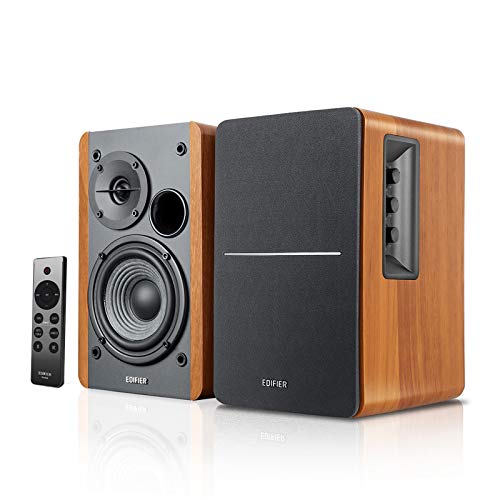
The Edifier R1280DBs is the most balanced starting point in this guide, and the pair most music listeners should consider first. It is a powered 2.0 bookshelf pair with a 4-inch woofer and a 13mm silk dome tweeter in each cabinet, driven by a 42W RMS amplifier. The sound is warm and easy to listen to for long sessions, with clear vocals, a smooth top end, and enough bass for most music without a subwoofer. The wooden enclosure, in a wood grain finish, looks at home on a shelf or a desk, and the front-facing bass port means the speakers can sit closer to a wall than rear-ported rivals.
Connectivity is generous for the size. Bluetooth handles a phone or laptop wirelessly, optical and coaxial digital inputs cover a television or a computer, dual RCA inputs cover a second wired source, and a subwoofer output lets you add a powered subwoofer later. Bass, treble, and volume controls sit on the side of the active speaker, and a wireless remote covers volume, mute, and input switching from across the room.
Who it is for: music listeners who want one versatile pair for a desk or a small room, with Bluetooth, digital inputs, and a subwoofer output for future expansion.
Caveats: the 4-inch woofer cannot produce the deepest bass on its own, so bass-heavy electronic music benefits from a subwoofer. The side-mounted controls are easy to reach on a desk but less convenient when the speakers sit on a high shelf.
Klipsch R-51PM Powered Bluetooth Speakers
Klipsch R-51PM Powered Bluetooth Speakers
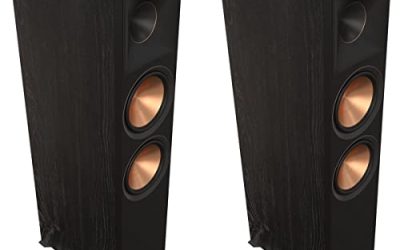
The Klipsch R-51PM is the most powerful and most versatile pair in this guide. It is a powered bookshelf pair with a 5.25-inch copper-spun woofer and a 1-inch titanium tweeter behind Klipsch’s Tractrix horn in each cabinet, driven by a 120W system amplifier. The horn-loaded tweeter gives the R-51PM a lively, detailed top end and a wide soundstage, while the larger woofer produces deeper, more confident bass than the smaller picks here.
Inputs are the strongest here as well. Bluetooth covers wireless streaming, a phono input with a built-in preamplifier covers a turntable directly, optical covers a television, USB digital covers a computer, and a 3.5mm auxiliary input covers anything else. That range means the R-51PM can serve as the only audio system in a room. The cabinets are larger than the Edifier picks, so they need a proper shelf or stands.
Who it is for: listeners who want a single pair to anchor a living room, with a turntable, a television, and wireless streaming all connected.
Caveats: the horn-loaded tweeter sounds bright to some ears, especially in a hard, reflective room, so placement and tone adjustment matter. The pair is larger and heavier than the compact picks, and needs a sturdy shelf or stands. There is no dedicated subwoofer output listed for this model.
JBL 305P MkII Powered Studio Monitor Pair
JBL 305P MkII Powered Studio Monitor Pair
The JBL 305P MkII pair brings a studio monitor’s accuracy to music listening, and it is the pick for listeners who want to hear a recording as it was made. This listing is for a matched pair of two monitors, each with a 5-inch woofer and a 1-inch tweeter behind JBL’s Image Control Waveguide, driven by its own built-in amplifier. The waveguide widens the sweet spot, so the stereo image stays stable even when you move slightly off centre. The sound is neutral and detailed, with tight bass and a clear midrange that suits vocals, acoustic instruments, and well-produced recordings of every kind.
Each monitor is sold as a single powered cabinet, so the pair listing covers a complete stereo set. Inputs are balanced XLR and unbalanced TRS, which are studio connections rather than the RCA and Bluetooth found on the other picks. That means the 305P MkII suits a listener with a suitable source, such as an audio interface, a mixer, or a DAC with balanced outputs. The rear panel includes boundary compensation and high-frequency trim controls, which let you adjust the sound for placement near a wall or on a desk.
Who it is for: listeners who value accuracy and detail above warmth, and who already have, or are willing to add, a suitable source with balanced or line-level outputs.
Caveats: there is no Bluetooth, no remote control, and no phono input, so this is not a plug-and-play living room pair. The studio inputs need the right cables and a suitable source. The 5-inch woofer produces clean bass but not the deepest low end. Confirm the pair listing before ordering, because the same monitor is also sold singly under a separate identifier.
Audioengine A2+ Wireless Desktop Speakers

Audioengine A2+ Wireless Desktop Speakers
The Audioengine A2+ Wireless is the compact pick in this guide, built for a desk where space is limited and the listener sits close. Each cabinet holds a 2.75-inch aramid fibre woofer and a 0.75-inch silk dome tweeter, driven by a 60W amplifier with a built-in 24-bit DAC. The sound is clean and articulate, with a surprising amount of presence for a speaker this small. Vocals sit forward and clear, and acoustic instruments sound natural. This is a near-field speaker, designed to be listened to from a short distance, and at a desk it excels.
This is the wireless version, in black, with Bluetooth aptX alongside a USB digital input, a 3.5mm auxiliary input, and RCA inputs. The built-in DAC means a computer connected over USB bypasses the computer’s own sound output, which often improves clarity. A subwoofer output is included, so the A2+ can grow into a fuller system later. The cabinets are small enough to sit beside a monitor without dominating the desk.
Who it is for: desk listeners who want clear, refined sound in a compact pair, with Bluetooth and USB for a computer and a phone.
Caveats: the small woofer cannot produce deep bass, so this is not the pick for a large room or for bass-heavy music without a subwoofer. Colour and wired variants use different identifiers, so confirm the black wireless version when ordering.
Edifier R1700BTs Active Bluetooth Bookshelf Speakers
Edifier R1700BTs Active Bluetooth Bookshelf Speakers
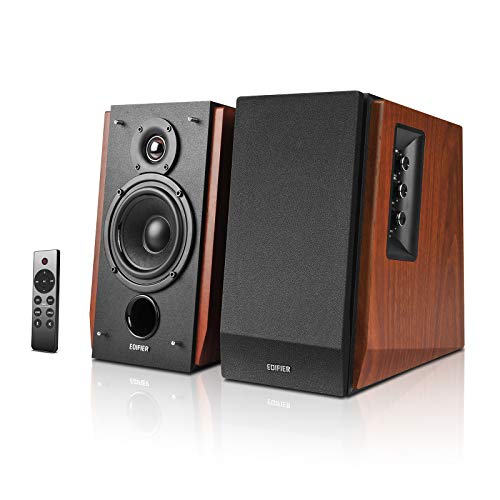
The Edifier R1700BTs is the step up from the R1280DBs for listeners who want a larger, more powerful bookshelf pair without moving to the Klipsch’s size and liveliness. It is a powered 2.0 pair with a 4-inch woofer and a 19mm silk dome tweeter in each cabinet, driven by a 66W RMS amplifier. The extra power gives the R1700BTs more headroom at higher volumes and a fuller sound in a medium-sized room. The wooden enclosure looks at home in a living room, and the front-facing bass port allows placement closer to a wall.
Connectivity covers Bluetooth 5.0, dual RCA inputs, and a subwoofer output, with bass, treble, and volume controls on the side of the active speaker and a wireless remote for everyday use. The sound is warm and balanced, with a smooth midrange that suits vocals and a controlled bass that works for most music without a subwoofer. There is no optical or coaxial digital input, so a television or computer connects over analogue RCA or Bluetooth.
Who it is for: listeners who want a larger, more powerful Edifier pair for a bedroom or a living room, with warm sound, a remote, and a subwoofer output for later expansion.
Caveats: no optical or coaxial digital input, so a television needs an analogue or Bluetooth connection. The cabinets are larger than the R1280DBs, so measure your shelf before ordering.
Comparison Table
| Speaker | Woofer | Power | Inputs | Subwoofer Output | Remote | Best For |
|---|---|---|---|---|---|---|
| Edifier R1280DBs | 4-inch | 42W RMS | Bluetooth, optical, coaxial, dual RCA | Yes | Yes | Versatile desk and small room |
| Klipsch R-51PM | 5.25-inch | 120W system | Bluetooth, phono, optical, USB, 3.5mm | Not listed | Not listed | Living room, turntable, TV |
| JBL 305P MkII pair | 5-inch | Built-in per cabinet | XLR, TRS balanced | Not listed | No | Accurate near-field listening |
| Audioengine A2+ Wireless | 2.75-inch | 60W | Bluetooth, USB, 3.5mm, RCA | Yes | Not listed | Compact desktop |
| Edifier R1700BTs | 4-inch | 66W RMS | Bluetooth 5.0, dual RCA | Yes | Yes | Medium room, warm sound |
Which One Is Right for You?
If you want one pair that does almost everything, start with the Edifier R1280DBs. If your listening happens in a living room, with a turntable and a television sharing the same speakers, the Klipsch R-51PM is the stronger choice, with more power, a larger woofer, and the widest set of inputs in this guide. If accuracy matters most and you have a suitable source, the JBL 305P MkII pair rewards careful listening with a neutral, detailed presentation. For a desk where space is tight, the Audioengine A2+ Wireless is the refined compact option. And if you like the Edifier sound but want more presence in a medium room, the R1700BTs gives you extra power and a fuller cabinet.
Whichever pair you choose, spend a few minutes on placement. Pull the speakers away from the wall a little, angle them toward your listening position, and raise them so the tweeters sit near ear level. Then listen to a recording you know well, and adjust the bass and treble controls until it sounds right in your room.
Frequently Asked Questions
Do I need an amplifier for these speakers?
No. All five pairs in this guide are powered, which means the amplifier is built into the active speaker. You connect a source directly, such as a phone over Bluetooth, a computer over USB or auxiliary, or a turntable over a phono input where one is provided.
Can I connect a turntable to these speakers?
It depends on the model. The Klipsch R-51PM includes a phono input with a built-in preamplifier, so a turntable connects directly. The Edifier and Audioengine picks use line-level RCA or auxiliary inputs, so a turntable needs its own built-in preamplifier or a separate phono stage. The JBL 305P MkII needs a suitable line-level source, such as an audio interface or a preamplifier, because it has no phono input.
Do I need a subwoofer for music listening?
Most listeners do not, at least to start with. The bookshelf picks here produce enough bass for most music on their own, and a subwoofer mainly adds the deepest low frequencies for electronic music, hip-hop, and films. Three picks in this guide include a subwoofer output, so you can add a powered subwoofer later without replacing the speakers.
How far apart should I place bookshelf speakers?
A good starting point is to place the speakers as far apart as you sit from them, forming a triangle with your listening position, and to angle them slightly inward so they point toward your ears. Keep the tweeters near ear level, and pull the speakers forward so their front edges clear the shelf. Small adjustments to angle and distance often make a noticeable difference.
Disclosure: As an Amazon Associate, we may earn from qualifying purchases.
Related guides
More from Amazon
Programs that pair well with the guide above. Offers and eligibility are set by Amazon and may change.
A free business account with business pricing and bulk-buying tools for work, shop or home office.
Create a business accountFree shipping on eligible items, Prime Video and more. Eligible new members can start with a free trial.
Start a Prime free trialAudiobooks and podcasts to listen to on the go. Eligible new members can start with a free trial.
Try Audible freeAd-free music streaming. Eligible new subscribers can start with a free trial.
Try Music Unlimited freeAs an Amazon Associate we earn from qualifying purchases.