For a cool, quiet gaming or small-form-factor PC, the Ryzen 7 9700X is the 65 W chip reviewers most often name for performance, the Ryzen 5 8500G is the pick when you want integrated graphics and no separate card, and Intel’s 35 W T-series parts such as the Core i5-14500T suit tiny cases if you accept their short-burst power behaviour.
As an Amazon Associate we earn from qualifying purchases at no extra cost to you.



Our Top Picks
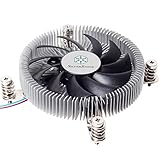
- Silverstone Technology SST-NT07-115X-USA LGA1150/1151/1155/1156/1200 CPU Cooler Low ProfileCheck on Amazon
Top 3 picks at a glance
Low TDP Options Compared
| CPU | Rated power | Best for | Key stated specs | Limit |
|---|---|---|---|---|
| Ryzen 7 9700X | 65 W TDP | Best performance at low rating | 8 Zen 5 cores, 16 threads, 3.8 to 5.5 GHz, AM5, no cooler included | Real draw above 65 W under load |
| Ryzen 5 9600X | 65 W TDP | Cheaper low-rating AM5 | 6 cores, 12 threads, 3.9 to 5.4 GHz, 32 MB L3 | Fewer cores |
| Ryzen 5 7600X3D | 65 W TDP | Gaming at low power | 6 cores, 12 threads, 4.1 to 4.7 GHz, 96 MB L3 | Limited stock; weaker productivity |
| Ryzen 5 8500G | 65 W (45 to 65 W configurable) | No discrete GPU | 2 Zen 4 plus 4 Zen 4c cores, up to 5.0 GHz, Radeon 740M, Wraith Stealth cooler | Modest graphics |
| Ryzen 7 5700X | 65 W TDP | Budget AM4 | 8 Zen 3 cores, AM4 | Older platform |
| Core i5-14500T | 35 W base (PL1), 92 W PL2 | Tiny and quiet builds | 14 cores (6 P, 8 E), 20 threads, up to 4.8 GHz, 24 MB L3, LGA 1700 | Turbo draws far more than 35 W |
| Core i5-13500T | 35 W base | Older small-form-factor option | Turbo reported up to 92 W | Previous generation |
What TDP Actually Tells You
TDP stands for thermal design power. It is a cooling guideline from the maker, not the exact power a chip draws in games or heavy work. Reviewers point out the gap clearly. In one test, both 65 W Ryzen chips averaged under 90 W, with the 9700X drawing 89 W. CPU-Monkey lists the 9700X package power limit at 88 W, with an optional 105 W mode that AMD added later through the BIOS. Intel’s T-series is the starkest example: the i5-13500T has a 35 W base rating but can turbo up to 92 W, according to a comparison site, and the i5-14500T is listed with the same 35 W base and a 92 W maximum.
So a low TDP helps most in two situations: choosing a smaller cooler, and designing a case with limited airflow. It does not guarantee a low electricity bill under load, though idle and light-use power draw is generally low on these parts.
Ryzen 7 9700X
Reviewers consistently name the 9700X as the top low-TDP performer. It has eight Zen 5 cores with 16 threads, runs from 3.8 to 5.5 GHz, uses the AM5 socket, is built on TSMC 4 nm and does not include a cooler in the box. Cache is quoted inconsistently across retailers: B&H lists 8 MB of L2 and 32 MB of L3, while some retailers show 40 MB combined. One roundup calls it the best-performing CPU with a 65 W rating. A small-form-factor builder can pair it with a low-profile cooler, though sustained loads will push it close to its limit.
Choose it if
- You want eight cores in a compact or quiet case.
- You are buying into AM5 and DDR5.
- You have a discrete graphics card (the integrated graphics are basic).
Ryzen 5 9600X and Ryzen 5 7600X3D
Both are 65 W, six-core, twelve-thread chips. The 9600X is a Zen 5 part running 3.9 to 5.4 GHz with 32 MB of L3, while the 7600X3D is a Zen 4 chip at 4.1 to 4.7 GHz with 96 MB of L3, DDR5-5200 support and PCIe 5.0. Late-2026 reviews favour the 7600X3D for pure gaming value, while the 9600X is the quicker general-purpose option. If cooling headroom is the priority, both fit comfortably with a small tower cooler.
Ryzen 5 8500G
The 8500G is a Phoenix part with two Zen 4 and four Zen 4c cores, six cores and twelve threads in all. AMD lists a configurable TDP of 45 to 65 W, with boost up to 5.0 GHz, 6 MB of L2 and 16 MB of L3 cache and a default 65 W rating. Graphics are a Radeon 740M based on RDNA 3 with four compute units at up to 2.8 GHz. It is listed with PCIe 4.0, DDR5 support and a Wraith Stealth cooler in the box. One review says it handles 1080p gaming at 65 W. It makes sense for a compact living-room PC, a light-gaming box or a build that later adds a graphics card.
Ryzen 7 5700X for AM4
One guide picks the Ryzen 7 5700X as its overall low-power winner because it offers eight Zen 3 cores at 65 W on the cheaper AM4 platform. It is the choice when you have an AM4 board and DDR4 memory. Note that the 5700X3D, a different chip, carries a 105 W default TDP according to AMD, so do not confuse them when planning cooling.
Intel T-Series: Core i5-14500T and 13500T
The i5-14500T launched in January 2024 with six performance cores and eight efficiency cores, twenty threads, P-core speeds from 1.7 GHz up to 4.8 GHz, E-cores from 1.2 to 3.4 GHz, a 35 W base power, a 92 W PL2, 24 MB of L3 cache and UHD Graphics 770. It uses the LGA 1700 socket and supports DDR5-4800 or DDR4-3200. The T-series is mostly sold to system builders, so retail availability varies. The older i5-13500T shows the same behaviour: a 35 W base with turbo up to 92 W. Independent power-draw benchmarks for the 14500T were thin in the sources reviewed, so treat any battery of numbers with caution.
Fit and Compatibility
- Sockets: AM5 chips need AM5 boards and DDR5; the 5700X uses AM4 and DDR4; Intel’s 14500T uses LGA 1700 and can use DDR4 or DDR5 depending on the board.
- Coolers: The 9700X ships without a cooler, while the 8500G includes a Wraith Stealth. Low-profile coolers fit small cases but may throttle under sustained load.
- Motherboard power: Smaller boards can handle 65 W chips easily. A 105 W mode needs a more capable board.
- PSU size: SFX power supplies are common in small builds. A 450 to 550 W unit covers most 65 W CPU and mid-range GPU combinations, but follow the graphics card maker’s recommendation.
- Case airflow: Low TDP does not replace good airflow. A single intake and exhaust fan make a small case much cooler.
Pick X If You Need…
| If you need… | Pick |
|---|---|
| The fastest 65 W chip | Ryzen 7 9700X |
| Gaming at low power | Ryzen 5 7600X3D |
| Integrated graphics and no GPU | Ryzen 5 8500G |
| Budget AM4 build | Ryzen 7 5700X |
| A very small case with an OEM-style chip | Intel Core i5-14500T |
| A cooler included in the box | Ryzen 5 8500G |
Budget Tiers
The budget tier is the 5700X and an AM4 board. The mid-range covers the 9600X and 8500G. The premium tier is the 9700X and 7600X3D, where the platform costs add up through DDR5 and AM5 boards. Intel T-series pricing depends on the seller.
Building a Cool and Quiet PC Around a Low TDP Chip
Choosing a low-rated CPU is only the first step toward a quiet machine. The case, the cooler and the graphics card decide the noise level just as much. A mesh-front case with two slow-spinning fans often beats a small sealed case with one fast fan. Pair the processor with a cooler that is rated above the chip’s real draw, not just its TDP label, since a 65 W chip can briefly use more. Setting a custom fan curve in the BIOS, so that fans stay slow at idle and ramp gently under load, reduces the noise people notice most.
Small-form-factor builders also need to watch the graphics card, which is usually the largest heat source. A modest, efficient GPU with a low power limit can matter more for temperatures than the CPU choice. If the build will live in a cabinet or a living room, leave space around the vents and keep dust filters clean. The maker’s manual lists the maximum cooler height for each case, and checking it before ordering avoids a common mistake.
Alternatives
- Eco mode on any chip: AMD and Intel boards allow lower power limits in the BIOS, trading speed for heat.
- Ryzen 5 8600G and similar APUs: Other G-series chips offer integrated graphics at modest power. Look at the maker’s current spec list.
- Mini PCs: Pre-built small systems with mobile chips run at lower power for light gaming.
Frequently Asked Questions
Does a 65 W TDP mean the chip never goes above 65 W?
No. AMD chips can draw more under boost, and one test saw the 9700X average 89 W. TDP is mainly a guideline for cooler selection.
Are Intel T-series chips actually 35 W?
Their base power is 35 W, but they can turbo to around 92 W, as listed for the i5-14500T. They run cool at idle and light loads.
Can I run a high-power chip in a low-power mode?
Many boards allow power limits in the BIOS. It lowers heat and noise at some cost in speed.
Which is best for a living-room gaming PC?
The Ryzen 5 8500G suits light gaming with its Radeon 740M, while a 9700X or 7600X3D with a discrete GPU suits heavier play.
Do I need a special cooler for a low TDP CPU?
A small tower or low-profile cooler is usually enough. Check that the cooler fits your case height and supports the socket.
Do low TDP chips use less electricity at idle?
Idle draw depends more on the platform than on the TDP label, but modern efficient chips idle low in general.
Related guides
More from Amazon
Programs that pair well with the guide above. Offers and eligibility are set by Amazon and may change.
A free business account with business pricing and bulk-buying tools for work, shop or home office.
Create a business accountFree shipping on eligible items, Prime Video and more. Eligible new members can start with a free trial.
Start a Prime free trialAudiobooks and podcasts to listen to on the go. Eligible new members can start with a free trial.
Try Audible freeAd-free music streaming. Eligible new subscribers can start with a free trial.
Try Music Unlimited freeAs an Amazon Associate we earn from qualifying purchases.


