The best binoculars for glasses are 8×42 models with at least 17 mm of eye relief and twist-up or fold-down eyecups, and the Nikon Monarch M5 8×42 is the safest all-round pick. Eye relief is the distance behind the eyepiece where you can still see the full image, and it matters more than magnification or brand. If it is too short, your glasses hold your eyes away from the exit pupil and you get a shrunken, black-edged view.
As an Amazon Associate we earn from qualifying purchases at no extra cost to you.


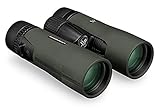
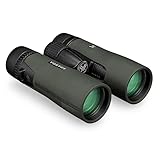
Top 3 picks at a glance
Quick comparison of the best binoculars for glasses
Eye relief and weight figures below come from the manufacturers’ published spec sheets. Check the current spec for your exact variant, because makers revise models.
| Pick | Best for | Key specs | Price range |
|---|---|---|---|
| Nikon Monarch M5 8×42 | Best overall | 8x, 42 mm, about 19.5 mm eye relief, roughly 5.25 mm exit pupil | Mid-range |
| Nikon Prostaff P3 8×42 | Best budget | 8x, 42 mm, about 19.9 mm eye relief, lighter build | Budget |
| Vortex Diamondback HD 8×42 | Best value for hard use | 8x, 42 mm, about 17 mm eye relief, HD glass, waterproof | Mid-range |
| Celestron Nature DX 8×42 | Best for casual birding | 8x, 42 mm, about 17.5 mm eye relief, waterproof | Budget to mid-range |
| Nikon Monarch HG 8×42 | Best premium with long eye relief | 8x, 42 mm, about 20.5 mm eye relief, low-dispersion glass | Premium |
| Swarovski EL 8×32 | Best compact premium | 8x, 32 mm, about 20 mm eye relief, 4 mm exit pupil | Top-tier premium |
How much eye relief do glasses actually need?
Manufacturers rate eye relief from the outer eyepiece lens to the point where the image is sharpest. With glasses, your eye is held back by the thickness of the lens and frame. A rough budget:
- Vertex distance: usually 12 mm, up to 14 mm with chunky frames or nose pads set wide.
- Lens thickness at the front surface: about 2 mm for a mild prescription, 3–4 mm for strong lenses or standard-index plastic.
- Gap between your lens and the eyepiece: about 1–2 mm, since the rubber eyecup is folded down and touches your lens.
Worked example, mild prescription (about -1.50): 12 + 2 + 1 = 15 mm needed. A binocular rated at 15 mm barely works, so aim for 16–17 mm for comfort.
Worked example, strong prescription with thick frames (about -6.00): 14 + 4 + 1 = 19 mm needed. Only models rated near 19–20 mm will show the full field.
Spec sheets round up and often measure at the best case, so add a 1–2 mm safety margin. That is why “15 mm eye relief” binoculars often disappoint glasses wearers, and why 17 mm is a sensible floor for most people.
Best overall: Nikon Monarch M5 8×42
The Monarch M5 8×42 combines about 19.5 mm of eye relief with a bright 5.25 mm exit pupil, so your eyes have slack in every direction. That makes it forgiving if you shift your head or wear thick lenses. The eyecups twist up and down with click stops, so you can lock them down for glasses and up when you take them off.
Trade-off: It costs more than entry-level 8x42s and weighs a bit more than 32 mm models. If you hike all day, the weight is noticeable.
Best budget: Nikon Prostaff P3 8×42
The Prostaff P3 8×42 has about 19.9 mm of eye relief on a budget-friendly body, which is rare. It suits glasses wearers who want a dependable first pair for backyard birds, ball games or a trip.
Trade-off: Glass and coatings are more basic, so expect softer edges and more colour fringing in harsh light than on the Monarch line.
Best value for rough use: Vortex Diamondback HD 8×42
The Diamondback HD 8×42 has about 17 mm of eye relief, which is enough for most prescriptions and frames. It is waterproof and fogproof, and Vortex backs it with its unconditional warranty. It fits people who are rough on gear.
Trade-off: At 17 mm there is little spare room for very strong lenses or deep wraparound frames. Try it with your own glasses if you can.
Best for casual birding: Celestron Nature DX 8×42
The Nature DX 8×42 offers about 17.5 mm of eye relief and a sturdy waterproof body at a gentle price. It is a good match for weekend birding and wildlife viewing.
Trade-off: It is heavier and less refined than premium glass, and the focus feel is not as smooth.
Best premium: Nikon Monarch HG 8×42
The Monarch HG 8×42 stretches eye relief to about 20.5 mm, the longest in this list at the 42 mm size. It also adds low-dispersion glass and a lighter magnesium body. It suits glasses wearers with strong prescriptions who want a sharp, high-contrast image.
Trade-off: It costs well above the M5, and the gain over it is mostly image refinement, not glasses comfort.
Best compact: Swarovski EL 8×32
The EL 8×32 has about 20 mm of eye relief in a compact, balanced body, so it is a good choice if you carry binoculars all day. Its field of view is wide, which helps when tracking moving birds.
Trade-off: It is a top-tier purchase, and its 4 mm exit pupil is dimmer than a 42 mm model at dusk.
Match your situation to the right binocular
| Your situation | Eye relief to target | Best size | Pick |
|---|---|---|---|
| Mild prescription, thin frames | 16–17 mm or more | 8×42 or 8×32 | Vortex Diamondback HD or Celestron Nature DX |
| Strong prescription (about ±5 or higher) | 19 mm or more | 8×42 | Nikon Monarch M5 or Monarch HG |
| Thick or wraparound frames | 19 mm or more | 8×42 | Nikon Prostaff P3 or Monarch M5 |
| Long hikes, light carry | 18 mm or more | 8×32 | Swarovski EL 8×32 or a compact 8×32 class |
| Hand tremor or unsteady hold | Longer is better | 8x, not 10x | 8×42 models above |
| Nearsighted or farsighted only, no astigmatism | Any, if you remove glasses | Any | Use the diopter ring |
Why 8x beats 10x for most glasses wearers
Exit pupil is the objective diameter divided by magnification. An 8×42 gives 5.25 mm, while a 10×42 gives 4.2 mm. A larger exit pupil makes it easier to keep your eye in the right spot behind your glasses, and the image blacks out less if you shift. Higher power also magnifies hand shake, and 10x models often have shorter eye relief. Published specs for 10×42 models are often 15–17 mm, so check each one. For glasses wearers, 8x is the better default.
How to test binoculars with your glasses
- Fold the eyecups fully down. They must sit flush so your lens touches the rubber and not the cup edge.
- Adjust the interpupillary distance until the two circles merge into one.
- Look for black rings or crescents at the edge. If you see “kidney beaning” or dark edges that move when you shift, the eye relief is too short for your glasses.
- Check the full field. Count how much of a distant sign or wall you see with glasses on and then off. A small difference is good. Losing a quarter of the view is a sign to try another model.
- Set the diopter ring last, by focusing the right eyepiece on a distant target with glasses on.
Features worth having, and ones to skip
- Multi-position click-stop eyecups: they let you set a position and trust it. Smooth-sliding cups often drift.
- Fully multi-coated lenses: they raise brightness, which compensates for light lost through spectacle lenses.
- Waterproof and fog-resistant sealing: useful if you wear glasses, since glasses fog easily in cold air.
- Skip “zoom” binoculars: they usually have poor optics and short eye relief at the high end.
- Skip very small compacts (such as 8×21 or 10×25) for strong prescriptions: many are rated about 10–14 mm, which is too short.
Frequently Asked Questions
How much eye relief do I need if I wear glasses?
Most glasses wearers need at least 15 mm, and 17 mm or more is safer. Strong prescriptions or thick frames can push the need to 19–20 mm. Add up vertex distance, lens thickness and a small gap, then add a 1–2 mm margin.
Should I keep my glasses on when using binoculars?
Keep them on if you have astigmatism, because binocular diopter adjustment cannot correct it. If you are only nearsighted or farsighted, you can remove them and use the diopter ring, which also lets you use any binocular regardless of eye relief. Many people still prefer glasses on for quick switching between scenes.
Do 10×42 binoculars work with glasses?
Some do, but many have shorter eye relief than their 8×42 siblings, and the smaller exit pupil makes the view harder to hold. If you want 10x, check the manufacturer’s spec sheet for eye relief of at least 16–17 mm. Test it with your own frames if possible.
Are compact binoculars good for glasses wearers?
Only some are. Many small models have 10–14 mm of eye relief, which is too short for most glasses. Look for 8×32 models rated near 17 mm or more, and avoid pocket-size designs unless the spec sheet confirms enough eye relief.
What does “kidney beaning” mean?
It is a dark kidney-shaped shadow that drifts across the image when your eye is not positioned correctly behind the eyepiece. For glasses wearers it usually means the eye relief is too short or the eyecups are not fully down. Fixing eyecup position and choosing longer eye relief usually solves it.
Can I use contact lenses instead to get a wider view?
Yes. With contacts, your eye sits closer to the eyepiece, so you can use the eyecups extended and get the full field of view on almost any binocular. If you switch between glasses and contacts, choose a model with long eye relief and click-stop eyecups so both work.
Related guides
More from Amazon
Programs that pair well with the guide above. Offers and eligibility are set by Amazon and may change.
A free business account with business pricing and bulk-buying tools for work, shop or home office.
Create a business accountFree shipping on eligible items, Prime Video and more. Eligible new members can start with a free trial.
Start a Prime free trialAudiobooks and podcasts to listen to on the go. Eligible new members can start with a free trial.
Try Audible freeAd-free music streaming. Eligible new subscribers can start with a free trial.
Try Music Unlimited freeAs an Amazon Associate we earn from qualifying purchases.


