The best affordable treadmill desk for most people is a flat, foldable under-desk walking pad with a 2.0–2.5 HP motor, a belt of at least 40 inches, a 265–300 lb weight rating and a remote, usually $180–$400. Skip handrails and steep incline unless you need them. At desk speeds of 1–2 mph, what matters is a quiet motor, a belt wide enough for a natural stride and enough clearance under your desk.
Prices below are general market ranges and change often. Model families named here (such as WalkingPad and UREVO) are real product lines, but lineups rotate, so confirm the current spec sheet before buying.
As an Amazon Associate we earn from qualifying purchases at no extra cost to you.
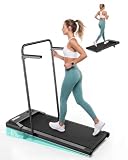


Top 3 picks at a glance
Quick comparison of the best affordable treadmill desk types
| Pick | Best for | Key specs | Price range |
|---|---|---|---|
| Best overall: flat 2.5 HP walking pad with remote | Most home offices and gaming desks | Speed 0.6–3.8 mph, belt about 40–47 x 15–17 in, 265–300 lb capacity, about 45–55 dB | $220–$400 |
| Best budget: entry-level folding pad (e.g. WalkingPad C2-class) | Light walkers, small rooms, tight budgets | Speed up to about 3.7 mph, belt about 36–40 in long, 220–265 lb capacity, folds in half | $150–$300 |
| Best for small spaces: slim 2-in-1 folding pad (e.g. WalkingPad P1-class) | Apartments, closets, shared rooms | Folds to about 5–6 in thick, 55–60 lb weight, belt about 41 x 16 in | $250–$450 |
| Best for taller users: long-deck model | Users over 6 ft, or anyone who walks faster than 2 mph | Belt 45–50 in long, 17+ in wide, 300–350 lb capacity | $350–$550 |
| Best with handrail: foldable treadmill with fold-down bar | Users who also want to jog | Speed up to 6–8 mph, 2.5–3.0 HP, handrail, sometimes manual incline | $300–$600 |
Best overall: flat 2.5 HP walking pad with a remote
This is the class to buy if you have no special constraints. A 2.5 HP peak motor, a 40–47 inch belt and a 300 lb rating hold a steady 1.5–2.0 mph without straining. A remote or wristband is more useful than an app because you can change speed without reaching for a phone.
Who it suits: home-office workers and PC gamers who want a walking session during strategy games, MMOs, video calls or browsing.
Main trade-off: flat decks have no incline, and many cap near 3.8 mph. Reaching a jog means buying a different class.
Best budget: entry-level folding pad
Pads in the WalkingPad C2 mold and generic equivalents are the cheapest sensible way in. They fold in half, weigh about 40–50 lb and handle gentle walking. Look for a motor continuous rating (not just “peak”) and a belt of at least 36 inches.
Who it suits: people under about 200 lb walking 1–1.8 mph for an hour or two a day.
Main trade-off: shorter belts and lighter motors. If you are tall, you may clip the back of the deck. Heavier users may hear the motor labour, per typical manufacturer weight-rating guidance.
Best for small spaces: slim 2-in-1 folding pad
Models like the WalkingPad P1 family fold to about 5–6 inches, so they slide under a sofa or bed. They add a little cost for the folding mechanism. Check that the unit is light enough to carry, since 55–60 lb is the usual weight.
Who it suits: renters, small gaming rooms and anyone who must put the pad away every evening.
Main trade-off: the fold hinge adds a seam, and the deck is typically shorter than on dedicated long-deck pads.
Best for taller users and faster walkers: long-deck model
If you are over 6 ft (183 cm), your stride at 2 mph is roughly 28–30 inches. A 40 inch belt then leaves little margin, so a 45–50 inch belt is far more comfortable. Pay attention to belt width too: 17 inches or more lets your feet stay clear of the side rails.
Main trade-off: longer decks need roughly 55–60 inches of floor depth under the desk and often cost $350 or more.
Best with a handrail: folding treadmill for walking and jogging
Entry-level folding treadmills with a handrail suit people who want one machine for desk walking and weekend jogging. Many sit at 2.5–3.0 HP with a manual incline. The handrail can be folded down for desk use on many models, but check that before purchase.
Main trade-off: they are heavier (often 70–90 lb) and taller when folded, and the handrail can collide with a desk edge.
How to choose: the numbers that matter
1. Check desk clearance (worked example)
Standing on a deck raises you. Take a user whose standing elbow height is 43 in (109 cm). A typical walking-pad deck plus belt is about 4–5 in (10–13 cm) thick. Your desk must go to about 43 + 4.5 = 47.5 in (about 121 cm) to keep elbows at 90 degrees. Many standing desks top out at 47–48 in, so a taller user has almost no spare height. Measure your elbow height in the shoes you will wear, add the deck thickness, and compare that to your desk’s maximum height.
2. Match motor and weight rating to your body weight
A practical rule is to pick a weight rating at least 30% above your body weight. At 220 lb, look for a rating of at least 285–300 lb. Under-rated motors run hotter and louder at the same speed.
3. Keep speed in the desk-work range
Most people type and mouse comfortably at 1.0–2.0 mph. Fast mouse work, such as aiming in a shooter, is hard when walking. A pad that goes down to 0.6 mph gives you a slow setting for those moments. A maximum of 3.8 mph is plenty for desk use.
4. Check noise
Manufacturer-rated noise for walking pads is typically 45–60 dB. That is quiet enough for calls but noticeable on a headset-free voice chat. Rubber feet or a mat on hard floors reduce transmitted vibration.
5. Estimate what it gets you
Walking 2 hours a day at 1.8 mph is about 3.6 miles. At roughly 2,000 steps per mile, that is about 7,200 extra steps. For an 80 kg (176 lb) person at an estimated 2.5 METs, gross burn is about 200 kcal per hour. Net of what sitting would have burned (about 1.3 METs, or roughly 104 kcal), the gain is about 96 kcal per hour, or roughly 190 kcal over 2 hours. These are rough estimates based on standard MET values and vary by person. Electricity is minor: a 200 W draw for 3 hours is 0.6 kWh, about 10 cents at $0.17 per kWh.
Decision matrix: which one fits your situation?
| Your situation | Choose | Why |
|---|---|---|
| Under 200 lb, walking 1–1.8 mph, budget under $300 | Entry-level folding pad | Lightest motor you actually need; rated capacity leaves a margin |
| 200–250 lb, daily use over 2 hours | Flat 2.5 HP pad, 300 lb rating | More headroom in motor and belt reduces heat and noise |
| Over 6 ft tall | Long-deck pad, 45+ in belt | Avoids stepping off the back of the belt |
| Must store the pad every day | Slim folding 2-in-1 | Folds to about 5–6 in thick |
| Want to jog too | Folding treadmill with handrail | Higher top speed, 6–8 mph |
| Desk tops out at 47 in or less | Thinnest deck you can find | Every inch of deck thickness costs desk height |
| Carpeted room | Higher ground clearance, firm mat underneath | Carpet can trap heat and fluff in the motor |
Setup tips that avoid common problems
- Use a height-adjustable desk. A fixed 29–30 in desk is too low once you stand on a deck.
- Raise your monitor. Keep the top of the screen at or just below eye level, since you will be 4–5 in taller.
- Lubricate the belt per the manual. Many pads need silicone lubricant every few months or about 100 hours of use.
- Use a surge protector with cable routing. Keep the power cord away from the belt and your PC cables.
- Start with 20-minute sessions. Build up to 1–2 hours over a couple of weeks.
What to skip at the budget end
Avoid listings that quote only “peak HP” with no continuous rating, belts under 36 inches, and weight ratings with no stated user limit. Treat step counters and app features as extras rather than reasons to pay more.
Frequently Asked Questions
How much should I spend on a treadmill desk?
Most buyers do well at $220–$400. Below about $200 you often get short belts and weaker motors. Above $450 you are mostly paying for longer decks, higher weight ratings or a handrail machine.
Can I use a walking pad with a regular desk?
Only if your desk is tall enough. A regular 29–30 inch desk is too low once you add a 4–5 inch deck, so you generally need a height-adjustable or standing desk. Measure your standing elbow height and add the deck thickness first.
Can I game while walking on a treadmill desk?
Yes, at slow speeds. Strategy, MMO, RPG and casual games work well at 1.0–1.5 mph. Fast, precise mouse aiming in competitive shooters is harder while walking, so many people pause the pad for those sessions.
Do under-desk treadmills work for running?
Most do not. Flat walking pads usually top out near 3.8 mph and are not built for the impact of running. If you want to jog, choose a folding treadmill with a higher top speed, a stronger motor and a handrail.
How loud is a budget treadmill desk?
Manufacturers typically rate walking pads at about 45–60 dB, which is similar to quiet conversation. Real-world noise depends on your weight, speed and floor. A rubber mat helps, and a well-lubricated belt is quieter than a dry one.
How long does a cheap walking pad last?
Many budget models run for years with regular belt lubrication and sensible weight limits. Staying well under the rated capacity and avoiding carpet-heavy setups both help. Check the warranty length, since 1 year is common at this price.
Related guides
More from Amazon
Programs that pair well with the guide above. Offers and eligibility are set by Amazon and may change.
A free business account with business pricing and bulk-buying tools for work, shop or home office.
Create a business accountFree shipping on eligible items, Prime Video and more. Eligible new members can start with a free trial.
Start a Prime free trialAudiobooks and podcasts to listen to on the go. Eligible new members can start with a free trial.
Try Audible freeAd-free music streaming. Eligible new subscribers can start with a free trial.
Try Music Unlimited freeAs an Amazon Associate we earn from qualifying purchases.


