The best 5.2 speaker setup for most people is a 5.2-channel AV receiver such as the Yamaha RX-V4A or Sony STR-DH590, paired with a five-speaker package and a second powered subwoofer. Almost no brand sells a boxed “5.2 speaker system”, so you build one: five speakers plus two subs, driven by a receiver with two subwoofer outputs. The picks below are organised by room size and how you use the system (PC, console or movies) rather than as a single winner.
As an Amazon Associate we earn from qualifying purchases at no extra cost to you.
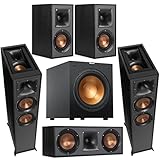


Top 3 picks at a glance
What “5.2” actually means (and why it is rare)
A 5.2 system has five full-range channels (front left, center, front right, surround left, surround right) and two separate subwoofers for the “.2” low-frequency channel. Most PC speaker kits are 2.1 or 5.1. A second subwoofer smooths bass across the room because it cancels some of the seat-to-seat peaks and nulls a single sub creates. The main trade-off is complexity: you need a receiver with two sub outputs, or a splitter, and you have to level-match both subs.
Also note that 5.2 is not 7.2 or Atmos. You get no height or rear-back channels, which suits small and medium rooms and a desk-to-couch gaming setup well.
Quick comparison of the picks
| Pick | Best for | Key specs | Price range |
|---|---|---|---|
| Yamaha RX-V4A + Klipsch Reference Theater Pack 5.1 + second sub | Best overall, living room | 5.2-channel receiver, HDMI with eARC, 5 speakers, 2 subs | Mid-range to upper mid-range |
| Sony STR-DH590 + compact 5.1 satellite kit + second small sub | Best budget | 5.2-channel receiver with dual sub outputs, small satellites | Budget to lower mid-range |
| SVS Prime Satellite 5.1 package + second SVS sub + 5.2 receiver | Best for bass and movies | Compact satellites, sealed or ported subs, high output | Premium |
| Bookshelf pair + center + surrounds + two 8–10 in subs (mix and match) | Best for custom builds | Choose your own sensitivity, 8 ohm, 80 Hz crossover | Flexible |
| Logitech Z906 (5.1, not 5.2) | Best plug-in desktop alternative | 500 W RMS total per Logitech, optical/coax/6-channel analog inputs, THX | Mid-range |
Best overall: Yamaha RX-V4A with a Klipsch Reference-class 5.1 package
The Yamaha RX-V4A is a 5.2-channel receiver with two subwoofer outputs and HDMI inputs that work with modern consoles and PC graphics cards. Pair it with the Klipsch Reference Theater Pack 5.1, which comes with a single sub, and add a second powered sub of similar size. Klipsch Reference speakers are efficient (high sensitivity), so a modest receiver goes loud without strain, which makes this combination an easy default.
Who it suits: living rooms of roughly 15–35 square metres where you game and watch films on the same system.
Main trade-off: Klipsch horn-loaded tweeters can sound bright in small, reflective rooms. If your room has bare walls and a hard floor, use a rug and turn the receiver’s treble down a notch.
Best budget: Sony STR-DH590 with a compact satellite kit
The Sony STR-DH590 is a 5.2-channel receiver with two sub outputs at a budget price. Pair it with any small 5.1 satellite package, then add one more powered sub. Small satellites with a higher crossover (100–120 Hz) are fine here as long as both subs handle the low end.
Who it suits: small rooms, dorms and apartments where neighbours are a concern. The dual subs let you run each at a lower level, so you get even bass with less rumble next door.
Main trade-off: receiver power is limited and automatic room correction is basic. You will likely level-match by ear or with a phone SPL app.
Best for bass and film: SVS Prime Satellite 5.1 plus a second SVS sub
The SVS Prime Satellite 5.1 package is built around small matched speakers and a capable subwoofer. Adding a second SVS sub gives you a true 5.2 system with deep, even bass. Feed it from a 5.2 receiver such as the Yamaha above, or a larger receiver if you plan to expand later.
Who it suits: people who watch action films or play bass-heavy games and want clean output below 40 Hz.
Main trade-off: it costs the most of the picks, and the small satellites cannot play as loud as floorstanding speakers in a big room.
Best custom approach: mix your own five speakers and two subs
If you already own bookshelf speakers, buy a matching center and a pair of surrounds from the same brand and series so the tonal balance matches across the front. Then pick two identical subs. Identical subs are far easier to integrate than mismatched ones because they share the same phase and response behaviour.
Main trade-off: more research and more cables, but you control every part and can upgrade one piece at a time.
The desktop option: Logitech Z906 is 5.1, not 5.2
If you want a plug-and-play desk system and have no space for a receiver, the Logitech Z906 is the usual choice. Per Logitech’s spec sheet it is rated at 500 W RMS and takes optical, coaxial and analog inputs. It uses one subwoofer, so it is a 5.1 system. It makes sense if your goal is surround sound from a PC or console without extra boxes, but it does not deliver the dual-sub benefit.
How much power you need: a worked example
Use this formula: SPL at the listening position = speaker sensitivity (dB at 1 W/1 m) + 10 × log10(watts) − 20 × log10(distance in metres). It ignores room gain, so real results are slightly higher.
Example: a speaker rated at 90 dB sensitivity, with you sitting 2.5 m away. Distance loss is 20 × log10(2.5) ≈ 8 dB, so you get about 82 dB from 1 W. Film dialogue and effects peaks are typically calibrated to about 105 dB at reference level, and many people listen 10–15 dB below that.
| Speaker sensitivity | Watts for 95 dB peaks at 2.5 m | Watts for 105 dB peaks at 2.5 m |
|---|---|---|
| 86 dB | about 50 W | about 500 W |
| 88 dB | about 32 W | about 316 W |
| 90 dB | about 20 W | about 200 W |
| 92 dB | about 13 W | about 126 W |
The takeaway: for ordinary listening, 20–50 W per channel is plenty, and an efficient speaker saves more than a bigger receiver would. Reaching reference-level peaks needs high-sensitivity speakers, and in practice those peaks only occur briefly. Also remember that receiver ratings are usually measured with two channels driven, so with five channels driven the real output is lower.
Decision matrix: which setup fits your situation
| Your situation | Choose | Why |
|---|---|---|
| Small room, under 15 m², tight budget | Sony STR-DH590 + compact satellites + two small subs | Low cost, even bass at low volume |
| Living room, 15–35 m², console and TV | Yamaha RX-V4A + Klipsch Reference package + second sub | HDMI inputs, efficient speakers, simple set-up |
| Large room or bass-heavy films | SVS Prime Satellite package + second sub | Deep, clean low-frequency output |
| Desk setup, PC only, no receiver | Logitech Z906 (5.1) or active speakers | No receiver needed, but only one sub |
| You already own speakers | 5.2 receiver + matching subs | Reuse what you have; add only the missing parts |
Set-up steps for two subwoofers
- Place the subs asymmetrically or at wall midpoints. A common starting point is the middle of the front wall and the middle of the back wall, or the midpoints of opposite side walls. The reason is that each position excites different room modes, so the peaks and dips tend to cancel out.
- Set the speakers to “Small” and the crossover to 80 Hz. This is the THX-style default. The subs handle everything below 80 Hz and relieve the small speakers of the deep bass.
- Level-match the subs separately. Play pink noise from the receiver’s test tone and mute one sub at a time. Use a phone SPL app and set each sub to the same level, around 75 dB at your seat, then re-run both together. This avoids one sub dominating.
- Check phase. Flip each sub’s phase switch between 0° and 180° and keep the setting that gives the louder bass at your seat. Opposing phase causes cancellation.
- For PC use, set Windows to 5.1 surround. Connect the GPU to the receiver by HDMI, choose the receiver as the output, and select 5.1 in the sound settings. Your game should send six channels, and the receiver then handles the two sub outputs.
Note that most receivers send the same LFE signal to both sub outputs, so the two subs reinforce each other. Only some models give separate level control for each sub. Check the manual of the model you are considering.
How to choose: key criteria with numbers
- Receiver sub outputs: look for two sub pre-outs (often labelled “Subwoofer 1/2”). If you only have one, a Y-splitter works but gives you no independent level control.
- Speaker impedance: 6–8 ohm speakers are safe on entry-level receivers. Avoid 4 ohm speakers on budget models.
- Sensitivity: 88 dB or higher keeps power demands modest, as the table above shows.
- Sub size: 8–10 inch drivers suit rooms up to about 25 m². For larger spaces, 12 inches or more with a ported design gives lower extension.
- HDMI features: if you game on a console or PC at 4K 120 Hz, check that the receiver’s HDMI inputs pass 4K 120 Hz. Many budget 5.2 receivers only pass 4K 60 Hz, so verify per the manufacturer’s spec sheet.
Frequently Asked Questions
Is a 5.2 speaker system better than 5.1?
For bass quality, usually yes. Two subs even out the bass across several seats and reduce room-mode peaks. For a single listener on a desk, though, a well-placed single sub often performs almost as well.
Can I use a 5.1 receiver for a 5.2 system?
Yes, but with limits. You can use a Y-splitter on the single sub output to feed both subs. You lose independent level adjustment, so choose identical subs and position them symmetrically.
Do I need a receiver for 5.2 sound from a PC?
In practice yes. PC speaker kits rarely offer two sub outputs, so an AV receiver connected by HDMI is the usual route. Some sound cards can output 5.1 analog, but you would still need an amplifier for passive speakers.
What is the difference between 5.2 and 7.2?
7.2 adds two more channels, usually rear surrounds, and needs a larger receiver and more speakers. 5.2 is simpler and often suits small and medium rooms just as well, particularly when your content is mostly 5.1 anyway.
Should both subwoofers be identical?
Ideally yes. Matching models share the same frequency response and phase behaviour, which makes level matching and integration much easier. Different subs can work, but they require more careful adjustment.
How loud will a 5.2 system get in a small room?
Louder than most people need. Using the power calculation above, a 90 dB-sensitivity speaker driven by just 20 W reaches about 95 dB peaks at 2.5 m, which is already very loud. In small rooms, room gain adds a few more dB to bass levels.
Related guides
More from Amazon
Programs that pair well with the guide above. Offers and eligibility are set by Amazon and may change.
A free business account with business pricing and bulk-buying tools for work, shop or home office.
Create a business accountFree shipping on eligible items, Prime Video and more. Eligible new members can start with a free trial.
Start a Prime free trialAudiobooks and podcasts to listen to on the go. Eligible new members can start with a free trial.
Try Audible freeAd-free music streaming. Eligible new subscribers can start with a free trial.
Try Music Unlimited freeAs an Amazon Associate we earn from qualifying purchases.


