
The best guitar string winder and cutter tools for most players are the D’Addario Pro-Winder for an all-in-one solution, the MusicNomad GRIP ONE for a more comfortable premium design, and a separate high-leverage cutter plus a dedicated winder when you regularly restring bass guitars.
A string winder saves time by spinning the tuning post, while the cutter determines whether the job ends with a clean, controlled snip or a crushed, frayed string. The right choice depends less on brand than on tuning-post fit, cutter leverage, handle comfort, and the thickness of the strings you use.
As an Amazon Associate we earn from qualifying purchases at no extra cost to you.

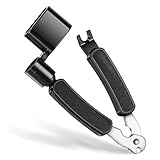


Top 3 picks at a glance
Quick comparison: which tool fits your setup?
| Tool or tool type | Winding speed | Cutter leverage | Tuner compatibility | Best fit | Typical price range |
|---|---|---|---|---|---|
| D’Addario Pro-Winder | Fast manual winding | Moderate integrated cutter | Most electric and acoustic posts; check bass fit | Players wanting one compact tool | Usually $12–$20 |
| MusicNomad GRIP ONE | Fast manual winding | Moderate integrated cutter | Broad guitar compatibility; verify large bass posts | Comfort-focused acoustic and electric users | Usually $15–$25 |
| Ernie Ball String Winder/Cutter | Fast manual winding | Moderate integrated cutter | Standard electric and acoustic tuners | General-purpose guitar maintenance | Usually $10–$18 |
| Separate peg winder plus flush cutters | Fastest and least tiring | High, depending on cutter length | Choose a guitar or bass-specific winder | Frequent restringing and bass players | Usually $20–$60 total |
| Powered string winder | Fastest | Usually no cutter included | Requires interchangeable or correctly sized peg adapter | Workshops and high-volume restringing | Usually $25–$80 |
Best all-in-one tool: D’Addario Pro-Winder
The D’Addario Pro-Winder is the safest recommendation for a guitarist who wants one tool that winds, cuts, and removes acoustic bridge pins. Its molded body is compact enough for a gig bag, and the integrated winder head is shaped for common six-string electric and acoustic tuning posts.
Its main advantage is convenience rather than maximum cutting force. The cutter handles normal electric and acoustic guitar strings well, but its short handles provide less leverage than dedicated flush cutters. That matters when cutting heavy strings, coated bass strings, or the stiff outer winding near the ball end.
Choose it if you change strings a few times per month, maintain both acoustic and electric guitars, or want to avoid carrying several separate tools. For a four- or five-string bass, confirm that the winder head fits the tuning-post buttons before buying; bass tuners are often larger and more widely spaced than guitar tuners.
Best comfort-oriented option: MusicNomad GRIP ONE
The MusicNomad GRIP ONE combines a string winder, cutter, and bridge-pin tool in a design aimed at reducing slipping during use. Its handle shape is useful when your fingers are damp, when you are changing several guitars in one session, or when arthritis and hand fatigue make thin plastic winders uncomfortable.
The integrated cutter is suitable for ordinary guitar string changes, but it is still a compact cutter. Do not expect the same leverage as a long-handled diagonal cutter. Use a dedicated cutter if you routinely work with .060-inch or heavier bass strings, seven-string guitar sets, or strings with unusually tough outer wraps.
The GRIP ONE makes the most sense for acoustic and electric players who value controlled handling more than the lowest price. It is also a good choice for a home repair kit because the bridge-pin puller reduces the temptation to pry pins out with a screwdriver or pliers.
Best budget-style general-purpose option: Ernie Ball String Winder/Cutter
The Ernie Ball String Winder/Cutter is a compact combination tool for standard guitar restringing. Its simple design keeps it light and easy to store, and the winder section works well with common electric and acoustic tuning posts.
Its cutter is best treated as a convenience feature. Cut each string several inches away from the post first, remove the tension, and then trim the remaining end. This two-stage method reduces the force required and makes the integrated cutter last longer.
It is a practical pick for beginners, students, and players who want a low-cost tool in every guitar case. If you own several instruments or frequently restring on a workbench, a separate cutter will usually feel cleaner and more controlled.
Why separate tools are better for bass and frequent restringing
A dedicated peg winder has one job: rotate the tuner quickly without slipping. A separate flush cutter has longer handles, sharper jaws, and more leverage. That combination is preferable for bass because thicker strings require more cutting force and may not sit correctly in a guitar-sized winder socket.
For bass, look for a winder explicitly described as bass-compatible or one with a large, open tuning-post slot. For the cutter, choose hardened steel diagonal or flush cutters with handles long enough to create leverage without requiring excessive hand pressure. Avoid using household scissors; they tend to deform the winding and can be damaged by the string.
A powered winder is useful in a repair shop or for a player who changes strings on many instruments each week. Use low speed near the end of the winding process. High speed can pull the string sideways, kink it around the post, or create sudden tension if the string catches.
Winding-speed calculation: how much time does a good tool save?
A typical guitar string needs roughly 8–12 visible wraps around the post, depending on the headstock, string gauge, and how much slack you leave. If a manual winder averages about 3 revolutions per second, a 10-wrap string takes approximately:
10 wraps ÷ 3 revolutions per second = 3.3 seconds of active winding.
Across six strings, that is about 20 seconds of spinning rather than several minutes of turning tuning keys by hand. In practice, the complete change still takes longer because you must remove the old strings, seat the new strings, stretch them, tune them, and trim the ends. The winder saves the most time when the tool fits tightly and the string does not bind against neighboring wraps.
Compatibility matrix: match the tool to your guitar
| Your situation | Recommended setup | Reason |
|---|---|---|
| Steel-string acoustic only | All-in-one winder/cutter with bridge-pin puller | One tool removes pins, winds posts, and trims strings |
| Solid-body electric guitar | Compact winder/cutter or powered winder with adapter | Electric posts usually have simple, accessible layouts |
| Four- or five-string bass | Bass-compatible peg winder plus dedicated flush cutter | Large posts and thick strings need clearance and leverage |
| Vintage-style slotted acoustic tuners | Narrow, carefully fitting winder; avoid forcing the socket | Slotted posts can be damaged by an oversized or loose head |
| Locking tuners | Winder is optional; prioritize a quality cutter | Locking posts use fewer wraps, so winding speed matters less |
| Seven-string or extended-range guitar | Dedicated cutter and a winder verified for the tuner buttons | Low strings can exceed the comfortable range of small cutters |
How to change strings cleanly with any winder
1. Loosen before cutting
Turn the tuning key until the string is slack, then cut it near the middle of the neck or between the nut and bridge. Cutting a fully tensioned string can make the loose end whip and places unnecessary shock on the tool.
2. Leave the correct amount of slack
For a conventional non-locking tuner, allow approximately two to three tuning-post heights of slack on the thinner strings and one to two on the wound bass strings. Too little slack causes poor wrap security; too much creates excess wraps that settle slowly.
3. Keep the first wrap below the string end
Feed the string through the post, bend the free end upward, and start winding so the wraps travel downward toward the headstock surface. The first wrap should lock the string end in place, while the following wraps remain neat and separated.
4. Use the winder slowly near pitch
Spin quickly while the string is loose, then reduce speed when the string begins to resist. Stop when the string is close to pitch and tune by hand. This avoids sharp kinks and makes it easier to see whether the wraps are stacking correctly.
5. Stretch and retune
Gently pull the string upward in several places along the fretboard, retune, and repeat two or three times. If the pitch drops sharply after stretching, inspect the bridge, nut, and tuner post for binding rather than simply adding more wraps.
6. Trim only after tuning is stable
Leave a small safety tail on the post until the string has been tuned and stretched. Then cut the end close to the outer wrap with the cutter held perpendicular to the string. Wear eye protection or point the cut end away from your face.
What to look for before buying
- Winder fit: The socket should engage the tuning button without rocking or slipping. A loose fit can round plastic tuner buttons.
- Cutter leverage: Short integrated cutters are convenient; long-handled flush cutters are better for bass and heavy gauges.
- Materials: Hardened steel cutting jaws generally hold an edge longer than soft stamped metal. Reinforced nylon or molded polymer handles keep combination tools light.
- Headstock clearance: Oversized winder heads may strike adjacent tuners on compact or three-per-side headstocks.
- Bridge-pin function: On acoustic guitars, a broad, smooth pin puller is preferable to prying with a screwdriver.
- Storage: A compact combination tool belongs in a gig bag; a separate cutter is better protected in a toolbox so its jaws do not become dull.
For most acoustic and electric guitar owners, choose the D’Addario Pro-Winder, MusicNomad GRIP ONE, or Ernie Ball String Winder/Cutter according to handle comfort and price. For bass, heavy strings, or frequent professional restringing, spend more on a bass-compatible winder and a dedicated high-leverage cutter; that combination is faster, cleaner, and less likely to damage either the tool or the tuning hardware.


