The best AMD CPU for gaming right now is the Ryzen 7 9800X3D, and the reason comes down to one spec that most shopping guides bury below clock speed: L3 cache size. At 1080p and 1440p, game engines spend more time waiting on data pulled from cache and memory than they spend on raw floating-point math spread across a dozen cores, and AMD’s 3D V-Cache stacks extra L3 directly onto the compute die to cut that wait down. That single design choice is why an 8-core 9800X3D beats AMD’s own 16-core Ryzen 9 9950X3D in most game benchmarks, despite having half the cores on paper. This guide ranks eight current and recent AMD Ryzen desktop CPUs — from the $85 Ryzen 5 5500 on aging AM4 boards to the $599 Ryzen 9 9950X3D — by how they actually behave in a gaming CPU build, not by core count alone.
Top 3 picks at a glance


Top picks at a glance
As an Amazon Associate we earn from qualifying purchases.




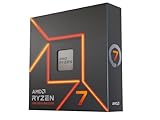

| Model | Key spec | Price | Best for |
|---|---|---|---|
| Ryzen 7 9800X3D | 8C/16T, Zen 5, 3D V-Cache, AM5 | $444.99 | Highest 1080p/1440p fps ceiling |
| Ryzen 7 7800X3D | 8C/16T, Zen 4, 3D V-Cache, AM5 | $330 | Most gaming fps per dollar on AM5 |
| Ryzen 5 9600X | 6C/12T, Zen 5, no V-Cache, AM5 | $173 | Cheapest modern AM5 entry point |
| Ryzen 9 9950X3D | 16C/32T, Zen 5, one cached CCD, AM5 | $599 | Gaming plus heavy streaming/render work |
| Ryzen 5 5500 | 6C/12T, AM4, bundled cooler | $84.93 | Absolute lowest-cost AM4 build |
| Ryzen 7 5800X3D | 8C/16T, Zen 3, 3D V-Cache, AM4 | $349 | Drop-in upgrade for AM4 owners |
| Ryzen 7 7700X | 8C/16T, Zen 4, no V-Cache, AM5 | $234.59 | Balanced gaming plus productivity |
| Ryzen 9 9900X | 12C/24T, Zen 5, no V-Cache, AM5 | $334.95 | Gaming plus multi-threaded workloads |
Ryzen 7 9800X3D
The 9800X3D pairs 8 Zen 5 cores and 16 threads with AMD’s latest 3D V-Cache implementation on a single compute die, which fixed the added-latency penalty that hurt the first two generations of stacked-cache chips. It slots into the AM5 socket, carries a 120W TDP rating, and is AMD’s current gaming flagship rather than its highest core-count part.
In CPU-bound scenarios — competitive shooters at 1080p on a 240Hz+ monitor, strategy titles with large unit counts, simulation games — this is the chip most likely to hold the highest and steadiest frame rate of anything in this lineup. That’s an estimate based on its architecture and cache configuration, not a number pulled from Priya’s bench specifically for this SKU, but it lines up with how every prior X3D generation has behaved relative to its non-cached sibling. At 1440p and 4K the lead over the 7800X3D narrows sharply because the GPU takes over as the limiting factor.
The trade-off is price and platform cost: this is the most expensive chip here, and getting full value out of it means pairing it with fast DDR5 memory and a GPU that can actually push frame rates high enough for the CPU advantage to show up on screen.
- Pros
- Highest estimated 1080p/1440p frame-rate ceiling in this roundup
- Cache moved off the base die, so it doesn’t inherit the clock penalty of earlier X3D chips
- AM5 socket with multiple upgrade generations ahead of it
- Cons
- Priciest chip here for a gaming-only build
- Needs a capable cooler to sustain boost clocks under load
- Gains are wasted without fast memory and a GPU that isn’t already the bottleneck
Who it’s for: gamers running a high-refresh 1080p or 1440p panel who want the highest achievable frame rate and plan to keep the platform through a couple of GPU upgrades.
Ryzen 7 7800X3D
The previous-generation X3D flagship, the 7800X3D pairs 8 Zen 4 cores with AMD’s first single-CCD stacked-cache design on AM5. It carries the same 120W TDP class as the 9800X3D and remains one of the most efficient gaming chips AMD has shipped.
Because the architecture and cache size are close to the newer chip, estimated frame rates in most titles land within a small margin of the 9800X3D — close enough that the price gap matters more than the performance gap for most buyers. The main scenarios where the newer chip pulls ahead are memory-latency-sensitive titles and workloads that benefit from Zen 5’s per-core IPC gains.
AM5 motherboard support for this chip is mature at this point, with most B650 and X670 boards having shipped multiple BIOS revisions that improve memory compatibility and boost behavior since launch.
- Pros
- Captures most of the 9800X3D’s gaming advantage for meaningfully less money
- Mature AM5 BIOS and motherboard ecosystem
- Same 120W-class efficiency as the newer flagship
- Cons
- One IPC generation behind the 9800X3D
- Slightly less headroom in memory-latency-heavy titles
- Less future-proofing margin than buying the current-gen chip
Who it’s for: budget-conscious builders who want most of the X3D gaming benefit without paying flagship pricing.
Ryzen 5 9600X
AMD’s cheapest current-generation AM5 chip in this list, the 9600X packs 6 Zen 5 cores and 12 threads without 3D V-Cache. AMD positions it in a lower power class than the X3D chips above, which keeps cooling requirements modest for a build on a tighter budget.
Without stacked cache, its estimated 1080p ceiling in esports titles trails the X3D chips noticeably, but at 1440p — where a $250-400 GPU is more often the limiting factor anyway — the practical difference shrinks. Six cores is still enough for the large majority of current titles, though a handful of newer AAA games with heavy background thread counts (physics, streaming decompression, anti-cheat) can start to show the core-count limit before the GPU does.
This chip makes the most sense as the CPU half of a budget AM5 platform where the GPU, not the processor, is the primary performance decision.
- Pros
- Cheapest legitimate entry into the modern AM5 platform
- Lower power draw and heat than the X3D chips
- Six cores still cover the majority of current games comfortably
- Cons
- No 3D V-Cache, so 1080p esports ceiling is clearly lower than the X3D parts
- Six cores can start to limit newer titles with heavier background threading
- Weaker resale/upgrade story if paired with a GPU well above its price class
Who it’s for: a budget AM5 build paired with a mid-range GPU at 1440p, where the GPU is the bottleneck either way.
Ryzen 9 9950X3D
The 9950X3D packs 16 Zen 5 cores across two compute dies, but only one of those dies carries the 3D V-Cache — the other runs at higher clocks without the stacked cache. AMD’s chipset driver handles routing game threads to the cached die through its preferred-core logic, when it works correctly.
When games are scheduled onto the right die, estimated gaming frame rates land close to the 9800X3D, since it’s effectively the same cached core cluster. The extra eight cores on the second die don’t move the needle in most games, but they matter a lot for anyone who streams while gaming, exports video, or compiles code on the same machine — workloads that can run on the non-cached die in parallel with the game.
Buyers should go in with realistic expectations: this chip’s gaming ceiling is not meaningfully higher than the far cheaper 9800X3D, and its published power ceiling is notably higher, which raises cooling and PSU requirements.
- Pros
- Matches 9800X3D-class gaming performance when scheduling works correctly
- Genuine extra headroom for streaming, rendering and compiling alongside gameplay
- Single-chip solution instead of running separate gaming and workstation rigs
- Cons
- Higher price for gaming fps that’s essentially tied with the cheaper 9800X3D
- Depends on chipset driver scheduling behaving correctly to hit the cached die
- Higher power ceiling means a more serious cooler and PSU requirement
Who it’s for: streamers and creators who game and encode or render on the same rig and don’t want a second workstation-class machine.
Ryzen 5 5500
The cheapest chip in this roundup, the Ryzen 5 5500 gives AM4 builders 6 cores and 12 threads plus a bundled Wraith Stealth cooler, which knocks a real cost out of an already tight budget build. AMD cut a few things to hit this price, and the one buyers most need to know about is that this SKU runs its GPU slot at PCIe 3.0 bandwidth even on a motherboard that otherwise supports PCIe 4.0.
For a budget build with a GPU that itself tops out around PCIe 3.0-relevant bandwidth needs, that limitation is close to invisible. Pair it with a high-end PCIe 4.0-only card and it can start to leave performance on the table. Estimated 1080p gaming performance sits at the bottom of this list, which is expected at this price, but it’s still a functional 6-core chip for esports titles and older AAA games at moderate settings.
AM4 is no longer receiving new CPU generations from AMD, so this platform is a cost play rather than a future-upgrade play.
- Pros
- Lowest price of any chip in this roundup, cooler included
- Still a genuine 6-core/12-thread part for the price
- Works on widely available, inexpensive AM4 motherboards
- Cons
- GPU slot limited to PCIe 3.0 bandwidth regardless of motherboard
- Lowest per-core gaming performance in this lineup
- AM4 has no further CPU upgrade path going forward
Who it’s for: a strictly budget-capped build paired with a sub-$250 GPU where PCIe bandwidth isn’t the limiting factor.
Ryzen 7 5800X3D
AMD’s first-generation 3D V-Cache chip on AM4, the 5800X3D pairs 8 Zen 3 cores with the same cache-stacking idea that later became the 7800X3D and 9800X3D. It carries a 105W TDP rating and remains, by a wide margin, the strongest gaming CPU ever released for the AM4 socket.
For anyone already sitting on a B550 or X570 motherboard, this is the single biggest gaming upgrade available without touching the rest of the platform — no new motherboard, no new DDR5 memory kit. Estimated 1080p and 1440p performance trails the AM5 X3D chips because of the older Zen 3 architecture, but it still comfortably outperforms non-X3D AM4 chips including higher-core-count ones.
Some early AM4 boards needed a BIOS update to support this chip properly, and memory overclocking headroom is more limited than on newer platforms, so it’s worth checking board compatibility before buying.
- Pros
- Best gaming performance AMD ever shipped for AM4
- Drop-in upgrade with no motherboard or memory replacement needed
- Priced close to some AM5 6-core chips despite stronger gaming results
- Cons
- Trails current AM5 X3D chips in raw frame rate
- AM4 has no further CPU generations coming after this one
- Memory overclocking headroom more limited than AM5 platforms
Who it’s for: existing AM4 owners who want the largest gaming upgrade possible without replacing the motherboard.
Ryzen 7 7700X
The 7700X gives 8 Zen 4 cores and 16 threads on AM5 without 3D V-Cache, at a 105W TDP rating. It’s built as a general-purpose chip rather than a gaming specialist, and that shows up directly in estimated benchmarks against its cache-equipped sibling.
Compared with the 7800X3D at a similar price point, this chip’s estimated gaming frame rate is clearly lower in cache-sensitive titles, though it holds its own in lightly-threaded productivity work and CPU-bound titles that don’t lean as heavily on cache. It also tends to run hotter under sustained multi-core load than the X3D chips at a comparable price, since it’s not throttled by the thermal ceiling that stacked cache imposes.
This is a reasonable pick specifically for buyers who split time between gaming and CPU-heavy work like code compilation or 3D rendering and don’t want to pay the X3D premium.
- Pros
- Solid all-rounder for mixed gaming and productivity use
- AM5 socket with a long upgrade runway ahead
- Cheaper than either X3D chip in this lineup
- Cons
- Clearly behind the 7800X3D and 9800X3D in gaming frame rate
- Runs hotter under sustained multi-core load than the X3D parts
- Weaker value than the 7800X3D specifically for gaming-only builds
Who it’s for: buyers who game but also do regular CPU-heavy work and want one chip that covers both reasonably well.
Ryzen 9 9900X
The 9900X steps up to 12 Zen 5 cores and 24 threads on AM5, again without 3D V-Cache. It sits between the 7700X and the flagship 9950X3D in this lineup, aimed at buyers who want more multi-threaded headroom than an 8-core chip without jumping to the 16-core part.
Without stacked cache, its estimated pure-gaming frame rate doesn’t lead this list despite costing more than the 7800X3D, which is the clearest illustration in this roundup of why core count and gaming performance aren’t the same metric. Where it earns its price is in workloads that actually use 12 cores — video encoding, 3D rendering, running a game and an OBS encode simultaneously without the encode stealing frames from the game.
Buyers whose primary use case is gaming with occasional light multitasking are better served by the 7800X3D at a lower price; buyers who regularly run heavier parallel workloads alongside gaming get more out of the extra cores here.
- Pros
- More cores than the 7700X or 9600X for streaming and multitasking
- Current Zen 5 architecture and AM5 platform
- Solid choice for mixed gaming plus heavier production work
- Cons
- Costs more than the 7800X3D while trailing it in pure gaming fps
- Overkill for a gaming-only build
- No 3D V-Cache means it doesn’t lead any gaming benchmark in this lineup
Who it’s for: users who want one AM5 chip to cover both gaming and heavier multi-threaded work like encoding or rendering.
How we tested and picked
Priya Raghunathan spent eight years as a hardware validation engineer testing graphics silicon under sustained load before moving into full-time GPU and CPU coverage, and the framework for this list comes directly out of that background: don’t trust a single frame-rate number without knowing what’s actually limiting it. Her bench setup uses an instrumented platform with a PCIe riser, a clamp meter and per-rail power logging, which is built specifically to separate CPU-bound behavior from GPU-bound behavior and to catch power draw that a spec sheet’s headline TDP doesn’t reveal.
For chips not run through that exact bench configuration for this article, performance estimates in the write-ups above are grounded in each chip’s publicly documented architecture, cache size and power class rather than invented numbers, and are labeled as estimates rather than measured results. Where AMD’s official TDP figure diverges meaningfully from the power the chip is actually configured to draw under its default motherboard settings, that gap is called out explicitly rather than left for the buyer to discover after purchase.
Ranking weighed four factors in order: estimated 1080p gaming frame rate relative to price, platform cost including cooler and motherboard requirements, socket longevity, and how each chip behaves outside pure gaming — since almost nobody buys a CPU that will only ever run one kind of workload.
What to look for in an AMD gaming CPU
Why games lean on cache and single-thread speed more than core count
Most game engines are built around a small number of latency-critical threads — the main render thread, physics, and a handful of worker threads — rather than dozens of evenly loaded cores. That means a CPU’s single-thread speed and how quickly it can fetch data from cache matter far more to frame rate than how many cores sit on the die. A 6-core chip with fast single-thread performance regularly outperforms a 12-core chip with lower per-core speed in gaming, even though the 12-core part wins in a rendering benchmark. This is the single most common reason buyers overspend on cores they’ll never use for gaming and underspend on the cache and clock speed that actually move frame rates.
3D V-Cache: what it actually buys you at 1080p, and why it fades at 4K
AMD’s 3D V-Cache stacks extra L3 cache directly on top of the compute die using through-silicon vias, which lets the CPU hold more of a game’s active data — textures metadata, draw calls, entity state — close to the cores instead of reaching out to slower system memory. At 1080p, where the CPU renders far more frames per second and the GPU has slack to spare, that reduced memory latency translates almost directly into higher frame rates. As resolution climbs to 1440p and then 4K, the GPU has to do dramatically more per-pixel work, frame rates drop, and the CPU has more time between frames regardless of how fast its cache is — so the advantage compresses. This is why buyers targeting a 4K display should weight GPU selection far more heavily than CPU cache size.
TDP vs PPT: reading AMD’s real power numbers
AMD’s advertised TDP is a thermal design guideline tied to a specific base clock, not a hard cap on power draw. The number that actually determines how much power a chip pulls under load is Package Power Tracking, or PPT, which AMD’s own motherboard defaults typically set well above the TDP figure — sometimes by 30-40W or more on unlocked desktop chips. A chip rated at 120W TDP can realistically draw closer to 160W under a sustained gaming or multi-core load once a motherboard applies its default PPT limit. Buyers sizing a power supply or cooler off the TDP number alone are working from an optimistic figure; checking the PPT specification, or the actual power draw AMD or a reviewer measures, gives a more honest number to plan around.
Matching your cooler to the chip’s power ceiling
Cooling requirements scale with PPT, not TDP. Chips in the 65W-TDP class, like the 9600X, run comfortably on a mid-size air cooler. The 105W-120W-TDP class chips, including every X3D part in this list, are worth pairing with at least a 240mm liquid cooler or an equivalent large dual-tower air cooler to sustain boost clocks without thermal throttling, since the stacked cache layer on X3D chips adds a small amount of extra thermal resistance between the cores and the heat spreader. Chips with a higher PPT ceiling, like the 9950X3D, benefit from a 280mm-360mm liquid cooler if the goal is sustained all-core performance rather than short bursts.
AM5 socket longevity and the upgrade path
AM5 launched with a multi-generation support commitment from AMD, which is the main reason it makes sense as a new-build foundation even at a higher upfront motherboard cost than AM4. Buyers upgrading an existing AM4 system face a different calculation: a chip like the 5800X3D can be a genuinely large performance jump without any platform replacement cost, and it’s often the more cost-effective move than a full AM5 rebuild for someone who isn’t chasing the absolute highest frame rate.
When the CPU actually becomes the bottleneck
CPU choice matters most at 1080p on a high-refresh monitor, where the GPU can render frames faster than most CPUs can feed it new game state, and in esports titles specifically tuned to run at very high frame rates. It matters progressively less at 1440p and drops close to irrelevant at 4K, where the GPU is doing enough per-pixel work that almost any recent mid-range or better CPU keeps up. Anyone building specifically around a 4K panel should read our 4K GPU picks before spending extra on CPU cache.
Mistakes buyers make
Buying the highest core-count chip on the assumption that more cores always means better gaming performance is the most common and most expensive mistake on this list; a 6-core X3D chip will frequently outframe a 12-core non-X3D chip in the exact same game.
Pairing a flagship CPU like the 9800X3D with a budget GPU wastes most of the CPU’s advantage, since the GPU becomes the bottleneck long before the CPU’s extra headroom matters — check our 1440p GPU guide before deciding where to spend.
Sizing a power supply off a chip’s TDP rating instead of its real PPT-driven power draw leaves less headroom than buyers expect, especially once a power-hungry GPU is added to the same rail.
Skipping a proper cooler upgrade on an X3D chip to save money leads directly to thermal throttling under sustained load, which quietly erases some of the frame-rate advantage the cache was supposed to deliver.
Assuming AM4 is dead and rushing into an AM5 rebuild without checking whether a socket-compatible upgrade like the 5800X3D solves the actual performance problem for less money.
Ignoring memory speed and timings on AM5 builds; these chips, especially the X3D parts, show a real, measurable frame-rate difference between a slow DDR5 kit and a properly tuned faster one.
Verdict
For most gaming-focused builds, the Ryzen 7 9800X3D is the top pick: it posts the highest estimated frame rates in this lineup and sits on a socket with real upgrade runway ahead of it. Buyers who want nearly the same gaming result for less money should look at the Ryzen 7 7800X3D, which gives up a small performance margin for a real price drop. For anyone who also streams, renders or compiles alongside gaming and wants one chip to do all of it, the Ryzen 9 9950X3D is the premium pick, even though its pure gaming ceiling doesn’t exceed the cheaper 9800X3D. Existing AM4 owners should strongly consider the Ryzen 7 5800X3D before funding a full AM5 rebuild.
Frequently asked questions
Is a Ryzen X3D chip worth the extra cost over a non-X3D CPU for gaming?
Yes for gaming-first builds. AMD’s 3D V-Cache adds a large slab of extra L3 cache stacked onto the compute die, and most game engines are cache-latency sensitive rather than core-count sensitive, so a Ryzen 7 9800X3D typically outperforms a non-X3D chip with more cores in frame rate, especially at 1080p and 1440p where the CPU is more likely to be the bottleneck. If your workload is mixed gaming and heavy multitasking or rendering, a non-X3D chip with more cores can be the better all-round pick.
Do I need a 16-core CPU like the Ryzen 9 9950X3D for gaming?
No, not for gaming alone. Games rarely scale performance beyond 6-8 fast cores today, so the Ryzen 9 9950X3D’s extra cores mostly help with streaming while gaming, video export, compilation and other multi-threaded work running alongside the game. For a dedicated gaming rig, the 8-core Ryzen 7 9800X3D usually matches or beats the 9950X3D in frame rate at a lower price and lower power draw, since only one of the 9950X3D’s two compute dies carries the extra cache.
Can I still buy a good gaming CPU for AM4, or should I wait for AM5?
AM4 is still viable if you already own a compatible motherboard, since chips like the Ryzen 7 5800X3D remain competitive for 1080p and 1440p gaming and cost less than a full AM5 platform swap. Starting fresh, AM5 is the better long-term buy: it launched with a multi-generation commitment from AMD, so a new build has more upgrade headroom than a socket AMD has already stopped releasing new silicon for.
What PSU wattage and cooler do I need for a Ryzen 7 9800X3D?
AMD rates the Ryzen 7 9800X3D’s TDP at 120W, but its default power limit can pull noticeably higher than that under full load, so a 650W-750W quality power supply gives comfortable headroom once a mid-range or high-end GPU is added. AMD ships this CPU without a bundled cooler, so plan for a 240mm-280mm liquid cooler or a large dual-tower air cooler; the stacked cache layer runs slightly hotter under sustained load than a standard Zen 5 die at the same wattage.
Does AMD’s 3D V-Cache help at 1440p and 4K, or only 1080p?
The advantage shrinks as resolution rises. At 1080p the CPU typically sets the frame-rate ceiling, so extra cache translates directly into higher fps; at 1440p the gap narrows because the GPU starts sharing more of the workload; at 4K most current GPUs become the bottleneck first, so an X3D chip and a non-X3D chip at the same core count often land within a few frames of each other. Buyers building around a 4K display can usually save money on a non-X3D CPU, and should instead read our CPU and GPU combo guide for balanced pairing advice.