The best antenna for 1090 MHz is a outdoor, 1090-tuned fiberglass collinear (roughly 5–7 dBi) mounted as high and clear as you can manage, with short low-loss coax and a filtered preamp at the antenna. A cheap 1090-tuned magnetic whip is the best entry point, and a DIY quarter-wave ground plane is surprisingly competitive. Generic “wideband” antennas and TV antennas are the usual wrong choices.
1090 MHz is the frequency used by Mode S and ADS-B Extended Squitter transmissions from aircraft, which you receive with an RTL-SDR-class dongle and software such as dump1090, readsb or the FlightAware and other feeder clients. Everything below is about receiving those signals. It is not about transmitting.
As an Amazon Associate we earn from qualifying purchases at no extra cost to you.



Our Top Picks
Top 3 picks at a glance
Quick comparison of antenna types for 1090 MHz
| Pick | Best for | Key specs (typical class) | Price range |
|---|---|---|---|
| Outdoor fiberglass collinear (e.g. FlightAware’s 66 cm 1090 MHz antenna) | Best overall, permanent roof or mast install | About 5 dBi, vertical polarization, N or SMA connector, around 60–70 cm long | Mid-range |
| Magnetic-mount 1090 MHz whip | Best budget, windowsill or metal-surface testing | 0–3 dBi, 1090-tuned, thin RG-174-type lead of 1–3 m | Budget |
| DIY quarter-wave ground plane | Best for tinkerers | About 68 mm radiator, 4 radials, about 2–3 dBi | Very low |
| High-gain collinear (7–9 dBi) | Rural, long-range, flat horizons | Longer (1 m+), narrower vertical beam | Mid-range to premium |
| Compact stub or small indoor antenna | Apartments, short-range coverage | Under 20 cm, about 0–2 dBi | Budget |
Best overall: outdoor fiberglass collinear
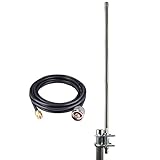
A sealed fiberglass collinear tuned specifically for 1090 MHz, such as the 66 cm antenna FlightAware sells for its feeder kits, is the safest buy. Its gain (about 5 dBi per the manufacturer’s class of spec) is concentrated toward the horizon, which is where aircraft at distance appear. It is built for rain, UV and wind, and it has a proper N or SMA connector so you are not forced to use a thin lead.
Who it suits: anyone who wants a set-and-forget feeder on a roof, chimney, balcony rail or pole.
Trade-off: you need to run coax, and cable choice can undo the antenna’s advantage (see the calculation below).
Best budget: 1090-tuned magnetic whip
A small magnetic-base whip designed for 1090 MHz (many RTL-SDR vendors sell kits like this) is the cheapest way to get aircraft on screen. Put it on a metal surface, such as a window frame, a baking tray or a car roof, because the metal acts as the ground plane. Expect good results out to a modest radius, with coverage depending heavily on what is outside the window.
Trade-off: the thin lead is lossy and the antenna usually sits low and indoors. It is a good first step, not a long-term answer.
Best DIY: quarter-wave ground plane
At 1090 MHz the wavelength is 299.79 / 1090 = 0.275 m. A quarter wave is about 68.8 mm in free space, so cut the vertical element to roughly 65–68 mm, allowing for the connector, and add four radials about 70 mm long angled down about 45 degrees. Mount it on a panel-mount SMA or N connector. Builders commonly report it matching commercial 3 dBi-class antennas, but the result depends on your cutting accuracy.
Trade-off: you have to be careful with soldering and weatherproofing, and it has lower gain than a collinear.
Best for long range: high-gain collinear
If your horizon is flat and you are in an area with sparse traffic, a longer 7–9 dBi collinear gives you more reach at low elevation angles. Higher gain means a narrower vertical beam, so aircraft passing close overhead may be weaker. It must also be mounted perfectly vertical.
Trade-off: a mast that sways in wind or leans will reduce the benefit, and these are more expensive and longer than ordinary antennas.
Best for small spaces: compact stub
A short stub or a small indoor antenna suits apartments and renters who cannot drill or run cable. Treat it as a “nearby aircraft” setup, such as flights on approach to a local airport, rather than a long-range feeder.
Worked example: why coax and preamp placement matter more than antenna gain
Assume a 15 m (about 50 ft) run from the roof to your computer. Approximate attenuation at 1 GHz, per typical manufacturer cable charts:
| Cable | Loss at ~1 GHz per 100 ft | Loss for a 50 ft run |
|---|---|---|
| RG-174 | ~30 dB | ~15 dB |
| RG-58 | ~20 dB | ~10 dB |
| RG-6 (75 ohm) | ~6 dB | ~3 dB |
| LMR-400 (50 ohm) | ~4 dB | ~2 dB |
Switching from a 5 dBi antenna to a 9 dBi antenna gains 4 dB. Switching from RG-58 to LMR-400 gains about 8 dB on that run, which is more than twice as much.
Now the preamp. Suppose an LNA with a 1 dB noise figure and 20 dB gain, a 10 dB cable loss, and a dongle with a 6 dB noise figure. Using the Friis cascade formula:
- LNA at the antenna: system noise figure is about 2.2 dB.
- LNA at the receiver, after the cable: system noise figure is about 11 dB.
That is almost a 9 dB difference from placement alone. The rule is to put the filtered LNA as close to the antenna as possible, and keep the rest of the run short or low-loss. Many dongles with built-in filters and LNAs, such as the FlightAware Pro Stick Plus, are sensible if the dongle sits next to the antenna with only USB or network running indoors.
Does height matter?
Radio horizon in nautical miles is about 1.23 × (√antenna height in ft + √aircraft height in ft). For a 35,000 ft airliner (√ ≈ 187):
- Antenna at 10 ft: about 234 nm
- Antenna at 30 ft: about 237 nm
- Antenna at 100 ft: about 242 nm
The numbers barely change, so for high-flying aircraft, height only matters for clearing obstructions, such as the building next door or a hill. For low aircraft at 3,000 ft (√ ≈ 55), moving from 10 ft to 100 ft raises the horizon from about 71 nm to about 80 nm. Practically, one clear line of sight is worth more than any gain figure.
Decision matrix: match your situation to a choice
| Your situation | Choose | Cable and filtering |
|---|---|---|
| Apartment, window facing an airport | Magnetic whip or compact stub | Short lead, keep it under 3 m, filtered dongle |
| House with roof or chimney access | Outdoor 5 dBi collinear | LMR-400-class coax if over 10 m; filtered LNA at the mast |
| Rural, open horizon, little traffic | 7–9 dBi collinear on a mast | Low-loss coax, LNA at the antenna |
| Strong cellular or FM sources nearby | Any antenna plus a 1090 MHz bandpass filter | Put the filter before the LNA |
| Tight budget, enjoys building things | DIY quarter-wave | Short coax, dongle nearby, Raspberry Pi at the window |
What to avoid
- Wideband and “scanner” antennas: they receive 1090 MHz poorly and pick up more out-of-band noise.
- TV antennas: they are made for different bands and polarization.
- Horizontal mounting: ADS-B uses vertical polarization, so mounting a collinear sideways loses several dB.
- Stacked adapters: each additional connector adds a bit of loss and a place for water to get in.
- Metal obstructions in the first meter: they distort the pattern, especially for a collinear.
How to choose: a short checklist
- Confirm the antenna is tuned for 1090 MHz, not 978 MHz or a generic range.
- Decide the mounting spot first and find out whether you need a cable run.
- Pick coax to keep loss under about 3 dB.
- Use a filtered LNA at the antenna if the cable run is more than a few meters.
- Mount it vertically, away from other antennas and metal.
- Check your coverage map in your decoder software after a day, then adjust location before spending on a bigger antenna.
Frequently Asked Questions
What is the best antenna for 1090 MHz ADS-B?
For most people, a vertical fiberglass collinear tuned to 1090 MHz and mounted outdoors is the best option. It offers around 5 dBi gain, weather resistance and a proper connector. Pair it with low-loss coax and a filtered preamp near the antenna.
Can I use a 978 MHz antenna for 1090 MHz?
It will receive some signal, but a 978 MHz antenna is tuned about 10% too low and will perform worse. A 1090-tuned antenna is a much better choice, and 978 MHz UAT is a separate system used in the United States.
Do I need a preamp or filter?
Often yes, particularly with a long cable or strong cellular signals nearby. A 1090 MHz bandpass filter reduces out-of-band interference, and an LNA near the antenna overcomes cable loss. If the dongle sits right at the antenna, a built-in filter and LNA may be enough.
Is a higher-gain antenna always better?
No. Higher gain narrows the vertical beam, so nearby aircraft overhead may be weaker, and a poorly mounted or leaning high-gain antenna can underperform a simple 3–5 dBi model. Location and cable loss usually matter more than a few dB of gain.
How far can a 1090 MHz antenna receive aircraft?
Line of sight limits range, and a clear horizon can reach roughly 200+ nautical miles for aircraft at cruise altitude. In practice, buildings, trees and terrain reduce that substantially, and results vary by setup.
Can I build my own 1090 MHz antenna?
Yes. A quarter-wave ground plane with a vertical element of about 65–68 mm and four radials is a popular build. Take care with cutting length, soldering and weatherproofing, and check your coverage against a commercial antenna if you can.
Related guides
More from Amazon
Programs that pair well with the guide above. Offers and eligibility are set by Amazon and may change.
A free business account with business pricing and bulk-buying tools for work, shop or home office.
Create a business accountFree shipping on eligible items, Prime Video and more. Eligible new members can start with a free trial.
Start a Prime free trialAudiobooks and podcasts to listen to on the go. Eligible new members can start with a free trial.
Try Audible freeAd-free music streaming. Eligible new subscribers can start with a free trial.
Try Music Unlimited freeAs an Amazon Associate we earn from qualifying purchases.


