The best watch with a 2035 movement is a 36–40 mm stainless steel three-hand quartz model that names the Miyota 2035 on its spec sheet, has a screw-down or snap-tight caseback you can service, and costs roughly $60–$150. The 2035 is a basic Citizen Miyota quartz movement for time and date, so the case, crystal, water resistance and battery access matter more than the movement name. This guide treats “2035 movement” as the Miyota 2035 and compares spec classes, because many brands do not publish movement codes for every model.
As an Amazon Associate we earn from qualifying purchases at no extra cost to you.
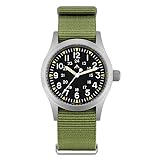
Quick comparison of the best 2035-movement options
| Pick | Best for | Key specs | Typical price |
|---|---|---|---|
| Microbrand 3-hand field/dive-style quartz (Miyota 2035 listed) | Best overall | 36–40 mm, 100–200 m water resistance, steel, sapphire or hardened mineral, date at 3 | $60–$150 |
| Mainstream fashion quartz with Miyota 2035 | Best budget | 38–42 mm, 30–50 m water resistance, alloy or thin steel case, mineral glass | $25–$60 |
| Bare Miyota 2035 movement plus dial/hands kit | Best for DIY and mods | Movement only, standard stem, 377/SR626SW cell, date wheel | $15–$40 |
| Slim dress quartz, 7–9 mm thick | Best for desk and typing | Under 9 mm case, flat caseback, leather or mesh strap | $50–$130 |
| Citizen Eco-Drive (alternative, different movement) | Best no-battery-change option | Solar charging, no routine battery swaps, usually 100 m | $150–$300 |
| Casio F-91W (alternative, digital) | Best ultra-cheap backup | Digital quartz, 30 m water resistance, resin case, about 21 g | $15–$25 |
Prices are general market ranges and shift by seller and region. The last two rows are not 2035 watches. They are the closest real alternatives for readers who want reliable, cheap quartz.
What the Miyota 2035 actually is
The Miyota 2035 is a standard analog quartz movement made by Citizen’s Miyota division. It is a three-hand movement with a date window, commonly sold both inside finished watches and as a replacement part for hobbyists. Watchmakers and microbrands like this class of movement because it is cheap, easy to source and easy to service. Check the exact specs (size, stem, cell type) with the seller or the movement maker’s spec sheet before buying a replacement, since variants exist.
Note that “2035” is a movement code, not a model year. A listing that says “2035 edition” with no movement named may be using the year as a marketing label.
Best overall: 36–40 mm microbrand three-hand quartz
This is the spec class to buy if you want a watch that looks more expensive than it is. Look for a steel case, a screw-down crown, 100 m or better water resistance and a replaceable crystal. The 36–40 mm range suits most wrists and keeps weight low enough that it does not knock on a desk or mouse pad.
Trade-off: microbrands vary in support. Confirm the seller names the movement, offers a warranty and lets you open the caseback for a battery swap without voiding it.
Best budget: mainstream fashion quartz
At $25–$60 you get the same basic timekeeping as a $150 watch, so the money goes to the case, the strap and the finishing. The movement is usually the best part. Expect 30–50 m water resistance, which means splash-proof only, not swimming.
Trade-off: alloy cases and thin plating wear fast, and the strap is often the first thing to fail. Budget about $10–$20 for a better strap.
Best for DIY and mods: bare movement and kit
If you like building things, a loose 2035 movement with a dial, hands and case kit is the cheapest way into watch modding. The process is similar to a PC build: standard parts, interchangeable cases and a few simple tools such as a case-back opener and hand-setting tweezers.
Trade-off: hand fitment, dial feet and stem length are easy to get wrong. Match the movement’s dial size and date position to the dial you buy, and expect a few failed attempts.
Best for desk and typing: slim dress quartz
Thickness matters if you spend hours at a keyboard. A 12 mm watch can catch on a wrist rest, while a 7–9 mm case slides under a cuff or glides over a desk. Quartz suits slim cases because it needs no thick rotor or mainspring stack.
Trade-off: slim cases usually give up water resistance and a lot of lume, so they suit offices better than outdoor use.
Alternatives worth considering
A Citizen Eco-Drive uses a solar cell instead of a replaceable battery, which removes the swap entirely if you wear it regularly. The Casio F-91W is a classic digital quartz at a very low price, and it makes a good beater watch. Neither uses a Miyota 2035, so treat them as substitutes rather than matches.
How to choose: a decision matrix
| Your situation | Choose | Why |
|---|---|---|
| First quartz, daily wear, small wrist | 36–38 mm microbrand three-hand | Best fit and finish per dollar |
| Need it to survive swimming or showers | 100 m+ with screw-down crown | 30–50 m ratings are splash-only |
| Under $40 total | Mainstream fashion quartz | The movement is the same class at lower cost |
| Want to build or mod | Bare movement and case kit | Cheapest entry and most flexibility |
| Hate changing batteries | Eco-Drive-style solar | No routine cell swap |
| Long typing sessions | Under 9 mm slim case | Fewer wrist-rest snags |
Worked numbers: accuracy and battery life
Accuracy. Miyota-class quartz movements are typically rated around ±20 seconds per month, according to the manufacturer’s published ratings for this movement family. Over a month of about 2,592,000 seconds, that is roughly 7.7 parts per million. Over a year, expect a worst-case drift of about ±240 seconds, or 4 minutes. A mechanical watch rated at ±20 seconds per day drifts up to ±600 seconds in a month, so quartz is about 30 times more accurate on that basis.
Battery life. A common 377 / SR626SW silver-oxide cell holds roughly 26–28 mAh, depending on the maker. A three-year life, the figure usually quoted for this movement class, is about 26,280 hours. That works out to an average draw of about 28 mAh ÷ 26,280 h ≈ 1.1 µA. If the draw is higher because of a stiff date mechanism or a weak cell, life can fall to 18–24 months. Plan to replace the cell every 2–3 years and do not wait for it to leak.
Checks before you buy
- Movement named on the listing: if the seller will not confirm “Miyota 2035” or a close equivalent, assume it is a generic movement.
- Caseback type: screw-down backs need a case-back wrench. Snap-on backs need a thin blade. Pressed-in or ultrasonically welded backs make battery changes harder.
- Lug width and strap: 18, 20 and 22 mm are the common sizes. Quick-release spring bars save time and prevent scratches.
- Crystal: sapphire resists scratches better, while mineral glass is cheaper and easier to polish.
- Date position: check that the date window and quickset behavior suit you. Avoid changing the date between roughly 9 pm and 3 am on any date-quartz movement.
- Magnetism: quartz is more tolerant of magnetic fields than mechanical watches, but keep the watch off speaker magnets and some wireless chargers.
Frequently Asked Questions
What is a 2035 movement in a watch?
It almost always refers to the Miyota 2035, an analog quartz movement made by Citizen’s Miyota division with hour, minute and second hands plus a date. It is widely used in budget and microbrand watches and sold as a replacement part.
Is a Miyota 2035 movement good?
For a quartz movement, yes. It is accurate to roughly ±20 seconds a month per the manufacturer’s rating, runs for about three years on one cell and is cheap to replace. It is a basic, reliable workhorse rather than a premium movement.
How often should I replace the battery?
Plan on every two to three years, and replace a dead cell promptly because a depleted cell can leak and damage the movement. If the second hand starts jumping in four-second steps, the cell is near the end of its life.
Can I replace a 2035 movement myself?
Yes, if you have a case-back opener, hand tweezers and a clean workspace. Match the movement’s dimensions, stem and date position to your dial and case. For water-resistant watches, have the gaskets checked or replaced afterward.
Is quartz better than mechanical for daily wear?
Quartz is cheaper, more accurate and lower maintenance, so it suits daily wear and travel. Mechanical watches appeal for craftsmanship and longevity but drift much more and need periodic servicing.
How much should I spend on a 2035-movement watch?
Most good options fall between $25 and $150. Spend more only for better materials like sapphire or steel, not for better timekeeping, because the movement performs the same across that range.
Related guides
More from Amazon
Programs that pair well with the guide above. Offers and eligibility are set by Amazon and may change.
A free business account with business pricing and bulk-buying tools for work, shop or home office.
Create a business accountFree shipping on eligible items, Prime Video and more. Eligible new members can start with a free trial.
Start a Prime free trialAudiobooks and podcasts to listen to on the go. Eligible new members can start with a free trial.
Try Audible freeAd-free music streaming. Eligible new subscribers can start with a free trial.
Try Music Unlimited freeAs an Amazon Associate we earn from qualifying purchases.

