The best car pedal extenders for most short drivers are rigid, adjustable-length, bolt-on or clamp-on units that raise the pedal face toward the driver by 2–6 inches without flex, rattle or slip. If you need a permanent fit or a large extension, a professionally installed fixed bracket from a mobility or adaptive-equipment dealer is the safer route. Measure first: the goal is to move your seat back until your breastbone is at least 10 inches from the steering wheel airbag cover (the distance NHTSA recommends), then extend the pedals only as far as that move requires.
This guide covers the main extender types, a worked sizing example, and a decision matrix. It names spec classes rather than specific models. Fit depends heavily on the vehicle’s pedal arm shape, so confirm compatibility with the manufacturer’s fitment list before you buy.
As an Amazon Associate we earn from qualifying purchases at no extra cost to you.
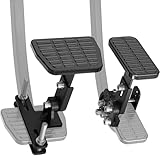
Quick comparison of the main extender types
| Pick (type) | Best for | Key specs | Typical price range |
|---|---|---|---|
| Adjustable bolt-on extender pair | Best overall: daily drivers 4’10″–5’3″ who want a custom reach | 2–6 in. of adjustment, steel or aluminum frame, bolts or clamps to pedal arm, set of 2 (3 for manuals) | Usually $50–$200 |
| Fixed-height clamp-on extender | Best budget: shared or older cars, short-term use | Fixed 2–4 in. rise, strap or U-bolt clamp, rubber face | Usually $25–$90 |
| Professionally installed fixed bracket | Best for permanent or large extensions (5 in.+) | Custom-fit to the vehicle, welded or through-bolted, installed by adaptive-equipment dealer | Usually $200–$700 including labor |
| Full pedal-box relocation or hand controls | Best for mobility needs beyond height | Dealer-fitted, often certified to the vehicle | Often $500–$1,500+ depending on setup |
| Sim-rig pedal-plate extension | Best for gaming rigs, not road cars | Aluminum plate or sled spacer, adjustable on a rig rail | Usually $20–$100 |
Best overall: adjustable bolt-on extender pair
An adjustable pair lets you dial in reach in small steps, which matters because most drivers need less extension than they expect. Look for a rigid frame that attaches at the pedal arm, not just the pedal pad, and for a wide, textured face so your shoe cannot slip off the edge. Slotted adjustment with at least two fasteners per pedal resists twisting better than a single thumbscrew.
Trade-off: more adjustability means more fasteners that can loosen. Check them with a hex key every few weeks, and use thread-locking compound if the manufacturer’s instructions allow it.
Best budget: fixed-height clamp-on extender
Clamp-on units are the cheapest way to add a fixed rise of roughly 2–4 inches without tools beyond a screwdriver. They suit a second car or a short trial, so you can find out how much extension you actually need before paying for a custom fit.
Trade-off: a clamp relies on friction and pad shape. On pedals with an unusual curve or a small pad, it may creep or rattle. Skip any budget unit with a thin sheet-metal face or loose strap hardware.
Best for permanent or large extensions: professional fixed bracket
If you need more than about 5 inches, or you share a car with a taller driver and want a stable, repeatable setup, a dealer-installed bracket is the better choice. Installers can match the bracket to your pedal geometry and check pedal travel, floor-mat clearance and brake-light switch operation after fitting. In many regions, adaptive-equipment installers also document the modification, which helps with insurance.
Trade-off: cost and less flexibility. A fixed bracket is harder to adjust if your seat position or shoes change.
Best for gaming rigs: sim-rig pedal extension
Sim-racing pedals sit on a plate or sled rather than a factory pedal arm, so a car extender does not apply. Instead, move the pedal base closer using a longer rail or a spacer plate. Keep the pedal angle roughly where you want your ankle to rest. Because a rig is not a road vehicle, you can experiment freely here.
Worked example: how much extension do you need?
Pedal extenders solve one problem: you are sitting too close to the wheel to reach the pedals. The extension you need roughly equals the distance you want to move the seat back.
- Measure current clearance. With your normal seating position, measure from your breastbone to the airbag cover in the wheel hub. Example: 6 inches.
- Set the target. NHTSA advises at least 10 inches. The gap is 10 − 6 = 4 inches.
- Account for other fixes. Raising the seat height, tilting the wheel toward your chest and reclining the seatback slightly can add about 1 inch. The remaining need is about 3 inches.
- Add margin for ankle comfort. Choose an extender whose range covers 3 inches plus about 1 inch of adjustment, so you can fine-tune. In this case, a 2–5 inch adjustable unit fits.
- Verify with the car off. Fully press each pedal. Your knee should stay slightly bent at the bottom of travel (about 20–30 degrees is commonly cited ergonomic guidance), and your heel should stay planted for the brake.
| Current clearance | Target | Gap | Minus seat/wheel adjustments (~1 in.) | Suggested extension range |
|---|---|---|---|---|
| 8 in. | 10 in. | 2 in. | 1 in. | Fixed 1.5–2 in. or adjustable 1–3 in. |
| 6 in. | 10 in. | 4 in. | 3 in. | Adjustable 2–5 in. |
| 4 in. | 10 in. | 6 in. | 5 in. | Professional fixed bracket or dealer assessment |
Decision matrix: which type fits your situation?
| Your situation | Choose | Why |
|---|---|---|
| Need 1–3 in., one driver, automatic | Fixed clamp-on or small adjustable pair | Low cost, quick to remove |
| Need 3–5 in., daily driver | Adjustable bolt-on pair | Fine-tuning and stronger attachment |
| Need 5 in. or more | Professional bracket | Safer for large offsets and better pedal geometry |
| Manual transmission | Three-pedal set, adjustable | The clutch must match brake and throttle height |
| Drivers of different heights share the car | Quick-release adjustable, or alternative such as an adjustable pedal option if the vehicle offers one | Easy to remove and reset |
| Limited leg strength or mobility | Adaptive-equipment assessment | Extenders do not reduce pedal effort |
What to check before you buy
Rigidity and attachment point
The extender must not flex under heavy braking. Look for steel or thick aluminum construction and attachment to the pedal arm itself. Avoid designs that rely only on gripping the rubber pad.
Face size and grip
A face that is at least as wide as the original pedal, with a textured or rubberized surface, reduces the chance of your foot sliding off, especially in wet-weather shoes.
Pedal spacing
Extenders move pedals toward you, and they can also change the spacing between brake and throttle. Confirm that the brake and throttle faces are still separate and that you cannot press both by accident. Both extenders should sit at similar heights unless the original pedals are offset.
Full travel and brake-light operation
After installation, press each pedal through its full range. The pedal should not touch the floor mat, carpet, center console or the other pedal. The brake lights should come on at light pressure and go off when you release.
Fitment and legality
Pedal extender rules and insurance requirements vary by region. Check with your insurer and local licensing authority. Do not use extenders on vehicles with a pedal design the manufacturer specifically excludes.
Frequently Asked Questions
Are pedal extenders safe?
They can be when they are rigid, correctly sized and securely fastened to the pedal arm, and when they allow full pedal travel without snagging. Poorly fitted or flimsy extenders can slip or flex, so inspect them regularly. For large extensions or any doubt, use a professional installer.
How far should I sit from the steering wheel?
NHTSA recommends at least 10 inches between your breastbone and the airbag cover. If you cannot reach the pedals at that distance, pedal extenders are intended to close the gap rather than moving you closer to the wheel.
Can I use extenders in a manual car?
Yes, but you need a set that covers the clutch, brake and throttle. The clutch extender must match the others in height and not interfere with the pedal’s return. Because a stalled or mistimed clutch has direct consequences, have the setup checked before driving in traffic.
Do pedal extenders work for sim racing?
Car extenders are made for factory pedal arms, so they do not suit most sim pedal sets. For a rig, adjust the pedal base position on the rail or add a spacer plate. This is also how you tune pedal angle for ankle comfort.
Is there an alternative to pedal extenders?
Yes. Some vehicles have power-adjustable pedals, and a dealer can fit hand controls or a relocated pedal box for specific mobility needs. Seat risers, a steering wheel with more tilt and telescoping range, or a different driving shoe can also reduce the amount of extension you need.
Related guides
More from Amazon
Programs that pair well with the guide above. Offers and eligibility are set by Amazon and may change.
A free business account with business pricing and bulk-buying tools for work, shop or home office.
Create a business accountFree shipping on eligible items, Prime Video and more. Eligible new members can start with a free trial.
Start a Prime free trialAudiobooks and podcasts to listen to on the go. Eligible new members can start with a free trial.
Try Audible freeAd-free music streaming. Eligible new subscribers can start with a free trial.
Try Music Unlimited freeAs an Amazon Associate we earn from qualifying purchases.

