For most gaming PCs in 2026, the best CPU cooler is a dual-tower air cooler such as the Thermalright Peerless Assassin 120 SE (usually $30–$40). If you want a 360 mm AIO instead, the Arctic Liquid Freezer III 360 is the strongest all-round pick. Your CPU’s sustained wattage, your case’s clearance and your noise target decide the rest, and those matter more than any single ranked list.
Roundups from outlets like PCMag are a useful starting point, but they change often and cannot know your case. This guide gives you the decision criteria and a worked heat calculation, then maps each situation to a cooler class.
As an Amazon Associate we earn from qualifying purchases at no extra cost to you.

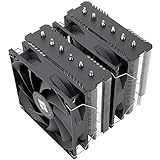


Top 3 picks at a glance
Quick comparison of the best CPU coolers
| Pick | Best for | Key specs (per manufacturer) | Typical price |
|---|---|---|---|
| Thermalright Peerless Assassin 120 SE | Best value air cooler | Dual tower, 6 heat pipes, two 120 mm fans, ~155 mm tall | $30–$40 |
| Noctua NH-D15 G2 | Best premium air / quietest high-power | Dual tower, three-fan-capable design, ~168 mm tall, long warranty | $130–$150 |
| Deepcool AK400 | Best budget | Single tower, 120 mm fan, ~155 mm tall | $20–$35 |
| Arctic Liquid Freezer III 360 | Best AIO for hot CPUs | 360 mm radiator, 38 mm thick, three 120 mm fans, VRM fan | $100–$140 |
| Noctua NH-L12S | Best compact / small case | Low-profile tower, ~70 mm tall, 120 mm fan | $60–$80 |
Best value: Thermalright Peerless Assassin 120 SE
This is the default answer for Ryzen 7 and Core i7-class chips. Its twin-tower fin stack gives it large surface area for the price, and it is widely reported in published reviews to land near coolers costing three to four times as much. It suits builders who want strong cooling and do not mind a plain look.
Trade-off: It is about 155 mm tall and wide enough to crowd tall RAM on some boards. Check your case’s stated CPU cooler clearance, since many slim cases stop at 150–155 mm.
Best premium air: Noctua NH-D15 G2
If you want a flagship air cooler with low noise at high loads, this is it. Its larger fin area and offset design are made for hot CPUs and sustained all-core work. It is also the choice when you do not want a pump or a leak risk. Noctua backs it with a long warranty and a mounting kit that covers current AMD and Intel sockets.
Trade-off: It is big (about 168 mm tall) and costs several times more than the Peerless Assassin for a modest temperature gain.
Best budget: Deepcool AK400
The AK400 is for Ryzen 5 and Core i5 builds, and for anyone replacing a weak stock cooler. It is simple, inexpensive and fits most mid-tower cases and RAM layouts.
Trade-off: A single tower runs out of headroom on 200 W+ CPUs. Expect higher fan speeds and noise under heavy rendering loads.
Best AIO: Arctic Liquid Freezer III 360
A thick 360 mm radiator moves a lot of heat at moderate fan speeds, which is why it suits Core Ultra 9, Core i9 and Ryzen 9 chips that spike to 200 W+. It also tends to price below name-brand rivals with similar performance, and its extra fan on the VRM area helps board temperatures.
Trade-off: You need a case with a 360 mm top or front mount and enough radiator-plus-fan thickness. Check your case’s spec sheet for the supported radiator size.
Best compact: Noctua NH-L12S
For small-form-factor cases that allow around 70 mm of CPU height, this is a practical low-profile option for 65–125 W gaming CPUs. Check your case’s cooler height limit, since some ITX cases allow only 47–65 mm. Those will need a thinner cooler such as Noctua’s NH-L9 series.
Trade-off: Low-profile coolers cannot sustain 200 W+ CPUs without loud fans. Use an efficient chip or a power limit.
How much cooler do you need? A worked calculation
A cooler’s real job is to keep the thermal resistance between the CPU and room air low enough. A rough method:
- Take the CPU’s sustained power (PPT for AMD, maximum turbo power for Intel, per the vendor’s spec sheet).
- Pick a target temperature, such as 80 °C, leaving margin below the 95–100 °C throttle points.
- Subtract the air temperature around the cooler (about 35 °C inside a case in a 27 °C room).
- Divide: required thermal resistance (°C/W) = (target − case air) ÷ power.
Example: a 250 W CPU with an 80 °C target gives (80 − 35) ÷ 250 = 0.18 °C/W. A 120 W CPU gives 45 ÷ 120 = 0.375 °C/W, so the cooler can have about double the thermal resistance. That is why a $25 tower is fine for the second chip and badly stretched for the first. These are simplified estimates. Real results vary with the CPU’s die size, paste, fan curve and case airflow.
| CPU example | Approx. sustained power | Required resistance at 80 °C target | Cooler class |
|---|---|---|---|
| Ryzen 5 9600X | ~88 W | ~0.51 °C/W | Budget tower (AK400) or low-profile |
| Ryzen 7 9800X3D | ~160 W | ~0.28 °C/W | Dual tower or 240 mm AIO |
| Ryzen 9 9950X | ~230 W | ~0.20 °C/W | Premium dual tower or 360 mm AIO |
| Core Ultra 9 285K / Core i9-14900K | ~250 W+ | ~0.18 °C/W or lower | 360 mm AIO or NH-D15 G2 class |
Decision matrix: match your situation to a cooler
| Your situation | Choose | Why |
|---|---|---|
| Midrange gaming PC, under $1,200 build | Peerless Assassin 120 SE or AK400 | Plenty of headroom for 65–120 W chips at low cost |
| Case clearance under 155 mm | Slim tower or 240/280 mm AIO | Tall dual towers will not close the side panel |
| 200 W+ CPU, heavy rendering | 360 mm AIO or NH-D15 G2 | Lower resistance at moderate fan speed |
| Quiet-first build | Large tower with 120–140 mm fans at under 1,000 RPM | Bigger fin area beats faster fans |
| Mini-ITX under ~70 mm clearance | NH-L12S class plus a power limit | Fits, and a lower power limit keeps noise reasonable |
| You move or ship the PC often | Air cooler | No pump, no leak risk, nothing to replace |
What to check before you buy
- Socket support: AM5 and LGA1700/LGA1851 need compatible brackets. Many LGA1700 coolers fit AM5 using included hardware, but confirm on the maker’s compatibility list.
- Clearance: Compare cooler height with your case’s CPU cooler limit. For AIOs, check radiator size and thickness, and whether fans plus radiator clear your RAM and motherboard.
- RAM overhang: Dual-tower coolers can block the first DIMM slot with tall modules.
- Fan noise: Look for PWM fans that idle below roughly 800 RPM. A fan curve helps more than a different cooler.
- Warranty and pump life: AIO warranties usually run 2–6 years. Air coolers often cover fans too.
Frequently Asked Questions
Is an AIO better than air cooling?
Not automatically. A good dual-tower air cooler matches many 240 mm AIOs in temperatures and has fewer failure points. A 360 mm AIO pulls ahead on CPUs above roughly 200 W, or when you want a clean look around the socket.
Do I need an aftermarket cooler for a Ryzen 7 9800X3D?
Yes, because AMD does not include a cooler with it. A quality tower such as the Peerless Assassin 120 SE or a 240 mm AIO handles it well. The chip’s heat sits in a dense area, so temperature spikes occur even at moderate power draw.
How tall a cooler fits my case?
Check the “maximum CPU cooler height” in the case’s manufacturer spec sheet. Many mid-towers allow 160–170 mm, slim cases 150 mm or less, and ITX cases as little as 47–70 mm. Leave a few millimetres of margin for the side panel.
How often should I replace thermal paste?
Every 3–5 years for most users, or sooner if temperatures climb noticeably under the same load. Cooler-supplied paste is usually adequate. Paste matters less than correct mounting pressure and fan setup.
Can I use a 120 mm single-tower cooler on a Core i9?
Only if you cap its power. At stock limits of 250 W+, a single tower will run hot and loud. Setting a lower power limit in the BIOS trades a small amount of multi-core performance for much lower temperatures.
Related guides
More from Amazon
Programs that pair well with the guide above. Offers and eligibility are set by Amazon and may change.
A free business account with business pricing and bulk-buying tools for work, shop or home office.
Create a business accountFree shipping on eligible items, Prime Video and more. Eligible new members can start with a free trial.
Start a Prime free trialAudiobooks and podcasts to listen to on the go. Eligible new members can start with a free trial.
Try Audible freeAd-free music streaming. Eligible new subscribers can start with a free trial.
Try Music Unlimited freeAs an Amazon Associate we earn from qualifying purchases.


