
Buying a gaming pc d on a prebuilt budget is one of the most confusing decisions in PC hardware right now. The market spans from renewed office towers dressed up with RGB strips to high-end custom builds with flagship silicon, and the price gap between them is enormous. The core problem a buyer faces is figuring out whether a given machine will actually run the titles they care about at acceptable settings, and whether the value proposition holds up against the alternatives at each price tier.
What separates a genuinely worthwhile prebuilt from a spec-sheet mirage comes down to GPU class, CPU architecture, memory bandwidth, and upgrade headroom. A machine with a current-generation RTX card and DDR5 memory will stay relevant far longer than one with a GTX 750 Ti and older DDR3 boards, even if the price difference seems steep at first glance. Owner feedback consistently highlights thermal management, power supply quality, and customer service responsiveness as the factors that turn a good spec list into a good daily experience. This roundup covers eight options across every budget tier, comparing published specifications and verified owner reports to help you find the right gaming pc d for your needs.
As an Amazon Associate we earn from qualifying purchases at no extra cost to you.


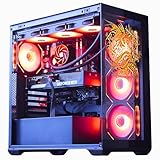


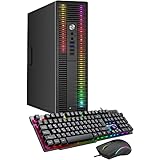

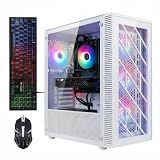
Top 3 picks at a glance
Quick Picks
| Product | Best for | Price |
|---|---|---|
| KOTIN Ryzen 7 8700F / RTX 5060 Ti | 1080p high-refresh gaming | $1,299.99 |
| KOTIN Ryzen 7 9700X / RTX 5070 | 1440p gaming without compromise | $1,999.99 |
| Horizon Autherium Dragon i9 / RTX 5070 OC | VR and content-creation workloads | $2,899.99 |
| Dell i7 6th Gen / GTX 1050 Ti (Renewed) | Light esports on a tight budget | $379.99 |
| STGAubron i5 / GTX 750 Ti | Entry-level gaming for older titles | $419.99 |
| HP ProDesk i5 6500 (Renewed) | Desktop replacement with RGB flair | $179.99 |
| MUSETEX K2 Case | Diy builders who want a polished chassis | $79.99 |
| STGAubron i7 / RX 470 | Budget 1080p in medium settings | $499.69 |
How We Picked
We evaluated each product against four criteria: GPU capability relative to current game demands, CPU generation and upgrade path, overall build quality as reported by long-term owners, and price-to-performance ratio within its tier. Systems with single-digit GPU generations or office-class processors were included only where their price point made them a reasonable choice for specific use cases like esports or secondary machines.
The 8 Best Gaming PC D in 2026
KOTIN Gaming PC Desktop with Ryzen 7 8700F and RTX 5060 Ti
This is the sweet-spot machine for anyone targeting smooth 1080p gameplay with room to push into 1440p at moderate settings. The Ryzen 7 8700F pairs well with the RTX 5060 Ti’s 8GB of VRAM, giving you enough headroom for high-texture loads in modern titles without bottlenecking the GPU.
- Current-gen RTX GPU delivers excellent ray-tracing performance for its class
- DDR5 memory and a 1TB NVMe SSD keep load times short and multitasking fluid
- 16GB of RAM may require an upgrade within a year or two for heavier workloads
Skip this if you plan to run VR or do video editing, where the 8GB VRAM ceiling and modest RAM will limit you.
KOTIN Prebuilt Gaming PC with Ryzen 7 9700X and RTX 5070
Step up to the 9700X platform and an RTX 5070 with 12GB VRAM, and you have a machine that handles 1440p gaming comfortably while remaining viable for entry-level 4K. The 32GB DDR5 configuration means you are not forced into a memory upgrade anytime soon.
- 12GB VRAM provides meaningful longevity for high-resolution texture packs and AI upscaling
- Ryzen 7 9700X is a current-generation chip with strong single-thread performance
- Price is nearly double the 5060 Ti option, which demands real value justification
Skip this if your monitor is 1080p and you do not care about ray tracing or DLSS-heavy titles, because the 5060 Ti machine covers that use case at far less cost.
The Horizon Autherium Dragon RGB with Core i9 and RTX 5070 OC
For VR enthusiasts and multitaskers, this is the most overbuilt system on the list. Sixty-four gigabytes of RAM, five terabytes of storage, an overclocked RTX 5070, and a 360mm AIO cooler mean this machine was designed for people who run demanding simulations while streaming or editing.
- The Core i9 with 5.4GHz boost clock handles heavy CPU loads that would bottleneck lesser chips
- 2.4GB/s WiFi and a massive storage array suit media libraries and large game installs
- The price premium over the KOTIN 5070 build buys quantity of RAM and storage, not a faster GPU
Skip this if pure gaming frame rates are your only priority; the KOTIN 5070 option delivers nearly identical GPU performance at a significantly lower cost.
Dell RGB Gaming Tower with i7 6th Gen and GTX 1050 Ti (Renewed)
This renewed Dell is the cheapest way to get a dedicated GPU in a prebuilt. The GTX 1050 Ti still handles esports titles at 1080p with medium-to-high settings, and the i7 6th Gen, while dated, is not a severe bottleneck at that resolution.
- RGB lighting and a Windows 11 Pro license at under $400 is a genuine value proposition for casual players
- Built-in WiFi removes the need for a separate adapter
- 6th-generation architecture means no PCIe 4.0 storage and no path to modern GPUs without a full replacement
Skip this if you want to play recent AAA titles above medium settings; the GPU simply lacks the power.
STGAubron Gaming PC Desktop with Core i5 and GTX 750 Ti
The GTX 750 Ti is one of the oldest cards still sold new in prebuilts. At 4GB VRAM, it handles older titles and light esports well, but modern games at 1080p will require low settings and may still stutter.
- Very low entry price makes it viable as a first PC for young gamers
- 16GB RAM and 512GB SSD provide a serviceable multitasking and storage baseline
- The GPU is several generations behind and will struggle with anything released in the last few years at playable settings
Skip this unless your game library consists of older titles or competitive shooters that scale down well.
HP ProDesk Desktop RGB Lights with Core i5 6500 (Renewed)
Honestly, this is an office PC wearing a costume. The Core i5 6500 and integrated graphics are not a gaming platform by any modern standard. The RGB lighting and included keyboard and mouse make it appealing for desk aesthetics, but do not expect frame rates in recent titles.
- At under $200, it serves as a capable web browsing, office, and light media machine
- Windows 11 Pro and included peripherals make it a complete desktop solution out of the box
- No dedicated GPU means gaming performance is limited to the iGPU, which handles almost nothing current
Skip this for any serious gaming use. Buy it as a general-purpose desktop with a fun light show if that is what you need.
MUSETEX ATX PC Case with 7 PWM ARGB Fans
This is not a complete gaming pc d but a chassis for DIY builders. Seven pre-installed PWM fans and dual tempered glass panels make it one of the best-value showpieces available, and the Type-C front panel keeps it compatible with modern boards.
- Seven ARGB fans pre-installed eliminates the need to buy cooling separately
- Mid-tower ATX form factor fits most consumer motherboards and GPUs up to standard lengths
- Tempered glass panels attract fingerprints and dust, requiring more frequent cleaning than mesh-front cases
Skip this if you want a plug-and-play experience; it is purely a case for someone assembling their own system.
STGAubron Gaming PC Desktop with Core i7 and RX 470
The RX 470 8GB sits in a strange middle ground. It outperforms the GTX 1050 Ti in many titles thanks to its larger VRAM buffer, and the included Core i7 keeps CPU loads manageable. At just under $500, it is the strongest budget card on this list.
- 8GB VRAM provides headroom for texture-heavy games that 4GB cards cannot handle
- The Core i7 gives this build better CPU throughput than the i5-based STGAubron sibling
- AMD RDNA 1 or older Polaris architecture lacks ray tracing and modern upscaling support
Skip this if ray tracing or DLSS matters to you; stick with an NVIDIA-based option from this list instead.
Buying Guide
GPU Tier Determines Everything
The graphics card is the single most important component in any gaming pc d. RTX 50-series cards support DLSS 4 and hardware ray tracing, which directly translates to higher frame rates at higher resolutions. Older GTX and RX cards lack these features, so their practical ceiling drops sharply in titles that rely on upscaling. If budget forces you into an older GPU, prioritize VRAM capacity over model number, because texture memory becomes the bottleneck before raw compute in most modern games.
CPU Generation and Upgrade Path
A renewed system with a 6th-generation i7 will work today but leaves you stranded if you want to swap in a newer GPU or SSD later, because PCIe 3.0 limits bandwidth. Current Ryzen 7 and Core i9 platforms on DDR5 and PCIe 5.0 or 4.0 give you room to upgrade individual parts without replacing the entire machine. Check whether the motherboard uses AM5 or LGA1700 sockets if future CPU swaps matter to you.
RAM, Storage, and the Longevity Math
16GB DDR5 is the functional minimum for gaming in 2026, but 32GB removes the worry for several more years. Storage size matters less than speed: a 1TB NVMe SSD loads games faster than a 512GB SATA drive in most real-world scenarios. The Horizon Autherium’s 5TB array is a convenience feature, not a performance one, so weigh it against your actual library size before paying the premium.
Our Verdict
The KOTIN Prebuilt with the Ryzen 7 9700X and RTX 5070 is our top pick for most gamers buying a gaming pc d in this price range. It balances current-generation GPU power, 12GB VRAM headroom, and 32GB DDR5 memory at a price that stays well below the premium VR builds.
For the budget shopper, the STGAubron with the RX 470 offers the best performance-per-dollar among machines under $500, thanks to its 8GB VRAM and capable i7 CPU.
The Horizon Autherium Dragon wins outright if you need a single machine for VR, streaming, and video editing simultaneously; no other option on this list has enough RAM and storage to handle those workloads without compromises.
FAQ
Is a renewed gaming PC worth buying?
A renewed system makes sense only if its GPU meets your resolution target. The Dell GTX 1050 Ti build is fine for esports at 1080p, but the HP ProDesk with integrated graphics is not a gaming machine in any practical sense.
How much VRAM do I need in 2026?
8GB is the current functional minimum for 1080p high settings, while 12GB lets you run 1440p without texture pop-in. If you plan to game at 4K or use AI upscaling, 12GB or more becomes strongly advisable.
Can I upgrade a prebuilt gaming PC later?
Most prebuilts use standard ATX components, so GPU and RAM swaps are straightforward. The main limitations are power supply wattage and physical case clearance, which vary by manufacturer. Current KOTIN and Horizon builds use standard parts that should not create upgrade headaches.
What is the difference between the MUSETEX case and a full prebuilt?
The MUSETEX is only a chassis with fans; it includes no CPU, GPU, RAM, or storage. You buy it to build your own system from scratch, giving you full control over component selection and cooling layout.


